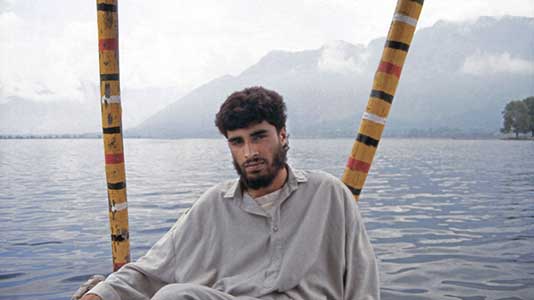
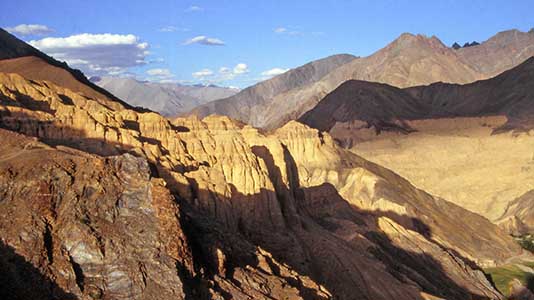
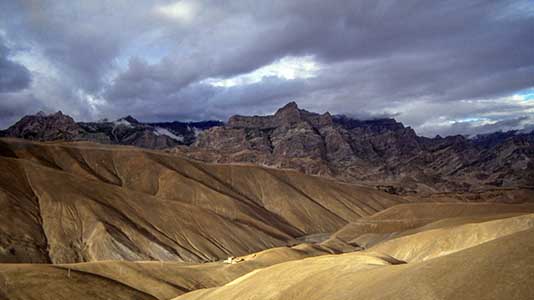
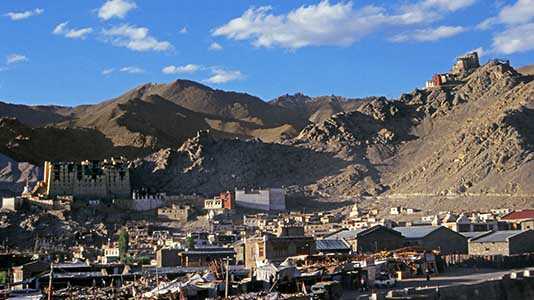
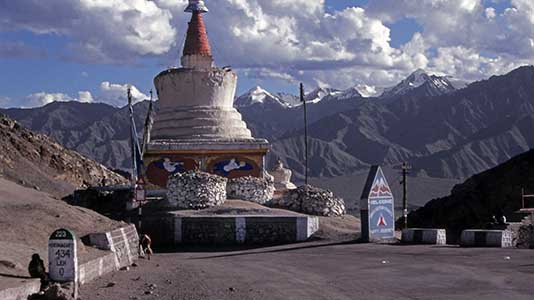
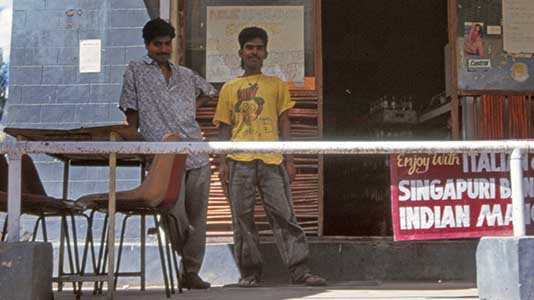
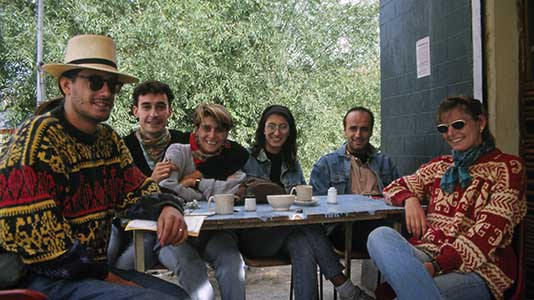
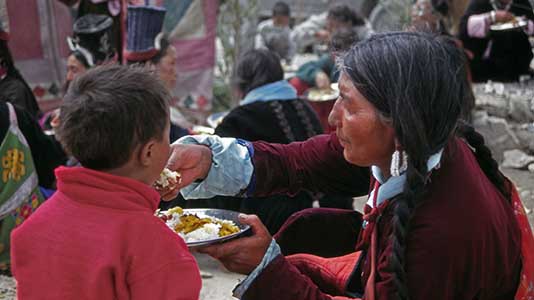
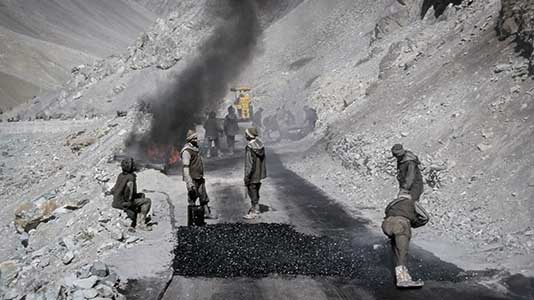
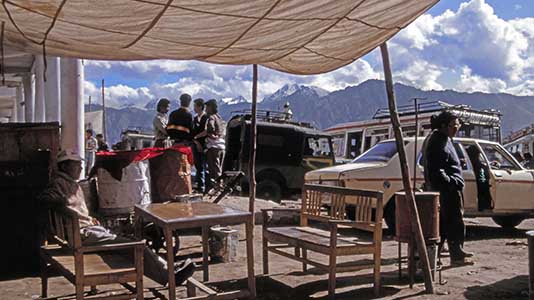
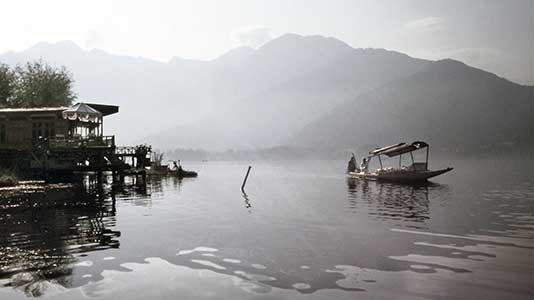
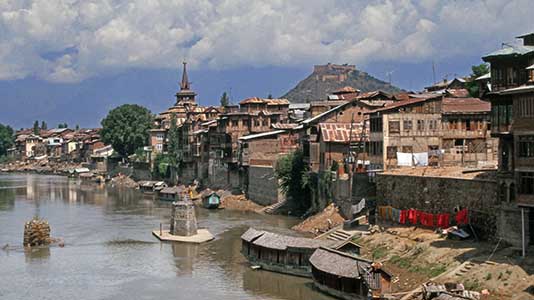
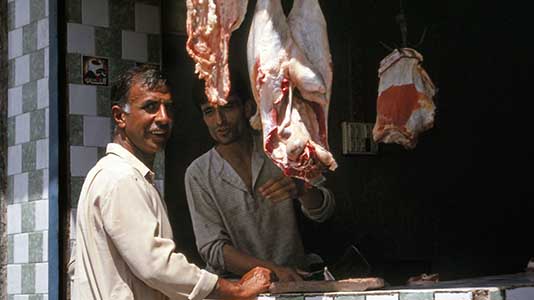
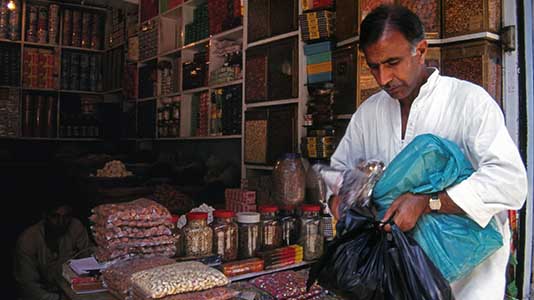
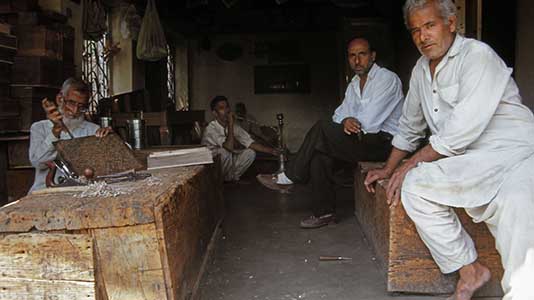
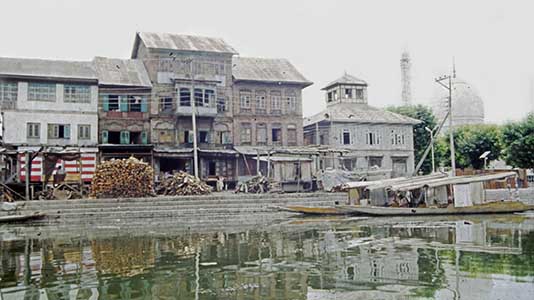
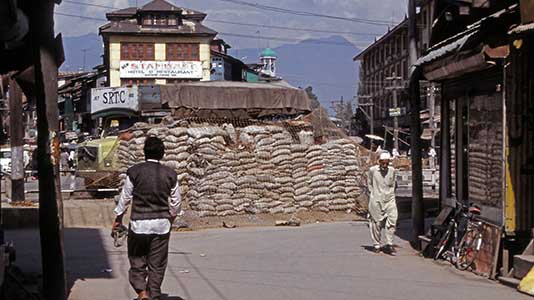
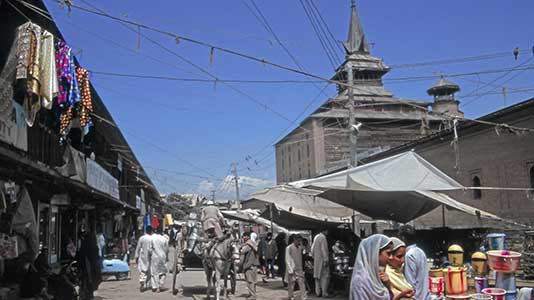
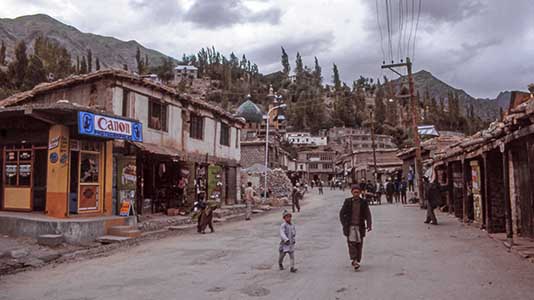
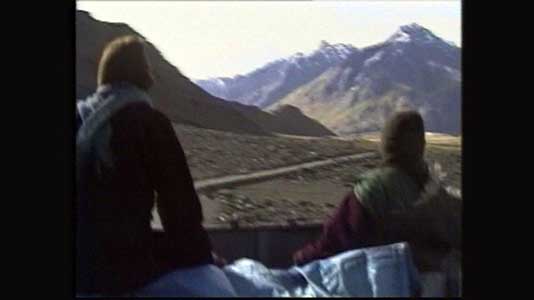
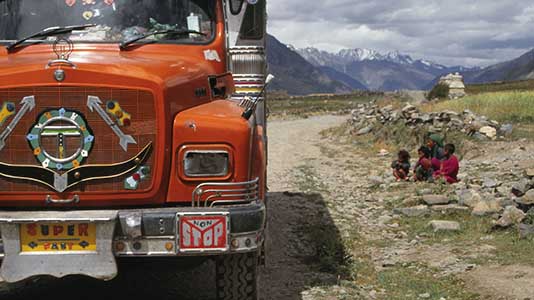
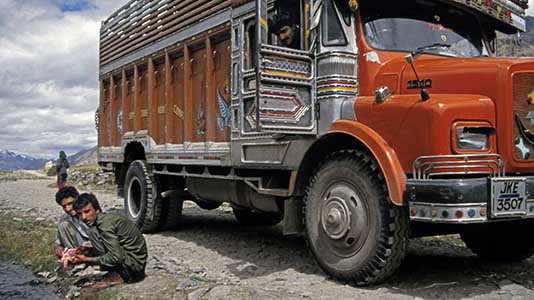
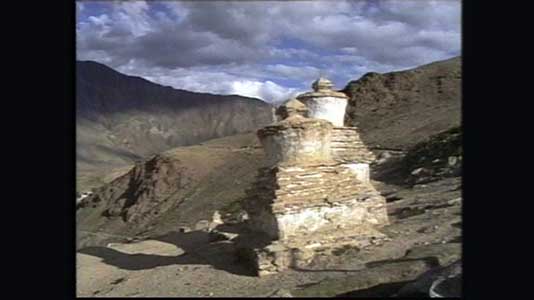
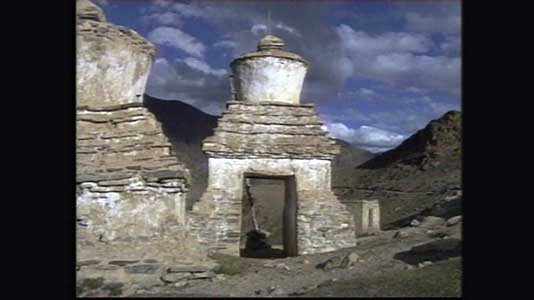
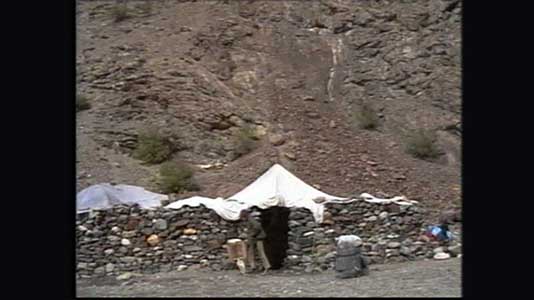
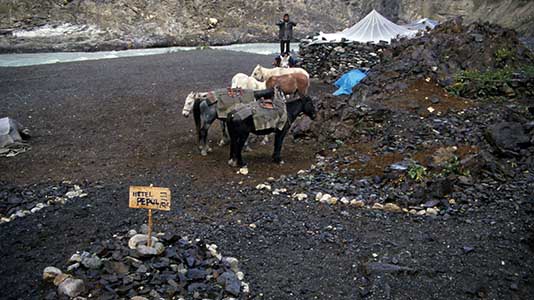
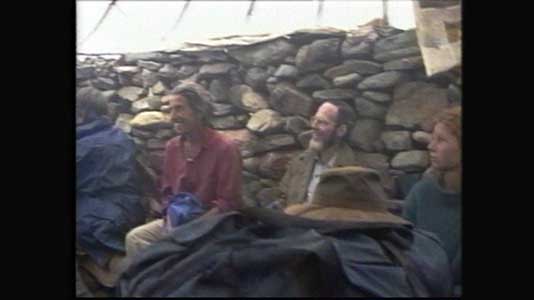
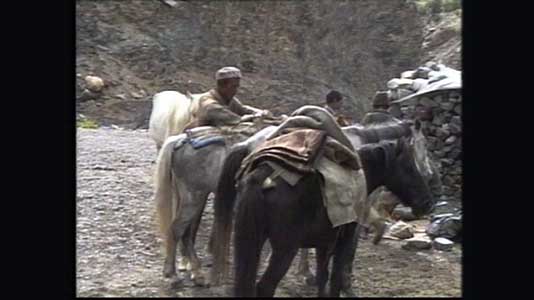
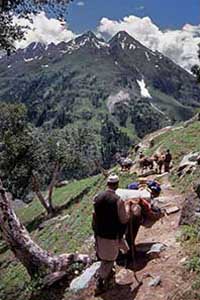
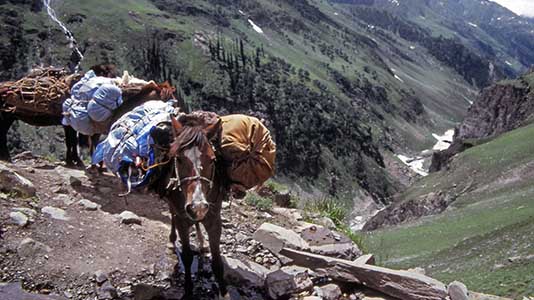
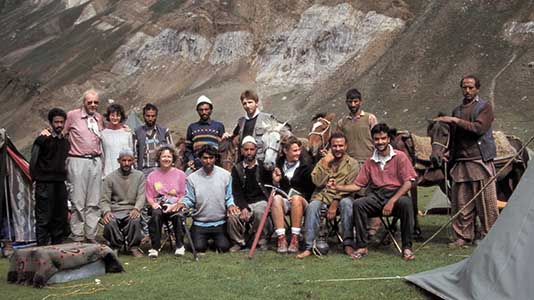
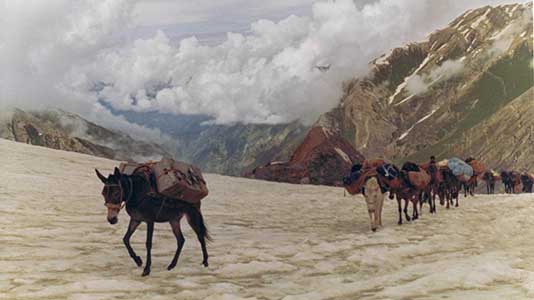
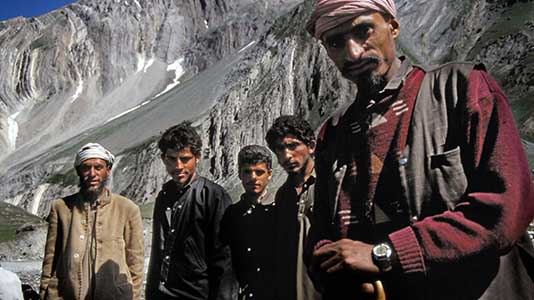
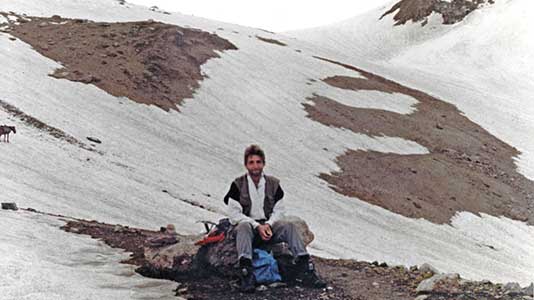
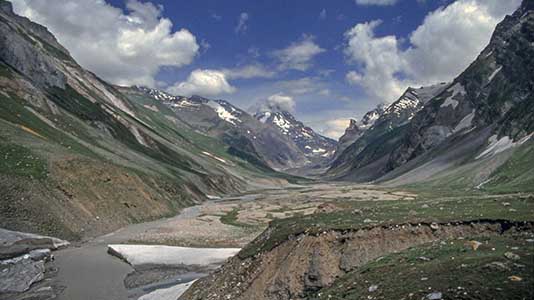
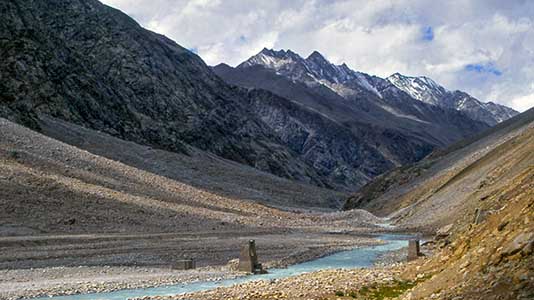
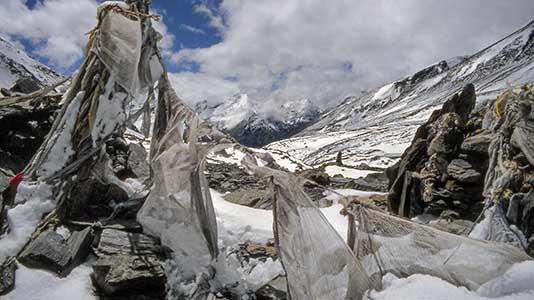
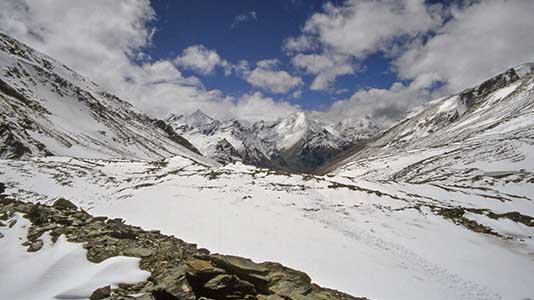
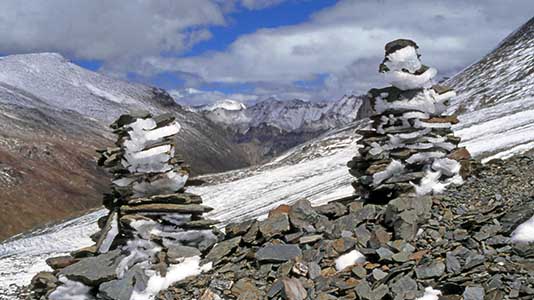
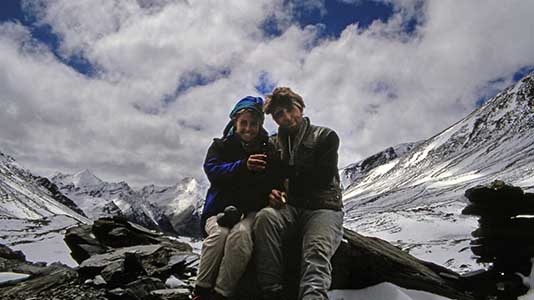
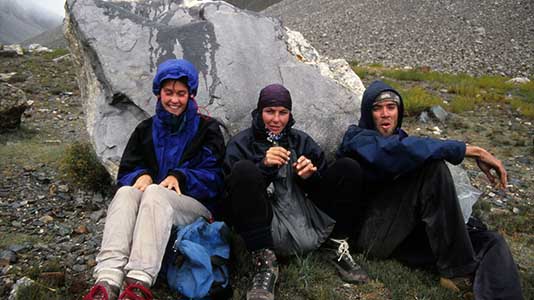
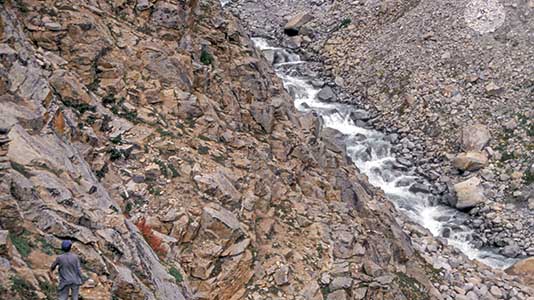
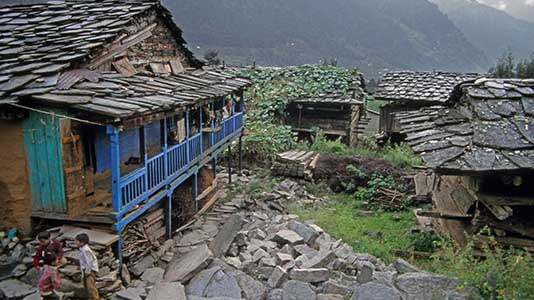
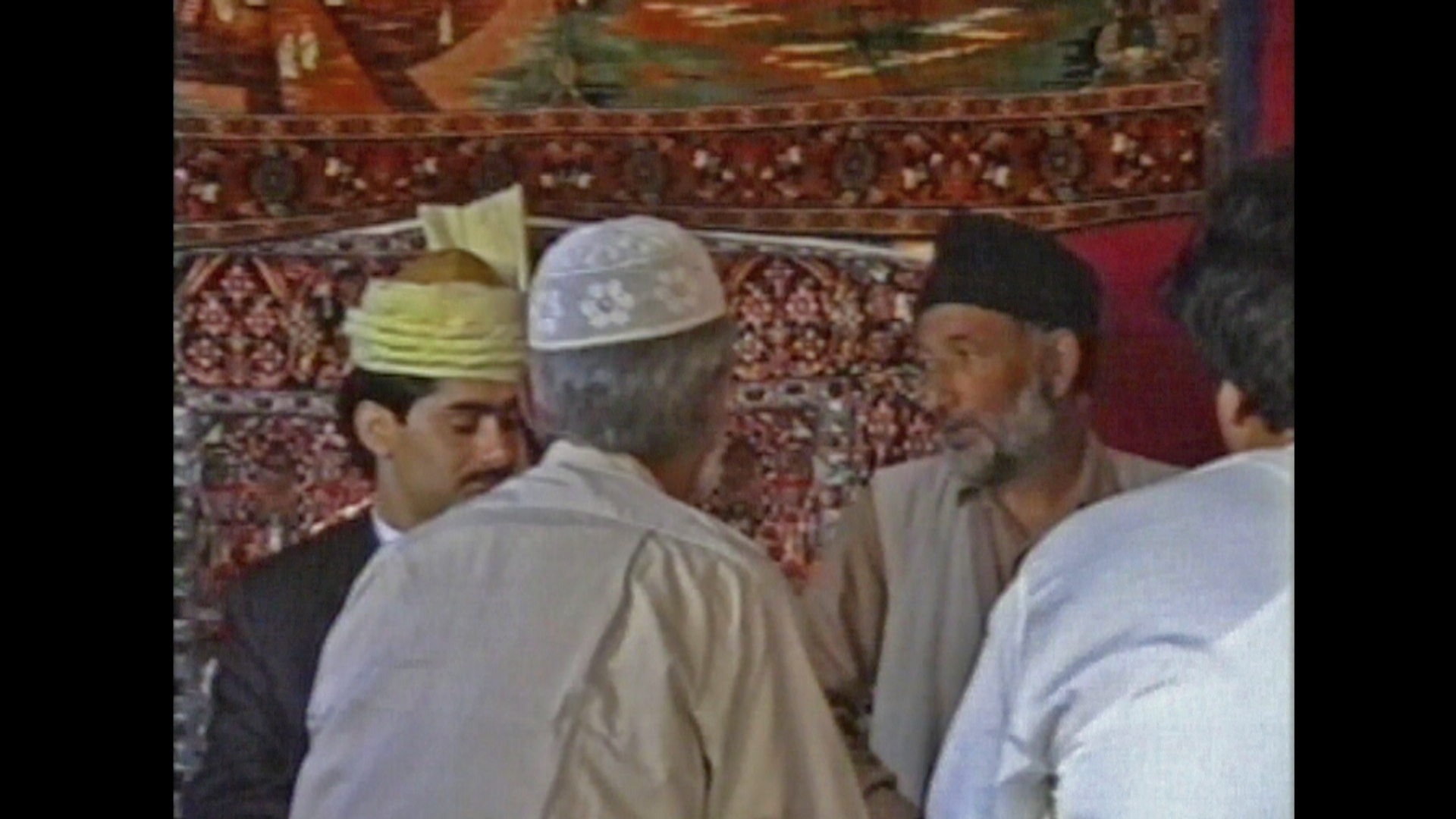
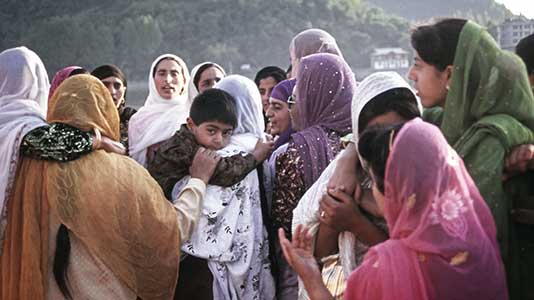
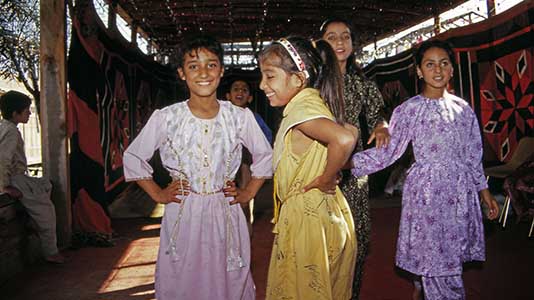
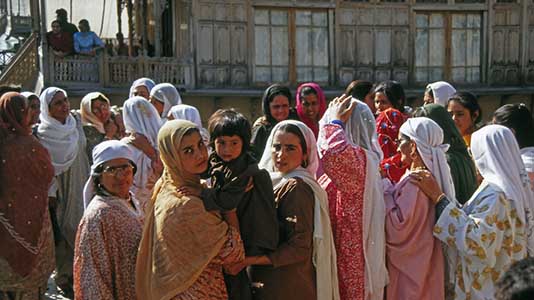
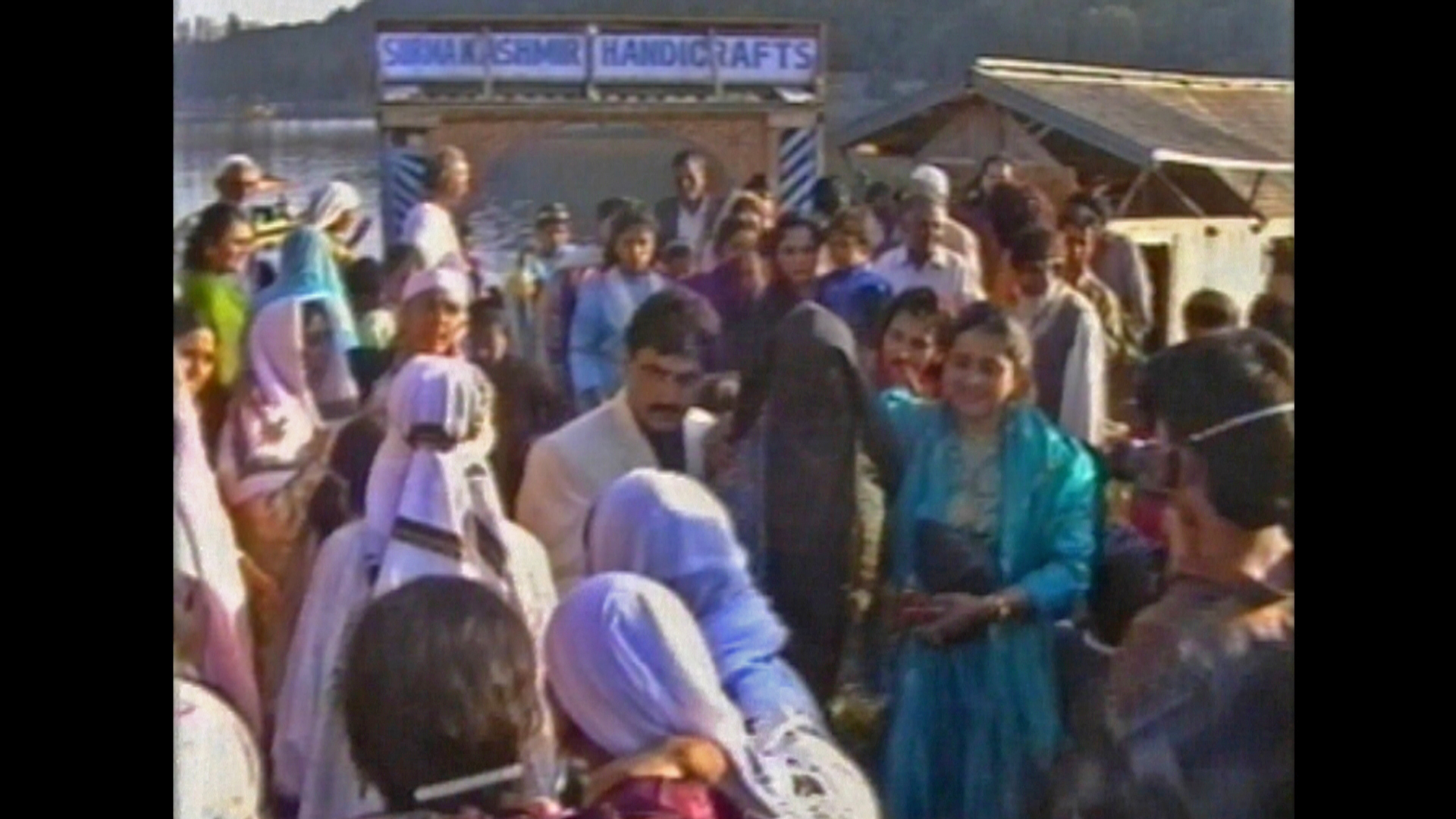
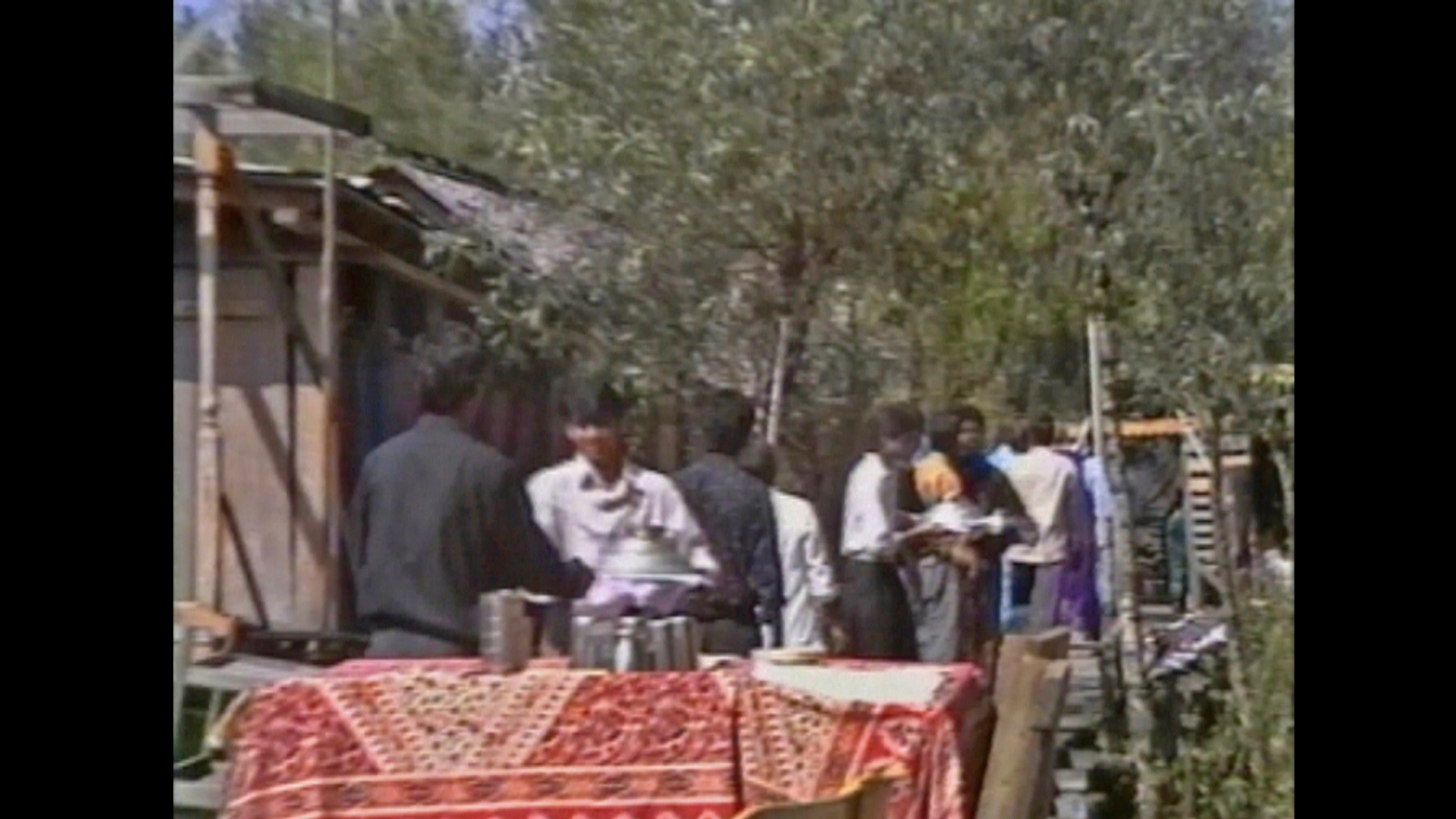
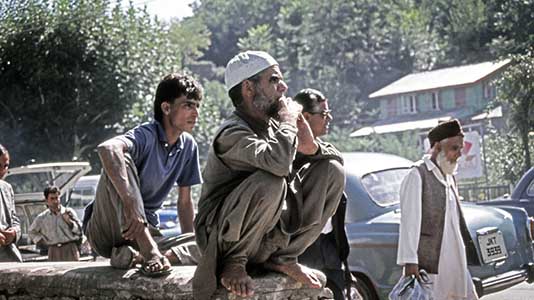
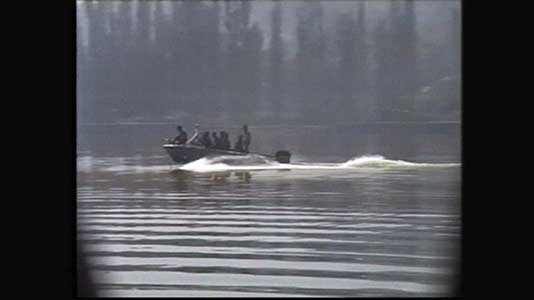
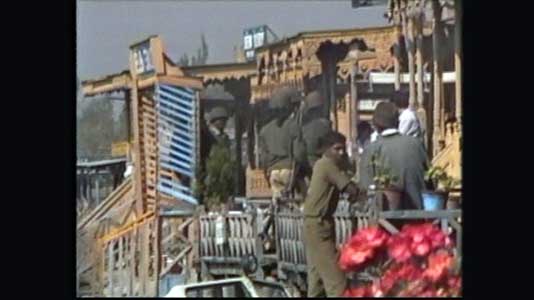
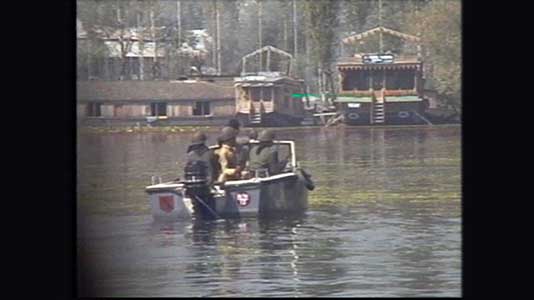
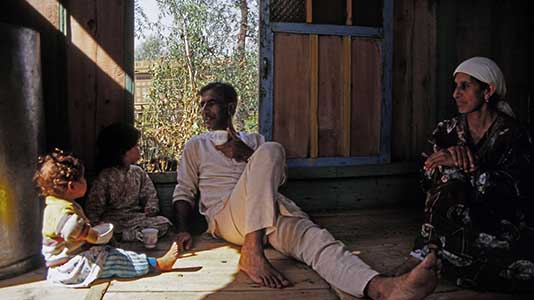
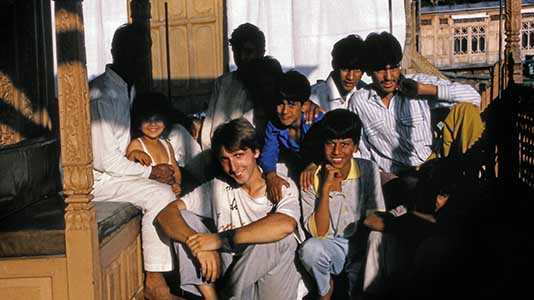
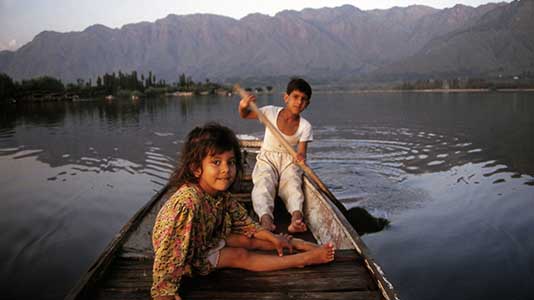
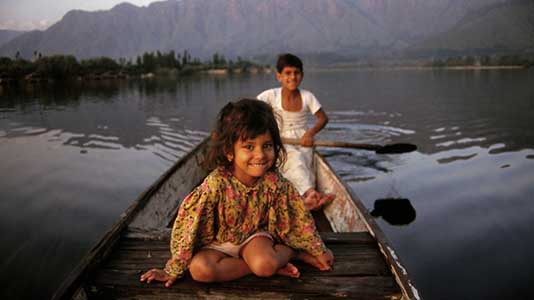
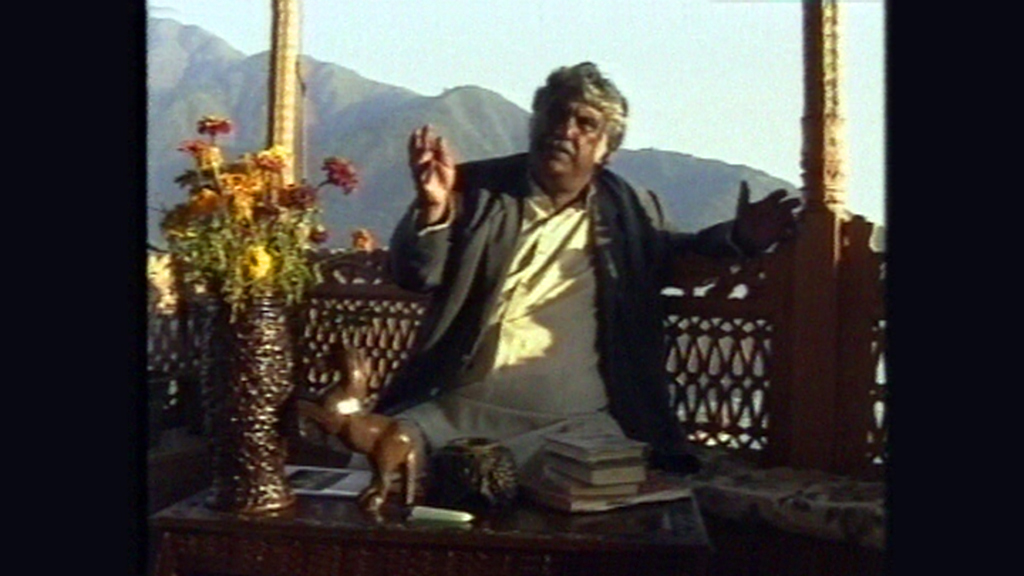
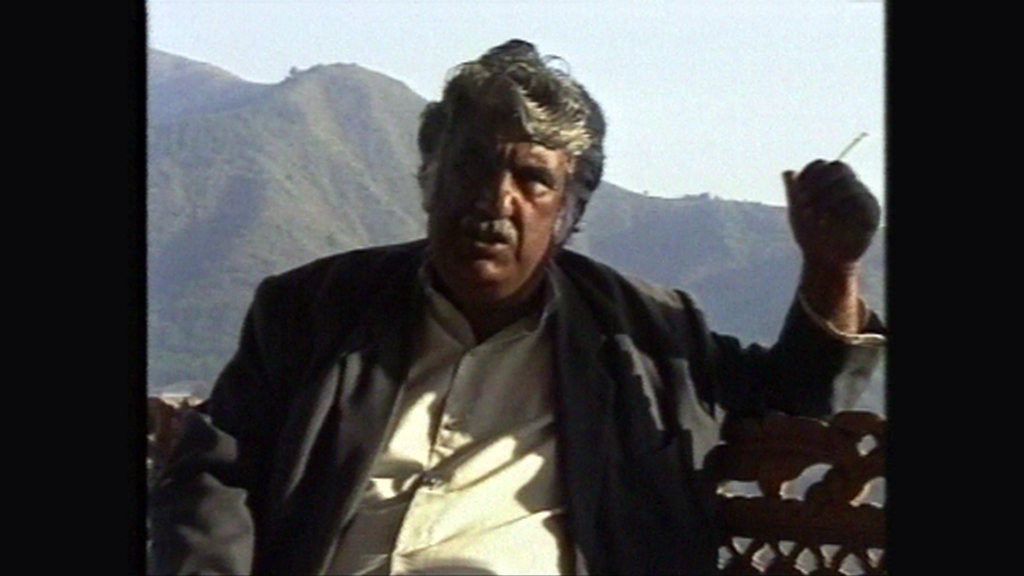
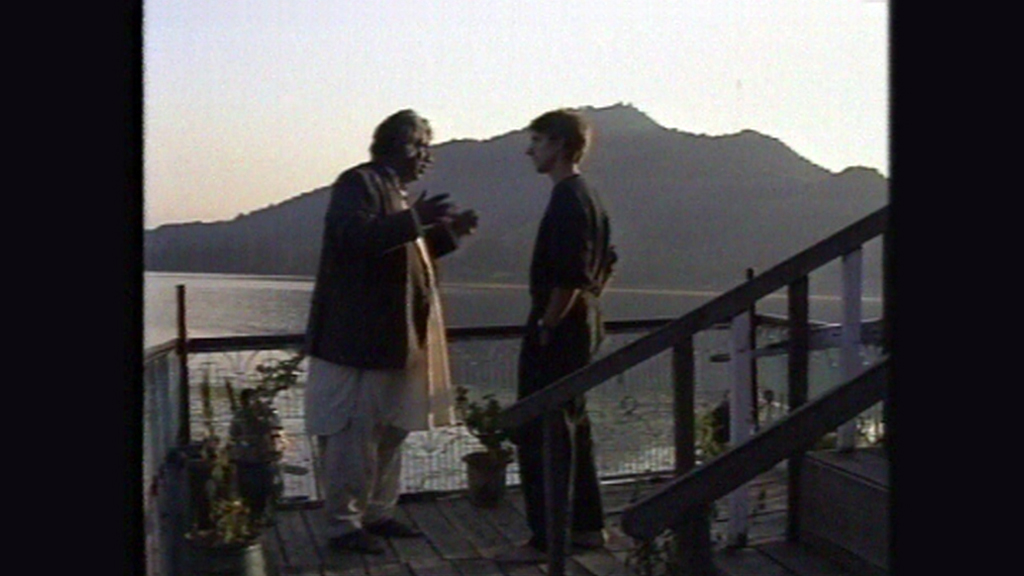
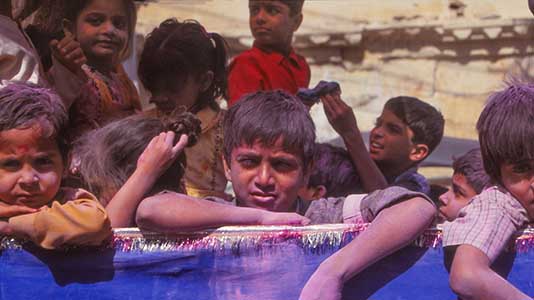
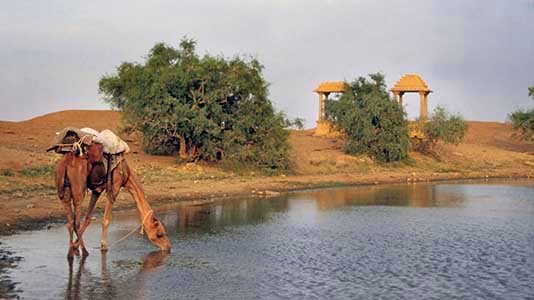
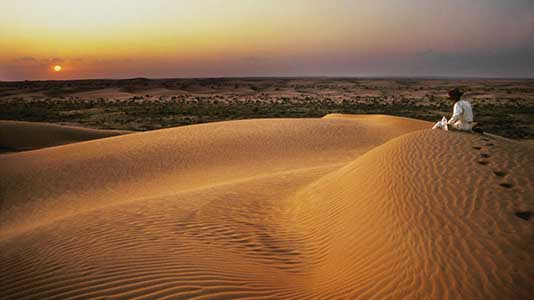
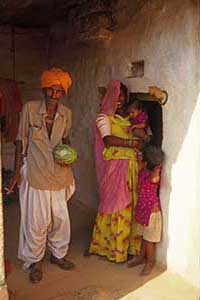
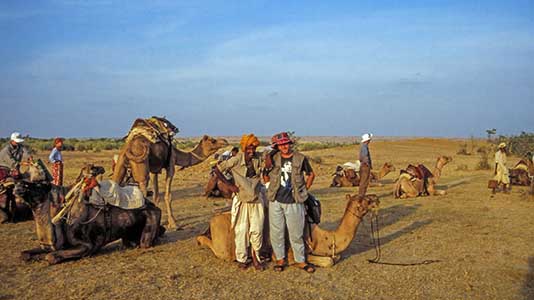
All of us, I suppose, have varying pictures of our native land, and no two persons will think alike. When I think of India I think of many things: of broad fields dotted with innumerable small villages; of towns and cities I have visited; the magic of the rainy season that pours life into the dry parched up land and converts it suddenly into a glistening expanse of beauty and greenery, of great rivers and flowing water, of the Khyber Pass in all its bleak surroundings; of the southern tip of India, of people, individually and in the mass; while above all the snow-capped Himalayas, or some mountain valley of Kashmir in the spring, covered with new flowers and with a brook bubbling through it. We make and preserve the pictures of our choice, and so I have chosen this mountain background rather than the more normal picture of a hot sub-tropical country. Both pictures would be correct, for India stretches from the tropics right up to the temperate regions, from near the equator to the cold heart of Asia.
– Jawaharlal Nehru The Discovery of India
FOREWORD - 1 October 2016
Believe it or not, there was a time when smartphones and social networking didn’t exist. Back in the early nineteen-nineties people still used pen and paper to record their thoughts, and photographic film to capture their memories. No smartphones. No GPS. No SMS. No Tweets. No Instagram. No Flickr. No Snapchat. No Facebook. If there was a ‘book’ that connected you to the world, it was published by Lonely Planet.
I doubt that this document has any great use today other than as a snapshot of another time. The world has changed, technology and infrastructure have changed, politics have changed, customs have changed. Cities have grown and India’s population has increased 49% to 1.35 billion people.
I went to India because my peripatetic American colleague and friend Lisa was determined to go and was looking for a travel companion. Despite her enthusiasm, it was only when she mentioned a visit to Nepal that my interest was piqued. That interest was cemented when the deputy head of the Environmental Desk at Tg2 – I was working at Italy’s state television, RAI, at the time – kindly suggested that if I were to go and record some decent video, they would be interested in buying footage for the archives. So armed with a Sony Hi8 camcorder and an unexpected financial incentive, I decided to accept the challenge. Hi8 video looks very mediocre today, but back then it was the best non-professional format available.
In 1992 if you were in the ‘middle of nowhere’ it was almost impossible to contact anyone. To reach travelling companions you relied on telegrams or messages left in pre-arranged places. To let people back home know you were safe there was the postal service. Cranky telephone exchanges could be found in the larger towns, but mostly we were on our own, especially once you went deep into the countryside and mountains. Twice during the journey Lisa and I went our separate ways to pursue our own agendas, and during those interludes I had no way of knowing where she was or if she was all right. It seems astonishing now that we were confident she could safely go off alone for days to heaven-knows-where – but we were, and she came to no harm. I’m not entirely sure we’d feel the same way today.
More significantly, to talk about the Mujahideen today is a very different matter. Largely because of the war in Afghanistan, in 1992 they were seen in the West as allies, noble fighters who had defeated the Soviet Union. Over the next ten years, of course, the perception of ‘holy warriors’ would change dramatically.
To give some historical context to this text, I’ve listed a few relevant highlights from 1988 up to the day we departed. This might seem pretentious, but it matters. I barely knew half of it at the time, and it makes interesting reading today. When Lisa and I travelled to India the prime minister was P. V. Narasimha Rao, the US president was George H. W. Bush, the prime minister of Israel was Yitzhak Rabin, the British prime minister was John Major, and Italy’s First Republic still existed.
With Nelson Mandela’s release from prison and the fall of the Berlin Wall in 1990, the swift end of the Gulf War in 1991, and signs that the Israeli Government might negotiate with the Palestine Liberation Organisation, the early nineteen-nineties felt like a time of great optimism – naïve, as it turned out, but real. The violent implosion of Yugoslavia notwithstanding, it wasn’t entirely unjustified. I see no such optimism today.
So while reading these pages, it helps to know when these events took place. I was a 27-year-old would-be filmmaker from Britain, living in Rome, Italy. I’d travelled extensively throughout Europe but had never been to Asia – and reading this journal now, I can say it shows. I began this foreword noting how much the world has changed in the last 24 years. Yet in many ways, it hasn’t changed at all. Kashmir is still in the headlines, there’s still conflict between Pakistan, India, and China over the region, and – as elsewhere – there’s no end in sight.
1988
A widespread popular insurgency starts in Kashmir as protests begin in the Valley along with anti-India demonstrations, followed by police reprisals and curfew.
May Rambo III is released in cinemas. John Rambo allies with the Afghan Mujahideen to fight the Soviet Army.
August Al-Qaeda is formed at a meeting between ‘several senior leaders’ of Egyptian Islamic Jihad, Abdullah Azzam, and Osama bin Laden.
1989
15 February After nearly 10 years of occupation, Soviet forces withdraw from Afghanistan.
1 March Massive protest marches by unarmed civilians continue in Srinagar and more than forty people are killed when police open fire.
September Muhammad Ahsan Dar founds the Hizbul Mujahideen, a Pakistan-based Islamist militant organisation dedicated to the Kashmiri separatist insurgency.
9 November The Berlin Wall is breached.
1990
11 February Nelson Mandela is released from Victor Verster Prison. The event was broadcast live across the world.
13 June East German military officially began dismantling the Wall.
6 August The army of Saddam Hussein invades Kuwait. President George H. W. Bush announces Operation Desert Shield: ‘This will not stand, this aggression against Kuwait.’
8 November The FBI raid the New Jersey home of El Sayyid Nosair, an associate of Al-Qaeda operative Ali Mohamed. They discover copious evidence of terrorist plots, including plans to blow up New York City skyscrapers. This is the earliest discovery of Al-Qaeda terrorist plans outside of Muslim countries.
1991
17 January Operation Desert Storm is launched with an air campaign that would last a month.
24 February The ground offensive begins
28 February President George H. W. Bush declares victory over Iraq and orders a cease-fire. Thus, after 100 hours, the ‘first’ Gulf War is over.
In 1991 Osama Bin Laden is expelled from Saudi Arabia due to his anti-government activities. He takes refuge in Sudan. Eventually, Saudi Arabia revokes his citizenship, and his family disowns him.
1992
1 January Boutros Boutros-Ghali of Egypt replaces Javier Pérez de Cuéllar of Peru as United Nations Secretary-General.
8 January President George H. W. Bush is televised falling violently ill at a state dinner in Japan, vomiting into the lap of Prime Minister Kiichi Miyazawa and fainting.
11 January Singer Paul Simon is the first major artist to tour South Africa after the end of the cultural boycott.
31 January The heads of state of the five permanent members of the United Nations Security Council and most of the temporary members, meet in New York City to discuss the new world order in the post-Cold War world.
1 February President George H. W. Bush meets with President of Russia Boris Yeltsin at Camp David, where they formally declare that the Cold War is over.
7 February The Maastricht Treaty is signed, founding the European Union.
16 February In Lebanon, Israeli helicopter gunships assassinate Abbas al-Musawi, the leader of Hezbollah, and his son, in retaliation for a 14 February raid that killed three Israeli soldiers.
17 February Mario Chiesa, a member of the Italian Socialist Party (PSI), is arrested for accepting a bribe from a Milan cleaning firm. The Mani Pulite investigations begin.
21 February The United Nations Security Council approves Resolution 743 to send a UNPROFOR peacekeeping force to Yugoslavia.
1 March The first victims of the Bosnian War are a Serb groom’s father and an Orthodox priest in a Sarajevo shooting.
10 March Following Super Tuesday voting, Bill Clinton is declared the likely winner of the Democratic Party presidential primaries.
29 March In France, police arrest 3 men believed to be planning a Basque separatist terrorist attack at the 1992 Summer Olympics.
7 April The United States recognises the independence of Croatia, Bosnia and Herzegovina, and Slovenia. The European Community recognises Bosnia and Herzegovina.
10 April A Provisional Irish Republican Army bomb explodes in the Baltic Exchange in the City of London; three are killed, 91 injured.
16 April President of Afghanistan Mohammad Najibullah is ousted and detained by Muslim rebels moving towards Kabul, setting the stage for the 1992–96 civil war in Afghanistan.
29 April The acquittal of four police officers in the Rodney King beating criminal trial triggers massive rioting in Los Angeles. The riots will last for six days resulting in 53 deaths and over $1 billion in damages before order is restored.
16–17 May Bosnian War: UN peacekeepers withdraw from Sarajevo.
23 May A bomb on the A29 motorway near Capaci, Sicily kills anti-Mafia judge and prosecuting magistrate Giovanni Falcone, his wife and three police escort agents.
30 May United Nations Security Council Resolution 757 imposes economic sanctions on Yugoslavia in an effort to end its attacks on Bosnia and Herzegovina.
16 June A ‘Joint Understanding’ agreement on arms reduction is signed by U.S. President George H. W. Bush and Russian President Boris Yeltsin. This is later codified in START II.
17 June The last western hostages in Lebanon, Thomas Kemptner and Heinrich Struebig – two German relief workers held since 1989 – are released.
23 June The Israeli legislative election is won by the Israeli Labor Party under the leadership of Yitzhak Rabin.
6–29 July Iraq refuses a UN inspection team access to the Iraqi Ministry of Agriculture. UNSCOM claims that it has reliable information that the site contains archives related to illegal weapons activities. UN Inspectors stage a 17-day ‘sit-in’ outside of the building, but leave when their safety is threatened by Iraqi soldiers.
13 July Yitzhak Rabin becomes prime minister of Israel.
19 July The Cabinet of Israel approves a freeze on new settlements in the occupied territories, a move expected to reinvigorate the Middle East Peace Process.
A car bomb near his mother’s house in Palermo, Sicily kills anti-Mafia judge and prosecuting magistrate Paolo Borsellino and five members of his police escort.
A Royal Jordanian Airlines flight takes off from Rome to Amman. Among the passengers are two travellers; one is from the UK, the other from the USA – both live in Italy. Their destination is New Delhi, India.
ROME - 19 October 1993
India was never a country I had particularly wanted to visit. Throughout the nineteen-eighties there had been a steady flow of films and television series set in the days of ‘The Raj’ - Heat and Dust, Gandhi, A Passage to India, The Jewel in the Crown etc. – which mostly reinforced stereotypes and India was viewed mainly through the lens of the East India Company and British imperialism. The history of India itself was, apparently, beside the point.
In effect, I knew very little about the country. Certainly, the assassination of Prime Minister Indira Gandhi in 1984 and her son, Prime Minister Rajiv Gandhi, in 1991 made headlines, and cricket was clearly an extremely big deal. A significant percentage of the British population is multi-generation British-Indian or British-Pakistani, and the ubiquitous Indian restaurants were by now a national institution – the coup de grâce for a beer-soaked Saturday night. Frankly, in the spring of 1992, India seemed to me a bit of a cliché for imperialist revisionists, cricket fans, and the tie-dye crowd bound for Goa.
The journey would have a far greater impact on me than I could ever have imagined. It was my first time in South Asia, and for anyone as unprepared as I was, it felt like a visit to another planet. We would travel from New Delhi to Kashmir to Ladakh to Himachal Pradesh and finally to Rajasthan – but it was Kashmir that proved to be my unmet friend, and it was to Kashmir that I would return three times in the 95 days we spent in the country.
A year later, I have decided to collect my travel notes and recollections of the experience. It was notable how many of my travelling companions, and people we met along the way, were constantly scribbling about what they had seen and how they felt. Some of these journals were beautifully maintained – illustrated with drawings or postcards – but nearly all were recognised as deeply personal and destined to be read by no one.
Always ready to resist the status quo, I tried to avoid beginning a diary, and it wasn’t until we reached Ladakh that I even began. There was a short-lived attempt at objectivity, but the pages quickly filled with how I was reacting – at a surprisingly deep level – to everything.
I often felt it was a shame that these journals rarely saw the light of day. Admittedly, travel in ‘far-away places’ does seem to provoke a strange and profound inner turmoil that does not generally warrant exhibition.
Sometimes I feel to have been too personal, other times not personal enough, but this is what I heard and saw. I do not claim to speak for anyone else, or to generalise blindly about a Nation and its people. Comparisons with your own background inevitably leads to ‘us’ and ‘them’ contrasts that can sometimes sound condescending. Nothing here was written in such a spirit.
Clearly I was more interested in the people I met and the experience of the journey itself, rather than creating a travel-guide to mountains, monasteries and monuments, but there are plenty of books that cover all that. This is just my journal, the impressions here are mine and to those who would criticise my opinions or perspectives, I can only say that I started where I was, I tried to learn, and I have tried to be honest.
So there it is.
3 words used frequently
local | ˈləʊkl | noun an inhabitant of a particular area or neighbourhood resident, parishioner, citizen
tourist | ˈtʊərɪst | noun a person who is travelling or visiting a place for pleasure traveller, sightseer, visitor, excursionist, backpacker, globetrotter
explorer, rover, pilgrim, voyager, journeyer
western | ˈwɛst(ə)n | adjective living in or originating from the West in particular Europe or the United States
NEW DELHI - 19 October 1992
Right now I wonder if I’m missing out on anything by spending most of my time in flea shops, cafés or here in the hotel. When I get back home I may not understand why I didn’t make more of an effort to get out and about to see unseen sights. It’s just that after three months I think I’ve reached a saturation level of temples, museums, landscapes and history lessons. I have a large supply of books to read and, as I feel I shouldn’t be here anyway, interest in further excursions is low. It feels like a good moment to look back on how I got here.
19 July seems a long time ago. 19 July was the flight, the last-minute frantic packing that bordered on a state of paranoia as the full size of what we were about to do and the time it would take to do it finally impressed me. The trip to the airport, almost forgetting my camera. Check-in, departure lounge civilisation, conversations of anticipation. Royal Jordanian flight to Amman, an in-flight movie we didn’t watch. Stopover in Amman. No idea whatsoever about what currency they use in Jordan. Bought two Cokes or was it one and we split it? Bought some chewing gum that was horrible and later thrown away.
Flight to Delhi, seats not available in the smoking section. Watched the in-flight movie. As dawn was breaking we were flying in over India. Outside the window dramatic cloud formations floated past, mountains soared beneath us, lakes swam by, the ground was virtually invisible, a flat plateau far away. There is a feeling of being unreachable in the sky, you cease to be a part of the chaos below and even though you are bound through technology to return it’s an independent space that gives us a corridor from one world to another. I’ve long associated flying with a strange melancholy and as we began the long descent it was in an envelope of mixed emotions.
On the morning of 20 July, we landed in Delhi. The humidity was extraordinary, the bustling chaos intimidating and as we wondered where to begin airport officials volunteered themselves as black-market moneychangers. Everybody wants dollars. The Rupee was recently devalued, the dollar is seen as more secure and it’s in demand. For three months, from the moment I literally set foot in the country, I’ve been chased to ‘Change money! Very good rates!’ long after my small supply of US dollars ran out.
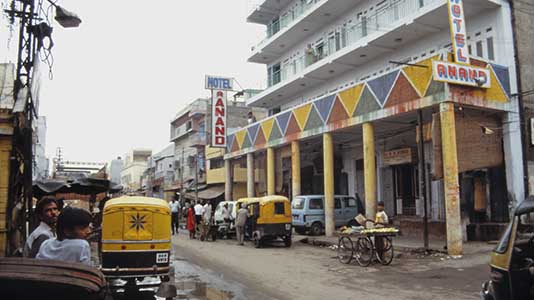
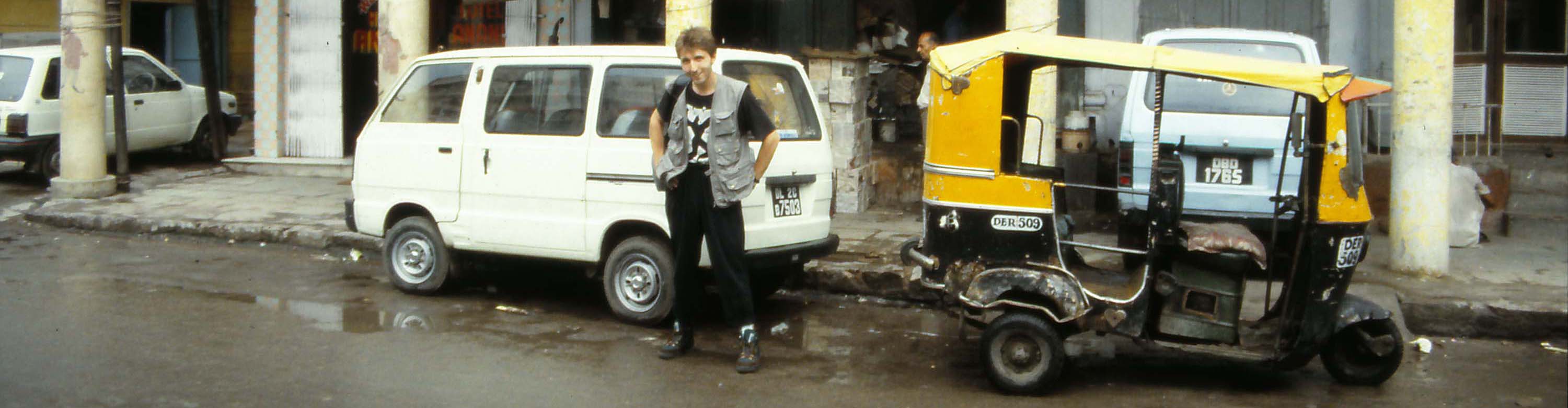
We took a bus from the airport to Connaught Place, the hub of New Delhi - so familiar to me now, then so unknown - where we were introduced to the rickshaw and the rickshaw scramble. We were carted off to a hotel, not the hotel we had asked for, needless to say, but the Hotel Anand in the Paharganj district turned out to be more than acceptable for first-timers. A shower, a ceiling fan, clean sheets and no insect life is about as good as it needs to get. Rs.150 a night for the double room – about $5 at the time – fair enough.
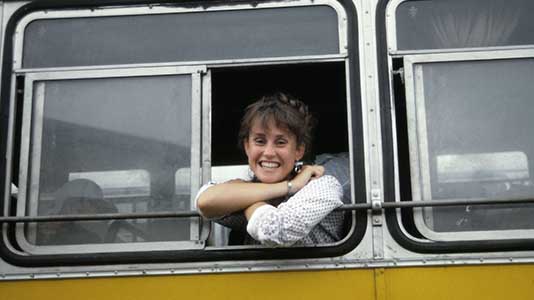
Lisa on the airport busFriendly adviceHotel Anand
The initial impact of Delhi was overwhelming. First impressions were of how many people there were, how rundown, crowded and dirty most places seemed to be. You feel that everyone is grabbing at something – anything – to get by, and that their worldview is markedly different from your own. A slight anxiety prevailed (and still does, to be truthful) whenever you had to trust somebody. I often felt incredibly vulnerable, usually alone or with Lisa, always surrounded by people who want something from you, and no clear sense of protocol. ‘Bad things’ do happen and people from other parts of India don’t like Delhi at all. While the city doesn’t rage with lurking violence, it certainly makes you wary. Of course that’s largely true of most cities in the world, it’s just the unfamiliarity and the claustrophobia of the crowds that amplify the disquiet.
In fact, three months later I now know my way around narrow patches of the city quite well, and I’ve dealt with a wide cross-section of people. I’ve been to other regions of India for a better cushion of comparison and experience. I’ve been ripped off, received medical attention, offered dubious deals, driven down dark back alleys at night. No damage. We’ve been very fortunate.
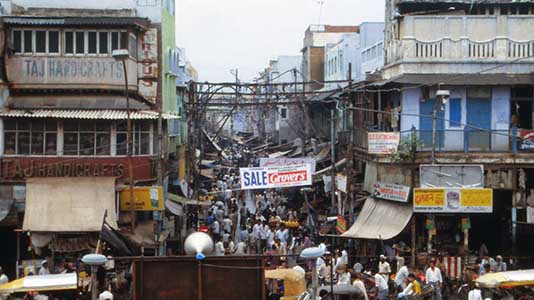
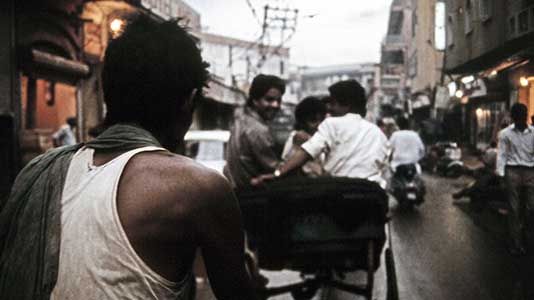
Having established our ‘base camp’ at the Hotel Anand, and after buying what turned out to be a very inaccurate map, we decided to walk to Old Delhi. New Delhi might have been busy, but Old Delhi packed thousands of shops and stalls, selling a kaleidoscopic range of goods to thousands of people, into a cramped area of grime, confusion and commerce.
Old Delhi
In 1992, India has a population of just over 900 million, with many millions living in extreme poverty. Statistically, national food production barely feeds everyone, but in Delhi food was more abundant and in more forms than anywhere I had ever seen. Everywhere there are food stands: in the street, mats on the pavements, small hole-in-the-wall restaurants and so on up the scale. It’s a mystery how so many vendors stay in business; you can ride along a main road lined with identical shops and they’ll all be busy. Evidently there are enough potential customers to go round.
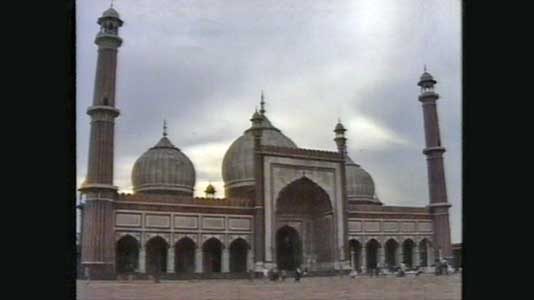
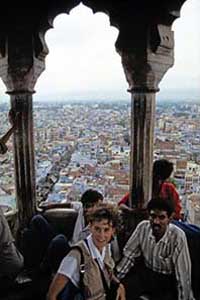
Old Delhi is a labyrinth of markets and historical buildings. The magnificent Masjid-i Jahān-Numā (Jama Masjid), the largest mosque in India, sits like an island in a sea of rickety shacks, awnings and fragile-looking buildings to which several equally fragile floors have been added. It all had the appearance of a structure about to collapse; somehow it does not. Lines of wagons, carts and trolleys are packed along the roadside, and the sheer volume of people threading through it all is stunning. The place seems to roll along oblivious to the rules of economics and an outside world represented only by cheap knock-offs of famous fashion brands.
Jama MasjidLisa on a minaret
Old Delhi is spectacular to the uninitiated, as we were, and a real exasperation if you are trying to drive through in a hurry. Auto-rickshaw drivers who operate mainly in New Delhi simply refuse to go there unless it’s part of a sightseeing deal that makes it worth their while. In many ways, words are wasted on Old Delhi, analogies and comparisons do not convey the true impression. In my memory I can see it and understand it because I was there; otherwise it is impossible for anyone who has never been east of the West to have any idea at all. Old Delhi is a melting pot and, like most melting pots, an accumulative exaggeration of its individual parts. The city, therefore, is a vast, unwieldy caricature of the country.
One of Old Delhi’s surprises is the contrast between modern architecture and the majestic, colossal monuments of the past. The Red Fort with its palaces and gardens, its enormous walls that reach wide and embrace the centuries, not to mention its sheer size and strength, is a stark reminder of what was once possible here. Far more than the renowned, commercialised ruins of the Roman Empire that feed Italian tourism, the era of the Maharajahs and Princes, great armies, great wealth and bloody combat, still runs like a vital nerve in India’s spine.
Where once there were Maharajahs, today there are industrialists – and in their world they may well feel like the Maharajahs of the twentieth century. The most popular ‘hero’ figures are undoubtedly the stars of Indian cricket and countless Hindi films. These people command enormous popularity and if you’re ‘big’ in India, you’re very big indeed. In a country where an amusingly high percentage of the population has never heard of Elvis Presley, cricket players enjoy a level of fame of which most western celebrities can only dream.
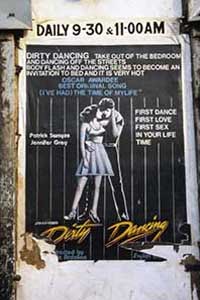
In terms of films produced and tickets sold, Indian cinema – almost entirely self-supporting – is the biggest in the world. Indians love the movies, and most prefer the Hindi action–love epics to western fare. Filmmakers and stars occupy a place somewhere up in the pantheon of deities. His latest cinematic creation! A celluloid masterpiece! scream the posters, showing garishly costumed heroes and damsels embracing, shooting, dying, or (mostly) simply looking surprised – presumably to make almost a billion people rush into dark auditoriums to discover what’s surprising them and why.
Personally I am not a fan. I’m told that the Bollywood films are often quite good – one earnest young man declared that Indian cinema was the ‘best in the world!’ and that I shouldn’t write it all off as unbearable kitsch nonsense. I take his point, but remain sceptical as at any moment in most of these works, the protagonists tend to break out in alarming, ear-piercing song. I have tried to sit, watch and enjoy these films, but directed by Satyajit Ray they are not. That’s just me being wilfully supercilious, of course. Anywhere on the planet where cinema serves as an escape from daily life, dreams of action and glamour prevail, and so they do here – albeit with far stricter codes of decorous conduct and a higher frequency range.
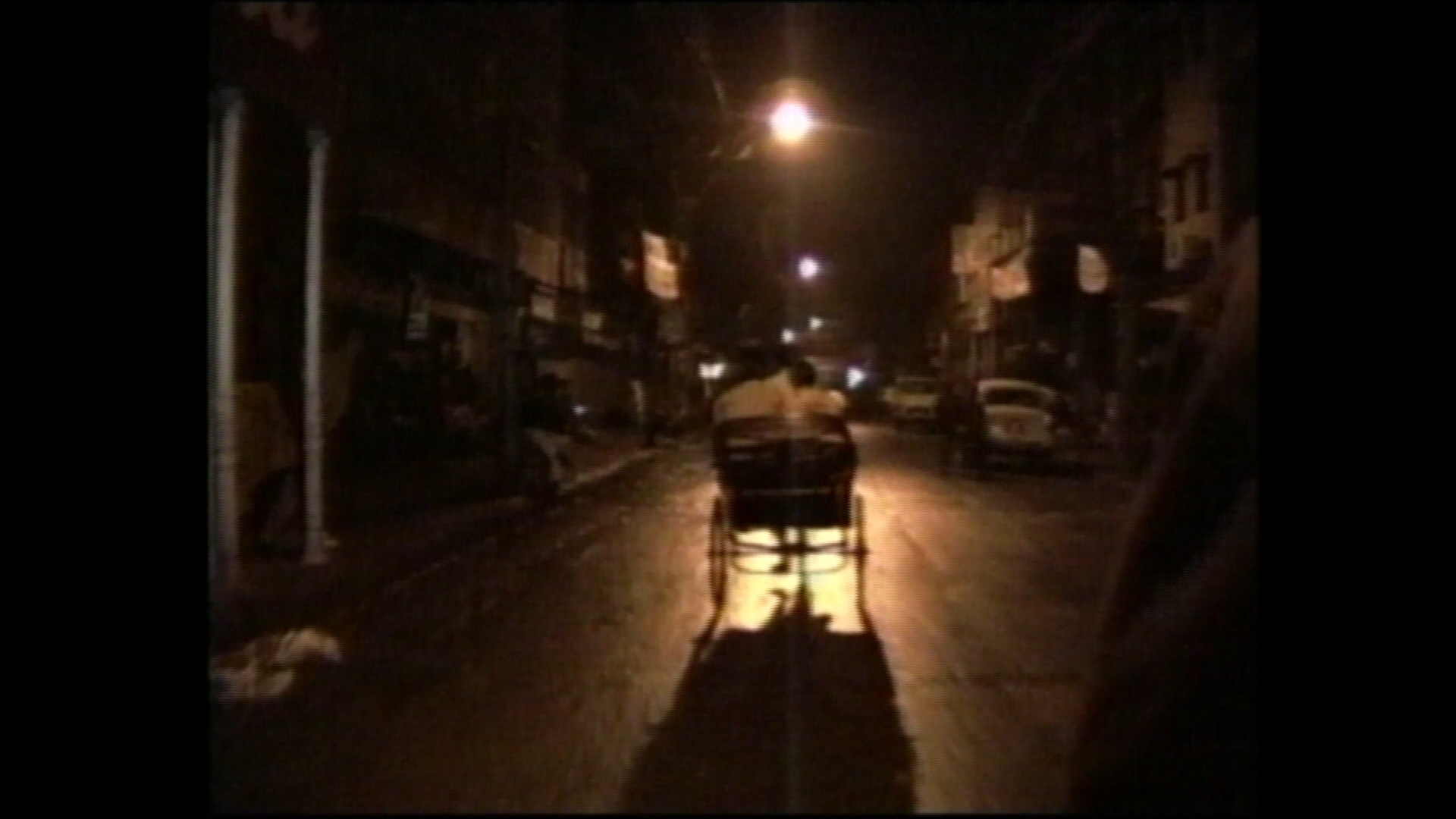
Over-selling Dirty DancingRickshaw ride - Old Delhi
We didn’t stay in Delhi long, wanting to get out quite quickly. A Sikh rickshaw driver who called himself ‘Mister Bill’ twice took us (unsolicited) to a ‘tourist bureau’ – on both occasions we had actually asked to go somewhere else altogether. The first time this happened it was irritating but informative; the second was just plain annoying. We were told the Punjab might be ‘a little risky’, while Kashmir was described as ‘not at all risky’. We had heard about ‘problems in Kashmir’ before leaving Italy and had told people we would check the situation once we arrived. The ‘situation’ proved to be a matter of opinion – depending on whether it was to the advantage of the person giving the opinion if we went to Kashmir or not. So, in the end, the decision was Srinagar, not Amritsar. Thanks to Mister Bill’s efforts to get us to take a bus, we chose the train.
We all have to start somewhere
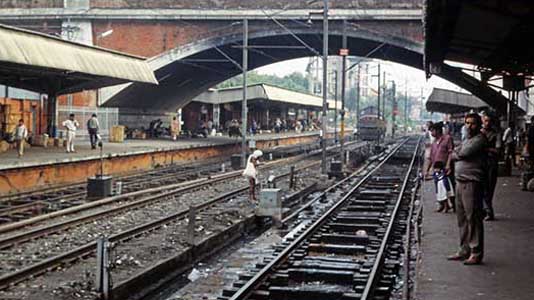
I remember walking through the mud and cow dung in the yard of New Delhi Railway Station – mainly because Lisa was wearing open sandals. It had been raining, so the ground was now disgusting and the air like hot soup. In the middle of the yard we discovered we’d left a bag in the rickshaw. We assumed it would never be seen again, but a few moments later the rickshaw driver appeared in the yard looking for us, bag in hand.
As we squished our way across to the station building to catch the 8.30pm train to Jammu, a man told me – out of the blue – that the 8.30pm train to Jammu was delayed. I didn’t believe him. That happens a lot: when people give you a piece of genuinely negative information, you tend not to believe them, as they probably want something or have a profitable alternative frequently involving ‘brothers’ or ‘cousins’. In fact, it becomes quite difficult to distinguish between useful information and baloney, as there’s a lot of one and a great deal of the other.
As soon as we reached the station concourse two things happened. First, we read that the 8.30pm Jammu train was delayed for at least six hours, and second, we found that waiting for us, though most certainly uninvited, was ‘Johnny’ from Srinagar.
‘Johnny’ could not have been his real name and that irritated me. ‘Mister Bill’ had not been Mister Bill’s real name either, but in his case it was a comic persona created by Mister Whatever-His-Name-Really-Was Singh.
I hadn’t much liked ‘Johnny’ from the moment we’d met him the previous evening at the Red Fort. We had gone to see the Son et Lumière potted history of India – and of the Red Fort itself. This involved the illumination of several buildings inside the fort, in sync with a somewhat questionable, overly dramatic recorded narration, and a barrage of sound effects: marching feet, horses, swords clashing, girls singing, market hubbub and so forth, all emanating from hidden speakers. We had arrived an hour early for the show and wandered around the stalls within the fort that were still open. ‘Johnny’ had started talking to Lisa and came over to have a Coke or Limca (an omnipresent Indian brand lemon and lime-flavoured soft drink owned by The Coca-Cola Company). After a while my impression was that he was hanging around. My reaction to him wasn’t hostile, but it wasn’t exactly warm or friendly either.
We had only been in the country about forty-eight hours and knew very little about what to expect from people. I felt constantly on guard and defensive about strangers who approached us, sometimes this was justified, sometimes I seemed antisocial. Three months later I don’t really act much differently. Maybe I ask more appropriate questions, but after three months you no longer look like you’re ‘just off the boat’. People in the cities who start talking to ‘tourists’ on their own initiative tend to fall into three categories: 1) they only want to sell you something; 2) they want to hang out with some tourists, practise English and – somewhere down the line – try to sell you something; 3) they are genuinely friendly and want nothing more than an interesting chat, which is usually very rewarding. However, it can be a little difficult to distinguish group three from group two. As far as I could tell, ‘Johnny’ was in group two and if he had used his real name, whatever it was, I might have been more inclined to believe him.
He was in his late twenties, dressed in a vividly colourful shirt and a pair of slacks – pleasant enough, but his whole approach seemed too calculated. Lisa always tried to see the ‘good’ in a person and admonished me more than once for being too cold or for not speaking my mind sooner. She probably had a point, but in these cases I was always looking for something I could believe in. In ‘Johnny’ I found nothing – and never did. When he joined us for the Son et Lumière, I found it highly unlikely that this was what he was really there for. He was certainly fishing for some hereto-undeclared business, but that did not make him a bad person, so I told myself to give him the benefit of the doubt. We had mentioned our intentions to go to Kashmir and, when he showed up the next night at the railway station, my doubts were confirmed.
Now we were facing at least a six-hour wait. I don’t mind long delays at railway stations if there’s a café or if the place is interesting, so I was happy to put up with it – and so was Lisa. ‘Johnny’, however, wanted to go to Old Delhi Station to catch an ‘alternative’ train that ‘left’ in twenty minutes. I was very reluctant to give up our reserved seats and, more than anything else, I doubted it was even physically possible – given the hour and traffic conditions – to get from New Delhi Station to Old Delhi Station in twenty minutes.
Of course, the dilemma was that when a ‘local’ is giving you ‘local’ information, you’d assume they have the better idea. ‘Johnny’ did not give me that impression. I wanted my reserved seat on my delayed train whenever it arrived. I wanted to stay where we were – and I certainly didn’t want to plunge out into a jammed Delhi evening to attempt the impossible. I said that time was against us and voted to stay and wait. Lisa thought the same. Abruptly, ‘Johnny’ agreed and decided to stay and wait as well. So we all stayed to wait.
As it was, ‘the wait’ turned out to be ten hours, and we spent the entire night at the station. A long time, to be sure – but if I had to do it again, I would.
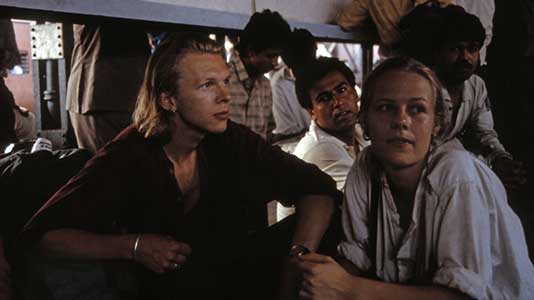
In the ‘buffet’ – where we insisted on drinking our own mineral water despite the rules laid down by a gruff waiter – we met a Swedish couple, Erik and B. I’m sorry to say I can’t remember her exact name – B something Swedish. They’d been travelling in India for a while already; both were into photography and Erik was studying film. They were very nice, spoke excellent English, and as they were waiting for the same train we ended up banding together for the duration.
With them as a distraction, it was something of a relief to be able to more or less ignore ‘Johnny’. Everything he had to say about tickets and trains turned out to be rubbish. He had no ticket, but it was clear that – one way or another – he was going to stick with us all the way to Srinagar. This I was not happy about, so by and large I left him alone.
New Delhi Railway Station overnight was fascinating. Initially we considered putting our baggage into left luggage and going off somewhere else, but a long-winded debate with the gentlemen at the left-luggage counter about the locks on our bags did not inspire great faith. So the decision was to stay put, and we all camped down outside a closed office on the first-floor balcony overlooking the main concourse.
We smoked cigarettes, drank lots of mineral water, and watched the crowds dwindle to small groups of people sleeping on the floor until they were moved on by unsympathetic station officials. When everything came to a standstill in the small hours, we watched a couple of geckos hunt mosquitoes up the wall. A gecko is your friend.
Once in a while, I’d make an excursion to the bathrooms. This introduced me to the vista of platforms covered with dormant bodies, lined up in rows of small groups – whole families lying on the concrete asleep. It wasn’t that they were ‘resting’, ‘lying down’ or ‘making do’: they had literally ‘gone to bed’ as if they were on the floor at home. It was a strange sight. What was even more surprising was that at 5.30am everyone woke up, went to the bathrooms, showered, washed, and changed their clothes as if it were all a big communal hostel. One thing people here are not is dirty. Everything else might be – the bathroom at the station was a tiled room from Hell – but people keep themselves clean in all circumstances. The sweatiest, smelliest person in the room will usually be a young ‘tourist’. We go around unwashed and in clothes that must seem unforgivable to many.
Garbage, human waste and scummy water might fill the gutters, but smart and elegant attire is worn all the same, long saris that reach to the ground don’t even seem to get particularly dirty at the hem. You really wonder how they do it. In the streets you see the thin figures of men who live on the sidewalks, clad only in a pair of shorts, covered head to toe in soap, washing vigorously under a water pump that, for us, represented a world of bacterial intrigue.
Waiting for a trainErik and B - ‘Johnny’ is in the background
Our train finally rolled in just after 6.00am. It felt like midday. Disorientated by a lack of sleep and the sudden hectic activity around us, it simply didn’t feel like six o’clock in the morning. On the platform notice board we found our names neatly printed next to our seat numbers. It turned out we’d be in the same compartment as Erik and B. We boarded, found our allotted seats, and folded them down to make beds. Indian 2nd class has a three-tier system – each compartment has six bunks. The top bunks (the ones you want, as you’re out of everybody’s way and everybody is out of yours) are rather close to the ceiling, but there are fans nearby to circulate the air.
As this was supposed to have been a night train to Jammu we had reserved bunks. However, it was now a day train and there was a degree of controversy over the status of the compartments. Lisa and the Swedes were having none of it: they’d reserved bunks and they were going to have bunks. Two grumpy Indian gentlemen objected strongly and scowled for approximately nine hours. I found myself with the bottom bunk, upon which the two men placed their feet in protest. I wasn’t much interested in sleep anyway and told ‘Johnny’ he could have my bunk. He was still with us, of course, and as far as I knew still hadn’t bought a ticket.
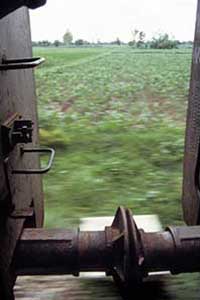
My life experience of train safety is that doors are kept closed, there’s a sealed walkway between carriages, you do not lean out. Not so here, at least not today. Doors remained open for air, and children climbed along the side of the moving train trying to sell this or that through the windows. To get from one carriage to the next you had to step across a half-metre gap between two weathered metal footplates. If you wanted, it was possible to climb up to the roof. Forsaking my crowded compartment, I sat down on the footstep of the open doorway to watch the landscape as we pulled out of the city.
Getting some airUnimpressed Gentleman
As a ‘tourist’, you see several different zones of Delhi. Everyone goes to the confusion of Connaught Place; the mixed-bag mess of hotels, shops and restaurants in Paharganj; Old Delhi – overcrowded and still part of another era; and the upper-class districts around the embassies, with large houses, parks, lawns and expensive hotels. What I hadn’t expected was what lay beyond the railway tracks – the slum that ran on for over half an hour as the train gathered speed.
At first, it was more of a shanty town of wooden and corrugated-iron structures; then, with a little distance, it became hundreds of ‘houses’ of low mud walls and canvas, all crammed together. The further we went, the more fragmented the slum became – scattered between gravel heaps and inky, poisoned streams. All along the railway embankments, and often along the actual tracks, people were washing or relieving themselves. The slum was going through its morning ablutions. Some people were vaguely concealed; others didn’t seem to care – and excrement was a continuous flow along the line. Children were everywhere, perched on the tracks like birds, mostly completely naked. In one field of open shingle, men were spread around at short distances from each other, crouched on the ground; a long-trodden path led from the centre of the field back towards the village beyond.
I imagined my expression to be one of grim astonishment – I’d never seen anything like it in person, and it underlined the abstract detachment of television.
Going back inside I reclaimed my seat from ‘Johnny’ and slept for a short time. The trip to Jammu seemed interminable and was extremely hot. After several hours of pacing, sitting and fidgeting, I ended up in the luggage rack on the other side of the narrow corridor – the most comfortable, out-of-the-way place I could find. The train was busy with people walking up and down selling foodstuffs, newspapers and small plastic toys. One man walked through each carriage, stopping at every compartment to sing loudly and then expect money. Most of the passengers gave him some.
We reached Jammu shortly after ten o’clock at night. It was pitch black and drizzling, the tail end of the heavy rain we’d seen coming up through the Punjab. Erik and B had got off earlier, and we were now left alone with ‘Johnny’ once again.
Arriving in a new city for the first time is always a challenge, wherever you are in the world. Delhi had been a daytime baptism of confusion; Jammu, only our second stop, would be different. Initially, I thought that ‘Johnny’ could finally be useful – he might know the place, or at least how to get to the centre. Cumbersome backpacks once again in place, we left the station just as the sky growled and the drizzle turned to light rain. ‘Johnny’ headed towards a line of auto-rickshaws on the far side of the station yard. Burdened with our bags, we followed slowly behind.
I had already decided which hotel I wanted. To ensure an electrical supply to charge my camera batteries, I was aiming for a so-called ‘mid-range’ hotel. When dealing with rickshaw drivers, a certain amount of determination is required and I was intent on getting our own way. As we trudged across the forecourt, I saw that ‘Johnny’ had already reached the rickshaws and was talking to a group of drivers. The vehicles were parked just below a muddy slope, slippery underfoot, and you had to watch your step to avoid a tumble.
I never saw the cause of what happened next. Lisa had already got into an indicated rickshaw when one of the drivers – a short, turbaned, chunky, bearded, very angry individual – appeared from the back of the line shouting ‘He cheating man! He cheating man!’ evidently referring to ‘Johnny’. I tried to ask what he meant, but he just repeated the phrase and glared. I felt decidedly uneasy. Somewhere beyond the rickshaws a commotion had broken out and the men were giving ‘Johnny’ a colourful piece of their minds. Our driver – younger, thinner, slightly anxious – bobbed about while I got into the rickshaw. Because of the rain the canvas side flaps were down, which might have been good if they hadn't made the interior very dark and it was impossible to see out.
With Lisa, myself and all our baggage, it was a tight fit and made us feel exceedingly vulnerable. I think this was the one time on the entire trip when I was genuinely concerned by the way events were unfolding. The driver finally got in; I told him the name of the targeted hotel and that I wanted to go there, and nowhere else. The rickshaw throttled into life and bumping from one hole in the road to another in almost complete darkness – the headlight, if it worked at all, was useless – we clattered off under a thundering canopy of lightning. Visibility was close to zero through the rain-drenched windscreen, but this didn’t seem to deter the driver from weaving on and off the road at great speed. Recalling the map in the Lonely Planet travel book, I spent the time trying to work out where we were and in which direction we were heading.
I never really did see Jammu during the day so there was no chance of my lasting impressions of that evening being tempered. At night, in those circumstances, it was like entering a suburb of Dante’s Inferno. I noticed liquor stores and ‘Arms & Ammunition’ shops in close proximity – not a good combination. People in general looked mildly angry. It was not the most welcoming of places. The rickshaw driver briefly tried to take us to a different hotel, but ultimately we went where I wanted to go. It wasn’t quite as the book had described – in fact, barely adequate – but there was electricity, we had arrived in one piece, and that was enough.
After the chaotic arrival things quickly calmed down. We went to find the ‘tourist office’ to inquire about the bus to Srinagar the following morning. We were told to come back at 6.00am, but ‘Yes, there were seats available.’ Pleased and relieved, we went for something to eat. Lisa – at that time, if not so much now – had a penchant for ‘getting close to India’ at mealtimes; the more authentic and cheaper the better. I wasn’t so fussed, and while we were in Delhi, air-conditioning had been an attraction. I quietly suspected that over the course of the trip we would get very close to India and see enough authentic, cheap eating houses whether we liked it or not.
We ended up in the back of a tiny restaurant where, as in the movies, all activity froze when strangers walked in. The only ‘tourists’ in sight, we were put at the end of a long table mostly occupied by a large family who didn’t so much acknowledge our existence as look faintly put out. I don’t blame them. I have no idea what we ate, but it was remarkably good.
I was on my umpteenth chapatti when ‘Johnny’ scurried in. Now, this was a restaurant we’d picked at random, and we were unintentionally hard to spot from the street, but somehow he had found us. I suppose all he had needed to do was ask around about two fresh-faced foreigners. ‘Johnny’ was quite upbeat and appeared completely unaware of what, from our point of view, had occurred at the station. He told us that the rickshaw drivers had been drunk. They might well have been, but that didn’t explain what problem they had with him. If the angry turban-and-beard hadn’t yelled ‘He cheating man!’ at me, I might have been more inclined to accept his explanation, but something more than his face must have set them off.
The next morning Lisa left the hotel to buy tickets from the ‘tourist office’, only to find ‘Johnny’ already waiting outside to tell us there were no buses and we would all have to get a (costly) taxi together. Lisa ignored this, found the buses, bought the tickets and met me back at the hotel. It was becoming clear that ‘Johnny’ was trying to make deals on the side, deals from which he hoped to take a cut – first with the rickshaw drivers and now with some taxi driver he had found. The good news was that ‘Johnny’ didn’t have a ticket for the bus. The bad news was that he quickly inserted himself into the small baksheesh group who pay the driver ‘off the books’ and sit in the cab. I ignored him. I don’t think Lisa spoke to him much either. However, learning about baksheesh seats would prove useful later in the trip.
The bus to Srinagar - ‘Johnny’ is lurking on the left in orange slacks
We arrived in the Vale of Kashmir in the afternoon. You enter the Vale through a tunnel – a long, cold, damp, narrow passage of darkness – heavily guarded at both ends and, for reasons of redundant military logic, strictly off-limits to photography.
We hadn’t known it, but – ‘Johnny’ aside – we had been lucky up to that point. It was only at the first ‘rest stop’ inside the Vale that the pestering over houseboats began, along with the security checks. Our ignorance regarding Srinagar was effectively total. The great Lonely Planet Bible spoke at length about houseboats, but it was not up to date on the war.
On the road to Srinagar
As the bus approached Srinagar, ‘Johnny’ tried to play the last card in his tourist-stalker deck – suggesting we go to his ‘father’s’ houseboat. This I absolutely did not want to do. Maybe it was an opportunity, maybe it wasn’t; Lisa seemed undecided. We were seated in the back row of the bus, and ‘Johnny’ stood in the aisle facing us for a very long time. My hostility was obvious – or so I thought – but the man would not take a hint. We told him we had already decided to find a hotel and look for houseboats ourselves. On hearing this, ‘Johnny’ claimed the army was occupying all the hotels and that none were open to ‘tourists’.
This seemed impossible to believe – and we didn’t believe him. He had lied about almost everything from the moment we met him, so this apparently far-fetched tale of occupied hotels just sounded absurd. Naturally, it would prove to be the one time since we had met him when he was actually telling the truth.
We declined his offer as graciously as ill humour would permit. It was, however – and I’m now sure of this beyond any reservation – absolutely the right decision.
When the bus finally pulled into the station at Srinagar, a mass of people awaited us. It was half expected, but I hadn’t anticipated having to save our bags from being gamely borne off to the ‘Tourist Reception Centre’. When dealing with tourists, Kashmiris seem to use a tactic of smothering into submission: you will eventually give in. But what can you do when you’re one of a handful of ‘tourists’ surrounded by a hundred highly motivated representatives of the local tourism business, all exceedingly anxious to secure your custom?
There are moments, crossroads and turning points on which everything that follows hinges; this was one.
I clearly remember the first time I saw Sultan standing quietly at the back of the crowd, looking at me over a sea of frantically bobbing, insistent men. We made our way towards him. He said he was a rickshaw driver and that he’d take us to a hotel – no houseboat. We bundled into the rickshaw, and I told him – rather dull-wittedly – not to talk to the others. He said he wasn’t with them, though of course he was; he worked with them, but that didn’t seem relevant. Sultan didn’t even drive the rickshaw, and it’s a testament to the long day that even this didn’t strike us as odd. He simply sat in the front with the driver, talking away in Urdu as we puttered through the town.
Srinagar felt less like India and more like El Salvador (as seen on TV, at least). The sheer number of soldiers everywhere was unsettling. There had been army camps by the roadside on the way in, but seeing fully armed troops on every corner, roadblocks every hundred metres, two for each bridge, had a different effect. At every ‘principal’ checkpoint we had to slow down so the soldiers could peer at us before waving us through. Leaving the main roads and bouncing up narrow backstreets tucked between buildings, I began to feel we should just leave.
We’d asked Sultan to take us to the Hill Star Hotel, but on arrival it was hard to believe there was a hotel at all. The name was painted roughly on a corrugated-iron gate topped with barbed wire, but the building itself was out of sight. To the right of the gate stood a bunker of sandbags and nets, from which protruded the muzzle of a large-calibre machine-gun. From within, helmeted soldiers looked out at us as we looked back at them.
Lisa started searching the guidebook for other hotels. Sultan then told us all the hotels had been taken over by the army, adding thoughtfully that we probably shouldn’t stay where we were much longer. We agreed. As the rickshaw turned and headed away from the Hill Star Hotel, Sultan casually mentioned that he ‘knew a good houseboat.’ We were defeated and there was clearly no choice but to visit ‘his’ houseboat. I noted that we’d been ‘taken’ to the Hotel Anand in Delhi and that hadn’t been too bad, so we bumped off through a maze of backstreets; the way people looked at us seemed to say ‘fresh meat’.
Then, finally, we reached the lake and everything changed. Dal Lake is beautiful, quiet and removed, yet remarkably close to the centre of Srinagar. We stepped into a big shikara – a long canoe-like vessel, the larger ones with canopies – and, dabbling her fingers in the water, Lisa said ‘Take me anywhere.’ By now we didn’t care and it was too late to do much else. As we were paddled across the lake for the first time, Sultan began to explain what was going on in Kashmir.
Sultan is a quiet, softly spoken man, a little younger than myself. As we headed to the houseboat belonging to his Uncle Ismail, I still thought he was a rickshaw driver. He wasn’t. He would later justify the ruse, correctly observing that if he’d told us the truth about the Hill Star Hotel, we wouldn’t have believed him – and he was right. He also admitted he doesn’t even know how to drive a rickshaw. I liked him from the start, and as he took me through my first real lessons on Kashmir, I began to like him more. By now, he’s a good friend.
It was 24 July. We had been in India four days, with two months and three weeks to go.
Landed fishSultan
As I didn’t start this journal until 11 August our first visit to Srinagar and the trek are not in chronological order. It begins in Leh, Ladakh.
LEH - 11 August
It’s hard to imagine a stranger world – surrounded by mountains, hundreds of kilometres from any large town, thousands from Europe or America. An ancient place, home to an ancient people who, until 1974, were completely cut off from the rest of the world. Leh City now finds itself awash with waves of German, Dutch, Israeli, British, French, American, Belgian, Canadian, Italian and Swiss tourists – the culture clash is astonishing. Tourists? Not in the usual sense – no package tours, no coach parties, no hotel-packing hordes.
Some arrive on the crowded, hot, dusty ‘A’ class, ‘B’ class and ‘service’ buses that grind along the long, difficult and sometimes dangerous roads linking Leh with Manali, Kargil and Srinagar. A few can afford to fly in on irregular air services, payable only in dollars or traveller’s cheques, but they miss the overland experience. Others come in on foot, off treks through the valleys and over the Himalayan passes. However you get here, the road to Leh is hard – and those with the will to make it are an unusual breed.
Once a long-term traveller has replaced most of their clothes – whether through wear and tear or by buying items better suited to the climate – once their hair has grown out and local food and drink have become the norm, the conversation shifts: which monastery to visit, which trek to take, where to find a pony-man, a stove, a tent, a second-hand sleeping bag, the cheapest, cleanest hotels. And as those become the topics of discussion, appearances begin to change.
Some people spend just a few weeks in Ladakh; others stay for months. We met travellers who’d been on the road for over a year – some for so long they’d almost shed any trace of who they used to be, their nationality now irrelevant. No one talks much about what they did or do ‘back home’. Why they are here or how they support themselves are not important questions. We’ve all become something else – these travellers – a curious, pan-national, nomadic tribe with its own identity, information network and wandering purpose.
LehLeh Palace
LEH - 12 August
The moon over Ladakh – the brightest, clearest moon I will probably ever see – lights the whole valley in an extraordinary silver-blue glow. After 9.30pm there are very few people in the streets. There is no curfew as such, yet it does not seem to be the local habit to be out. Late buses making slow U-turns and roaming army vehicles are the only transport moving; even the omnipresent jeeps and ‘Ambassador’ taxis retreat for the night. The atmosphere is not unfriendly as such, just guarded. The occasional figure peering from an upper-floor window adds to a faint, lingering unease. Restaurants are rarely encouraged to stay open much after nine, and if they do, their windows must be covered.
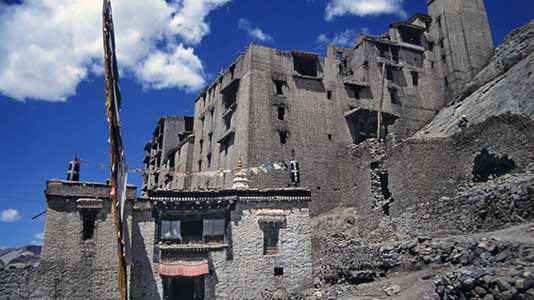
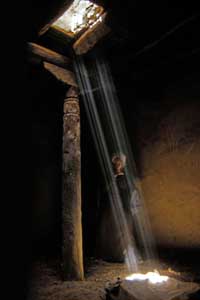
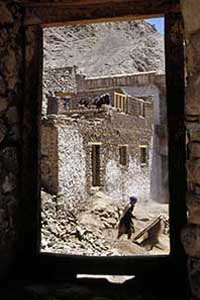
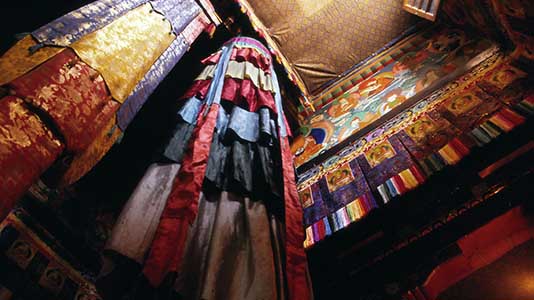
Leh Palace looms high above the town – by day, a place to clamber up to, a vantage point from which to take in the sweep of mountains and plains and to look down over the city’s tangled warren. Its many dark, dusty rooms and narrow corridors are pierced by shafts of sunlight filtering through holes in the walls and ceilings. In the inner Buddhist temple, shelves of rolled-up prayer cards stand beside oil lamps whose glow is caught and reflected in the colours of the drapes hanging from the skylight. By night, however, the palace becomes something else entirely – a ghostly, shadowed monument to times past and present change, staring down over the slow metamorphosis of a civilisation as it is reshaped by outside influences.
What is it about this place that produces such an intricate weave of contradictions? Leh is the capital of Ladakh – the eastern province of Jammu and Kashmir, itself the northernmost region of India. Yet Ladakh seeks independence from Kashmir, and Kashmir seeks independence from India. In Srinagar, the nightly exchanges of fire between army and militants – sharp, unmistakable in the darkness – are constant reminders of the gravity of the situation. Elsewhere it is the unending flow of soldiers and military vehicles, the camps surrounded with barbed-wire, the checkpoints, the long serpentine convoys winding along mountain roads and the faces of the people that tell their own story. The name ‘Ladakh’ means ‘the land of high passes’ – though some choose to call it ‘Little Tibet’ – and it is easy to see why.
The sprawling octopus of politics does not respect natural boundaries – not even the Himalayas – which for centuries have divided and preserved distinct cultures in their own high-walled territories. Roads and passes are carved through by those determined to expand into new lands. In the past it was armies that brought change; now it is buses, lorries, trucks and cars that deliver a different sort of invasion that is commercial rather than military, but still, as in centuries past, a form of domination.
Why does western imagery hold such a powerful allure? Is it the apparent ease of wealth, the style, the idea itself? What is it about western symbols that can so readily seduce and enthral almost any other culture? And why are we in the West so convinced that ‘West is best’? westerners – however deluded about their own self-importance – usually know that our systems are far more complex, divisive and brutally unfair than they appear from the outside. Here, though, people often seem to believe we live in some utopian Happy Valley.
It is the Ladakhi youth who show the clearest marks of this ‘invasion’. The girls, less so – female posturing still sits uneasily with the religious and cultural background here, and feels, for now, a long way off despite the changes. Young men – by which I mean fifteen-to-twenty-five-year-olds – unsurprisingly embrace the ‘new ways’ with wholehearted enthusiasm.
Interestingly, it is not pop music that has channelled the cultural change in this remote corner of the world. Beyond the presently inevitable Michael Jackson and the occasional fading poster of George Michael, knowledge of western music seems sparse – largely confined to the singularly ubiquitous Pink Floyd and, on rare occasions, Bruce Springsteen. What has caught on though is ‘the image’.
An influx of western-style clothing and brand names – almost always imitations – together with an avalanche of pirated Indian and American videos has presented previously unimagined alternatives to what had long been accepted as the norm.
There is no mistaking the efforts to be ‘cool’, especially around tourists. Groups of young men dressed in denim, black jackets, T-shirts and other stereotypical attire, are often to be found leaning against their Paja mopeds, or against walls, smoking cigarettes, sporting sharp haircuts and sunglasses. We are told that outside influences have made them consider their ‘small town’ traditions boring, old-fashioned and to be rejected. Perhaps that is true. It is also true that this mirrors what happened in Europe after 1945, when an exhausted continent was suddenly exposed to American swing and song. The difference is that in Europe such shifts were part of a relatively natural evolution – changes unfolding within societies and economies already moving along a similar cultural trajectory.
Old folks and despairing parents frowning at youngsters seeking to see themselves as ‘modern’ is universal, yet in Ladakh such changes are not easily absorbed; they threaten to unravel the very fabric of a life that has endured for centuries, while offering no practical alternative in its place.
There are, however, projects in Ladakh seeking to equip the young people of the region with a renewed understanding of their own heritage. One such initiative is SECMOL – the ‘Students Educational and Cultural Movement of Ladakh’ – which, according to its manifesto ...evolved from the need of guidance and direction to the younger generation, amidst the cultural confusions caused by Ladakh’s abrupt exposure to the outside world, its arrogant and imposing concepts of development, education and lifestyle. In every possible way SECMOL strives to rebuild the confidence of young Ladakhis and to restore their lost pride in their cultural roots. This we believe is the only way to save and preserve the wisdom, cultural heritage and unique identity of this land.
The idyllic vision of old Ladakh, cherished by ecologically minded westerners in Leh as a model of peaceful coexistence and community, of a life lived close to the earth, is indeed beautiful – and the cultural and literal pollution now enveloping it is indeed tragic. But was old Ladakh truly in a bubble, and wasn’t what is happening simply inevitable?
‘TRUTH WILL PREVAIL’ is a popular slogan in Ladakh and Kashmir – the words of the Dalai Lama about his own country of Tibet – adopted here to cover a range of political and religious conflicts. Its optimism and simplicity are commendable, yet the question lingers: whose truth will prevail, and how long must people wait for it? Ladakh or Kashmir, the Balkans, Northern Ireland, Palestine, Central America, Asia, Africa – the list is endless. Economic and religious divisions exist almost everywhere: the rich and poor, black and white, civil war both military and cultural. Individual truth is elusive. Take away our desire for power, our anger and jealousies, our guns, our poverty, our freedom to pollute, our intolerance of our neighbour’s colour, religion, music or cuisine – then perhaps ‘Truth will Prevail’. Yours may just take a little longer.
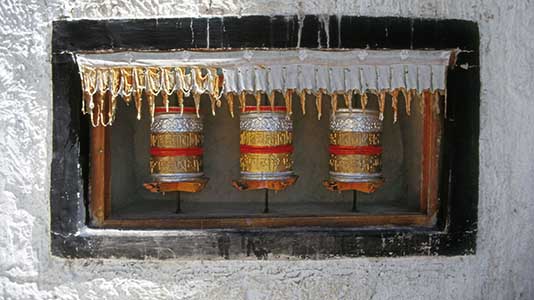
Buddhist Prayer Wheels Srinagar 434 – Leh 0
LEH - 20 August, 2.50pm
Time to move on. Every morning around ten o’clock a lorry pulls up on the other side of the narrow street from the ‘Cappu Chino’ café to clear away the small mountain of garbage that has accumulated by the stream over the previous twenty-four hours – while the dogs that transport fleas all over Leh haven’t yet gone to sleep after their long night of ceaseless barking, whining and yelping. Indeed, some of them feel moved to further exploits of canine copulation.
Leh is a fascinating place, but when you’ve consumed your hundredth chai or apple juice, coffee, banana lassi or whatever; when you’ve seen more or less everything the myriad of market stalls have to offer; when you’ve been accosted one time too many to go into a handicrafts shop because ‘Looking is free!’; when you’ve climbed the winding, muddy, smelly, rocky path through the backstreets and passageways up to the Palace; once you’ve seen your ninth or tenth Buddhist temple; when you’ve immersed yourself in the philosophy of the Ecology Centre – and their normally quite good ‘spinach and potato with garlic’ has made you throw up into a fast-flowing stream in a rainstorm under the one-eyed gaze of a mangy tortoiseshell cat at one o’clock in the morning
When you’ve queued for over an hour and a half to change a traveller’s cheque at a bank lit by candles because the outside generator has failed; when you’re tired of the absence of small change every time you buy a packet of cigarettes; when you’ve lain in bed all day watching the rain and listening to abrasive Hindi music blasting from a small transistor radio, followed by the Ladakhi Culture Group practising something traditional and cacophonous that lasts for hours; when you’ve heard the distorted bullhorn shriek of the call to prayer from the local mosque one time too many; when you’ve stared at the clearest night sky imaginable and noticed, abstractly, that north is always in the same place but the moon is not
When you’ve wandered through the market to the bus station with a big sack of trek provisions balanced on your shoulders; when you’ve said no yet again to the professional beggar from Calcutta who constantly asks for your cigarette lighter; when you’ve taken a photograph of everything you could possibly want to photograph – except that one photograph you will always forget to take – when you’ve had umpteen conversations about travel and trekking with different people from umpteen different countries; when you’ve discovered who you do and don’t like in the international melting pot; when you’ve wanted to punch out the next idiot in a jeep or on a motorbike who won’t stop hammering on the horn; when everything, no matter how initially beautiful, exotic or just plain weird, has become routinely normal – and then you finish your paperback book – maybe it really is time to get on the next crowded bus with your overweight baggage and bump out of town to wherever you want to go next.
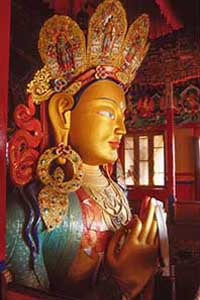
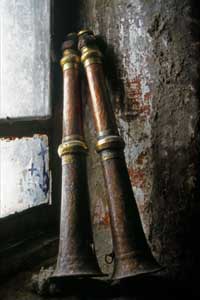
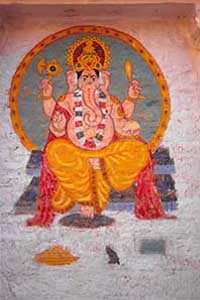
The ‘Cappu Chino’ café in LehThe Milan CrowdHemisThikseThe statue of Maitreya BuddhaDungchen - Tibetan hornsLord Ganesha
LAMAYURU - 21 August, 6.34pm
In Leh it turned out to be fairly easy to meet like-minded people going in the same direction with whom you can make up a group. As I won’t be going from Lamayuru to Padum, my place has been taken by Matthias – a tall, gangly German marionette who is constantly deciding whether to change his mind about any given matter and with whom I got into a bad headspace when – once I had made the tough decision not to take part in the first leg of the Zanskar trek – he kept asking to borrow my sleeping-bag ‘as I wouldn’t be needing it in Srinagar’. It got rather uncomfortable as, on one hand, I could see his point, sort of – but on the other hand, asking to borrow someone’s sleeping bag around here is tantamount to asking to borrow their girlfriend.
I wanted to say no, but I was hoping he would realise what he was asking and back down. Unfortunately, he didn’t. My British reticence justifiably irritated Lisa’s American frankness, and she had a few words with me about ‘being a man’ and ‘just saying no if you don’t want to.’ We sorted it out, and I kept hold of my sleeping bag. On a more positive note, we’ve found a really super Australian couple – Richard and Tracy. Cagey Germans I can do without; straight-up Aussies, I can do business with.
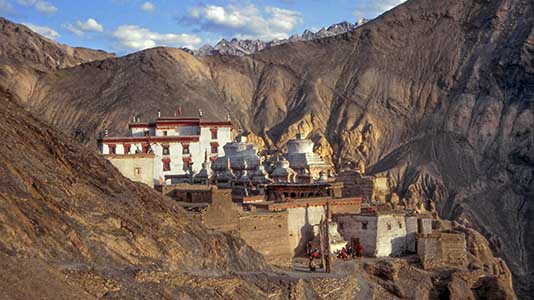
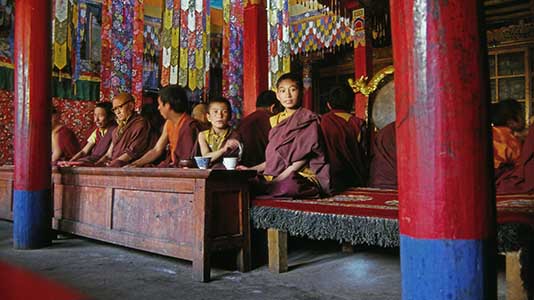
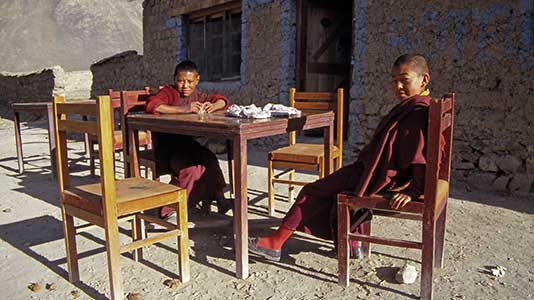
The monastery here is spectacular and set in some beautiful scenery; the monks are surprisingly laid-back, especially the younger ones, who during prayer ceremonies giggle and joke at the expense of their elders. The monks have certainly cornered the market – and the prices – of toilet rolls and chocolate bars. All told, though, Lamayuru is a bit of a dump; you may as well just read the info, check it out, buy the postcard and move on quickly.
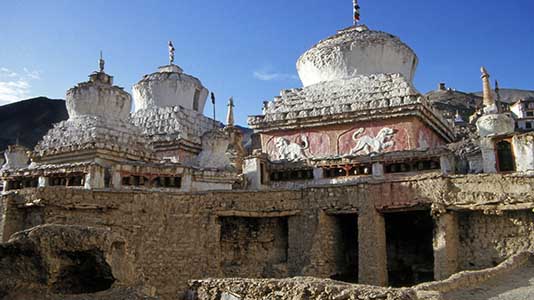
Lamayuru MonasteryTempleStupa
LAMAYURU - 22 August, 9.15am
Don’t drink the water. Richard has elaborated various theories on how to tell if the water coming from the local pump is drinkable or not. Last evening he gave a long lecture on the subject – natural filtration processes, centuries of tradition and so on – before downing a full bottle of the stuff and encouraging Tracy to do the same. His theories did not convince us one iota so Lisa and I declined to partake and, needless to say, Richard and Tracy subsequently spent the night throwing up and suffering acute diarrhoea.
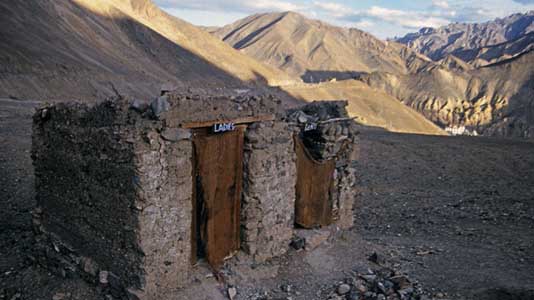
For your convenience
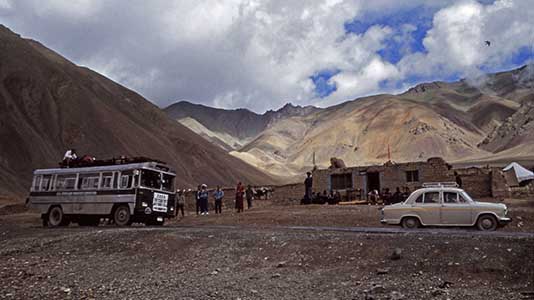
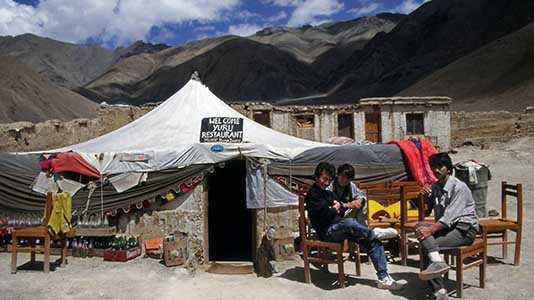
Lisa, Matthias, Richard and Tracy – both looking the worse for wear – left this morning with their newly acquired horseman, Pama, and his horses; I’ll meet up with them in Padum. Right now I’m sitting by the roadside in the blazing sun, outside the Yuru ‘Restaurant’ (a modest euphemism some might say), bags around my feet, waiting optimistically for a bus to Kargil.
From Kargil it’ll be another bus to Srinagar where, among other things, I need to recover my video camera, which ceased to function just before we set out from Pahalgam on the first Kashmir trek.
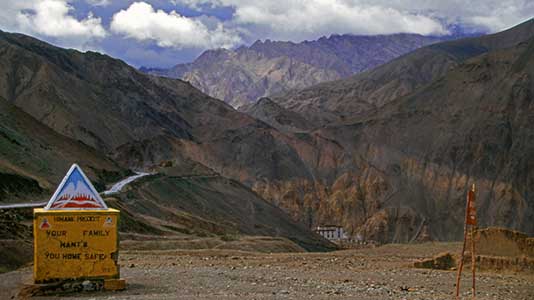
Yuru Restaurant - Music Booze Dance Your Family Wants You Home Safe RoadworksRest Stop
KARGIL - 22 August, 7.28pm
‘Thank God for what he gives us.’ said the Kashmiri gentleman, getting up from his table at the bus-stop teashop and slapping me firmly on the shoulder. Indeed.
The others should now be well on their way and I am back in the hotel in Kargil where I stayed with Lisa two week ago when we came through here on our way to Leh. Kargil is not my favourite place at all, it's a small grey transit town you want to leave pretty much as soon as you arrive.
Tomorrow brings another horribly early 3.30am departure for Srinagar – back to the lake, back to the houseboat, back to find out if my video camera has been repaired, back to see what’s in store for me. We’ll see. I didn’t want to start writing a travel diary – but it seems I have done so.
Dal Lake
SRINAGAR - 23 August, 7.30pm
Got here about an hour ago. The bus ride from Kargil was not quite hell-on-earth, but pretty close; very bumpy, and my seat #5 wouldn’t recline – obstinately remaining in a strictly upright position. A landslide on a precarious mountain pass had given the Army an excuse to block the road, blast and bulldoze, causing a three-hour delay before the service bus could lurch and rattle onward past the road gangs, ravines and ragged rockfalls. It was hot, dusty, jarring and uncomfortable – horrible blinding tedium.
The feeling of relief to be back on the houseboat is draining. I’ve been reading Freedom at Midnight by Dominique Lapierre and now have a head full of India, Gandhi, religion – and an almost overwhelming sense of spiritual confusion. Facing the images of Islam, Buddhism and Hinduism all together like this is strong stuff. On the bus entering Srinagar, I fell into a deep melancholia – so much seems to be changing, and I begin to wonder what I’m supposed to be doing and where I’m supposed to be going.
Ismail, who owns and runs the houseboat, is his usual ultra-courteous self and, initially, we were back to the use of ‘Sir’, which I’m trying to stop. I wish I could find the right words and questions in his company, for he is a rare person and I want very much to talk easily with him. The video camera has emerged and still refuses to give any indication of life; I’m hoping the right people will be found to look after it.
Jhelum River, Srinagar
SRINAGAR - 28 August, 6.37pm
Today, Ismail took me around the Old City. Srinagar is divided into three areas: the old, the new and the part that includes the maze of canals, waterways, houseboats and small satellite villages. The Old City is naturally a snarl of narrow streets, small shops, mosques and monuments from the era of the Moguls. Every now and then you pass a small cemetery where militants and casualties of the current ‘revolution’ are buried in what amount to a martyrs’ graves.
As we went around the markets and shops it was noticeable that there were hardly any ‘tourists’ about – almost none. Srinagar has always been a summer capital; the winter capital, in fact, is Jammu, when Srinagar becomes difficult to reach by road, Dal Lake freezes over, and the temperature drops to what might be expected in the Himalayas – certain regions of Ladakh regularly see minus 40 degrees Celsius. Up to only a few years ago there had always been a steady flow of tourists that represented a significant part of the region’s economy. The current situation has reduced Srinagar to the state of a busy ghost town; although there are a lot of people in the streets and the local tradesmen who cater mainly to the ‘local’ population appear to be busy, the reality is that there is a serious crisis.
IsmailIsmail
The absence of tourists means that a large percentage of the people are not earning and therefore do not have money to spend – which rolls back onto the shop owners. Many of the stores are empty of customers. As this is my first year in Kashmir, I have nothing with which to make comparisons, but out on the lake at least ninety percent of the houseboats are empty, and I believe that not so long ago – at the height of the season – you had to book in advance. Relative to how things are supposed to be, the place is deserted, and overall there is a strange, empty atmosphere.
You can do so if you wish, but tourists are not encouraged to wander around the Old City unaccompanied. Initially this can feel like possessive pestering on the part of your Kashmiri ‘hosts’ – you are, after all, a valued source of income – but unfortunately there are good reasons behind this, one of which I experienced this morning.
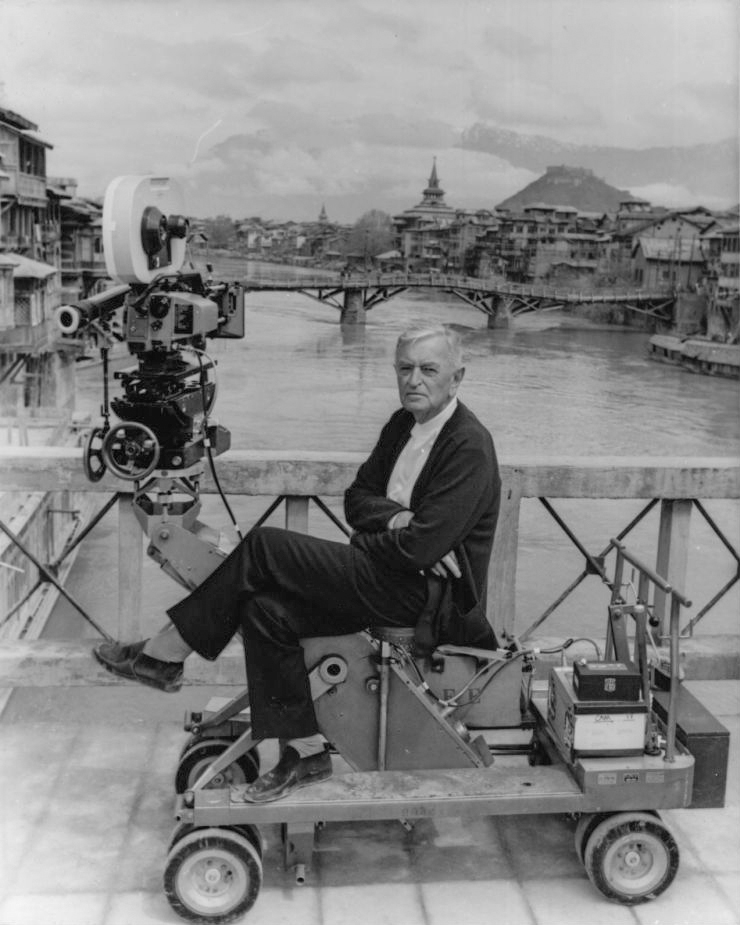
David Lean filming A Passage to India
Standing on one of the bridges over the Jhelum River, Ismail pointed out the ruins of a much older bridge that burned down in 1990 during an incident with the Army. The bridge was featured in the 1984 film A Passage to India and appears in the background of a publicity shot of the director the late Sir David Lean.
While we were talking, an old Kashmiri man came up and began shouting angrily and accusingly at me, pointing his finger in my face. Ismail tried to calm him, and whatever the problem was took a long explanation on his part before the old man seemed convinced and went on his way. As the man was walking off, Ismail turned back to me. ‘He thought you were Israeli,’ he said.
This refers to a controversial incident on 27 June 1991, when members of the Kashmiri Hizbul Mujahidin kidnapped a group of Israeli ‘tourists’ to use in protest against the military occupation. It was not the first time the militants had kidnapped tourists – usually men in their late twenties – to attract the attention of the international community. A strategy that has been used more recently in Turkey, for example. Generally, the ‘hostage’ would be kept for a relatively short time and then released unharmed, as it is would against the militants’ interests for them to come to any injury.
The details of what exactly happened have never been clear, except that the day before they were due to be released the Israelis – three young men – chose to try and break out, seizing a rifle and shooting one of the captors as he was praying. In the brief shoot-out that followed, one of the Israelis was killed and another wounded. The whole incident was a tragic mistake on everyone’s part. Consequently, Israelis were banned from the Vale – they were all asked to leave the next day – as there were many highly emotional reactions to what had happened. I am also told that the Mujahideen is convinced the Israeli Mossad is helping the Indian Government in espionage in the Vale, as it has ‘a long experience with Islamic Fundamentalism’. That’s what I’m told, anyway.
After the incident on the bridge, Ismail took me to lunch in a small restaurant comprising six tables in a room overlooking the Jhelum River. Kashmiris eat a good quantity of rice, and in front of you is placed a huge bowl of the stuff, on top of which is poured a spicy sauce often made with dahl, pieces of mutton, potato, different vegetables or whatever they have prepared that day. The only real way to eat it is with your hands.
Old SrinagarArmy Control PointJamia Masjid Road
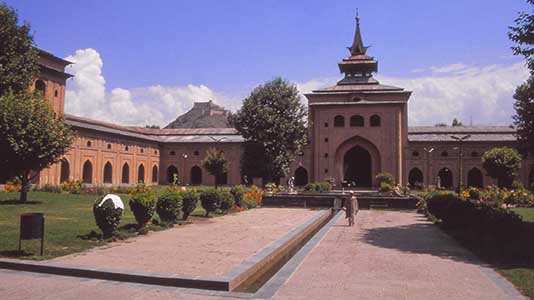
Jamia Masjid
Yesterday, we went to have lunch at Ismail’s brother’s house. Up until then, I had been using a knife and fork, but sitting on the floor in someone’s home with three other people eating with their right hand, you feel a bit of a pompous ass using cutlery and a ceramic plate while they have much more attractive large metal bowls.
So Ismail taught me how to eat with the right hand and the difference is extraordinary. There is a precise technique (including washing the hand before eating), and there is no question of ‘shovelling’ the food into your mouth. By slightly curling the fingers and using the thumb as a lever you can eat quickly and efficiently. After a childhood of being told to ‘use your knife and fork’, it was peculiarly liberating and quite simply the most practical way to eat rice; in addition, the food seems to taste better. However, I don’t suppose I’ll be taking the practice home with me.
Ismail and his brother
SRINAGAR - 1 September, 2.25pm
So far, so good – the video camera, against all expectations, has been brought back to life; a small camera shop has worked a minor miracle. Ismail was even filled with pride that a ‘Kashmiri man’ had been able to repair a Sony Hi8 camcorder. This demonstration of Kashmiri know-how has cost me a relative fortune – but it was worth it.
This Tuesday afternoon is cloudy and humid. I was supposed to leave Srinagar today, but a couple of things have come up and I can’t leave until Thursday. It’s been a really fascinating week, as well as extremely relaxing, since for the most part I’ve had the houseboat to myself. Ismail has turned into a good friend, and we’re getting along very well. Without exaggeration, he is probably the most sincere person I’ve ever known. He is also well respected in the local community – either for his involvement with the ‘Houseboat Committee’ or for having been a renowned sportsman in his youth. He disapproves of the fact that I smoke and tells me so. His brother smokes more than I do, but Ismail says he’s given up trying to persuade him to change.
The family photo album has been pulled out, and there are pictures of Ismail’s father, uncle and relations on various treks over the years. There is a black-and-white photograph of Sherpa Tensing on the houseboat with a group of visitors from Europe.
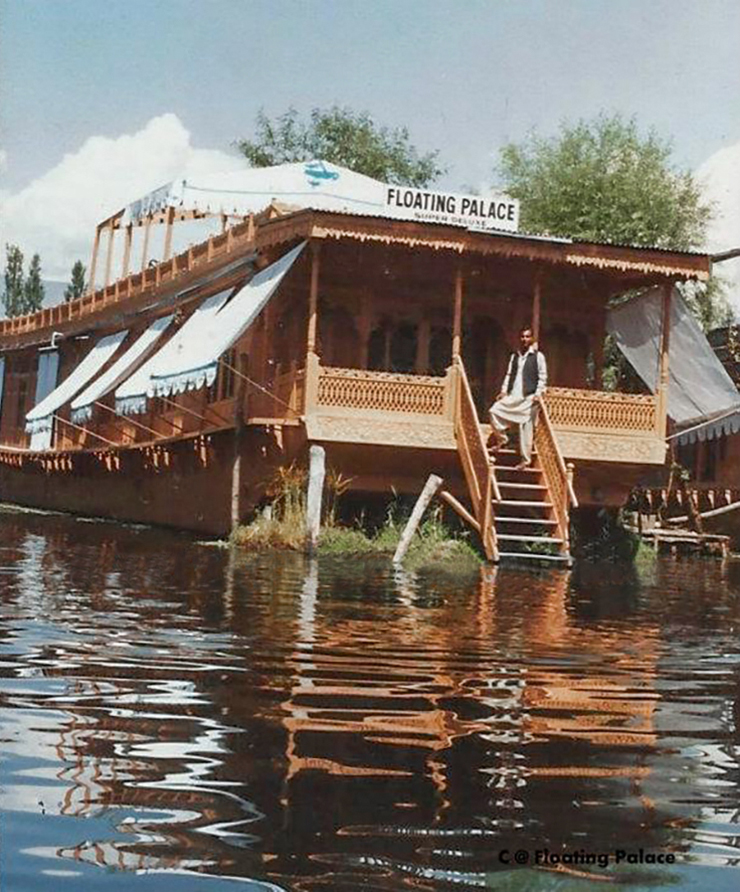
Ismail in his youthIsmail with Sherpa TensingThe Floating Palace in times past
Ismail becomes nostalgic looking at the pictures, they seem to represent a Kashmir that once was and is unlikely to return in the near future. An era when people came from all over the world to stay on the lake and trek through the mountains – though not in ripped jeans, T-shirts and dreadlocks on 5 dollars a day. These were full-on, five-star expeditions with more than a touch of the National Geographic Society at the turn of the 20th century.
I point out that people still come, albeit in smaller numbers, but he says that nowadays it is a completely different kind of traveller – more the young backpackers who want to do everything at minimum cost and don’t really appreciate everything the valley offers, because they are probably banging through from India to Nepal or vice versa.
The ‘golden days’ have certainly slipped into history. A visit to the Shalimar Bagh Mughal garden is an instructive exercise – there really isn’t much to see, but the feeling the place gives you of loss is extraordinary. For some reason there are two army posts at the entrance and a bunker across the road. The once well-tended lawns and flowerbeds are, in the main, overgrown and neglected; the fountains are long turned off, and their basins either dry or full of still, greenish water. A skeleton crew of gardeners keep small areas at least clear of undergrowth. In its own way, it is representative of the state of things.
At night, you sit on the houseboat’s veranda and look out over a dark lake where nothing moves except the occasional shikara hugging close to the houseboats. There’s not much else to do – the curfew prohibits all activity. Across the lake from here is Gopadari Hill (once known as Takhte Suleiman – the ‘Throne of Solomon’) at the top of which there is the small but noted Hindu Shankaracharya Temple and an army post, from where you can easily see the signal lights flashing as they talk with another army post on another hill. Occasionally, searchlights sweep out through the darkness over the water – sometimes resting on the houseboats, sometimes extinguished after only a few seconds. This is the Dal Lake that I have known.
The Dal Lake of a noisy, colourful nightlife, dancing and a restaurant on Nehru Park (a small ‘island’ in the middle, now an army station), of water skiing, of dozens of the big canopied shikaras gliding up and down, and of people filling brightly lit houseboats – all this, for me, is almost unimaginable. My reality is that most nights you can hear dogs barking in the distance, and sometimes the haunting sound of Kashmiri women singing drifts across the water. Sometimes you hear gunfire.
On Saturday, two girls from East Germany, Anna and Heike, arrived and threatened to disrupt my idyll. Happily they have turned out to be ‘all right’, and it’s almost nice to have them around. Lisa, Tracy, Richard and Matthias will presumably be arriving in Padum before long. I have to admit to having no real inclination to do the trek and would prefer to spend my time here – going to a forthcoming wedding to which I am invited, meeting people, reading and writing – instead of tramping around the hills of the Zanskar Valley. Once I’ve left here, though, I’ll probably be resigned to it. As Ismail would say, ‘What to do, sir? What to do?’
Srinagar Waterways
SRINAGAR - 2 September, 7.43pm
As we walked along a narrow path through a thickly wooded area outside Srinagar, men emerged from among the trees in front and behind us. Some of them carried guns concealed beneath their clothes. The man on my left leaned closer. ‘Now you are walking with the Mujahideen,’ he said in a low voice. The path stretched onwards and curved towards a small village.
We had taken a taxi from the centre and driven out of the city. There were five of us – all men – two in the front, and myself sandwiched between two others in the back, my video camera in an anonymous bag between my feet. Should we be stopped, I was told to say that we were going to see the saffron fields. Why it should need four Kashmiris to accompany one ‘tourist’ to the saffron fields seemed the obvious question, but that’s what they wanted me to say if the situation should arise. Fortunately, it didn’t. There was a curious moment when, having just passed an army roadblock, where we’d been casually waved through, the metal rim on the left headlight inexplicably decided to fall off and clatter back down the road. We pulled over, and the driver walked quickly back to retrieve it.
We drove on for nearly twenty minutes, then came to a halt by the side of the river. A small boat ferried us across with some locals and a couple of sheep. I was far from the beaten tourist tracks and received curious glances. I imagined everyone had some idea of what was going on.
Over the course of the week – having, little by little, better understood what is happening in the valley and who the protagonists are – I had made enquiries about interviewing one or some of the Kashmiri resistance, to include in a documentary that is forming in my mind for when I return to Italy. Someone spoke to someone else, and eventually the message came back that a ‘Divisional Leader’ would be in the area and was prepared to meet with me. The young man who had acted as a mediator was very enthusiastic – apparently it would be an honour for him to be in the same room as this man. I was nervous. I have a good idea how the Indian Army treats people suspected of having links with the militants, and I did not – and do not – wish to involve anyone around me.
Once across the river, I was taken quite a considerable distance to a house in the middle of the woods. We all sat down on the grass outside to wait for the man in question, who was coming in through the back roads. I was told that the Indian Army didn’t often dare to come into these areas. ‘They control the roads,’ I was told. ‘But the Mujahideen controls the countryside.’ We waited quite a while, and the men treated me with guarded courtesy. I asked about the house and they said it was owned by a sympathiser, only used this particular day for this specific purpose.
Mohammed Maqbool Illahi, the Divisional Leader I had come to meet, is an impressive figure. Not a tall man, he is, however, physically large and wears a thick black beard. He certainly looked the part – and his left hand was bandaged. He is probably in his mid-thirties, but many of the militants are surprisingly young. Either way, he carried an indisputable air of authority about him. He sat down on the grass in front of me and spoke in heavily accented but articulate English; evidently, this was not his first interview.
For almost an hour, he studied me and asked questions about who I was, where I was from, for whom I worked, and what I intended to do with anything he might have to say to me. I was not to be allowed to take any pictures; I would be able to record the interview, but I was not to start recording until he said so. He complained that, while he had given interviews in the past, many – he felt – had been distorted by the journalists. I told him I wanted to represent the facts I saw personally, and the rest as best as I could believe my sources. I said I wasn’t there just to record propaganda either. This he accepted and finally suggested that we go inside the house to begin.
In a large, carpeted – but otherwise bare – upstairs room, we all sat on the floor. Mohammed Maqbool and I were in one corner, with men sitting around the walls. In another corner was a tidy collection of Kalashnikov AK-47s. It was a peculiar moment: the two of us held the full and undivided attention of the others; it was the first time I had ever found myself in such a position. Outside, the cicadas were thundering in the undergrowth – clearly audible on the tape – along with my low exhalation of relief when Maqbool started to speak.
0:00
0:00
We were there a long time, stopping for lunch – which was brought to the room – and we ate where we sat, Maqbool and I sharing bowls. He spoke of Kashmir: its recent history, its educated men, its achievements, the domination by the Indian Government, the so-called ‘interrogations’, the torture, what the Mujahideen wanted to achieve – and that they would never stop fighting to achieve it. He frequently made comparisons between their position and that of the Afghan resistance (also Muslims, and therefore also known as the Mujahideen) under the Soviet occupation. He spoke slowly, clearly, and in detail.
There is a rivalry in Kashmir between the Mujahideen who want Kashmir in its entirety – Jammu, Kashmir, Ladakh, and Zanskar – to become part of Pakistan, the ‘natural’ choice in 1947 – and the ‘Jammu & Kashmir Liberation Front’ (JKLF), who want complete autonomy from either India or Pakistan. Sitting in that room, listening to that man, surrounded by his men, and trying to maintain objectivity and impartiality in my mind, it all became an entanglement of history, religion, war, opinions, objectives, and horrors. From time to time, I felt a detached unreality and the fact that only six weeks before I had never set foot in the country seemed incredible.
As I was leaving, Maqbool stood talking on the doorstep, and I looked at him with a mixture of admiration and regret – knowing we would never meet again. His life was accounted for, and it was only really a question of time. For Maqbool, there was no choice; he was simply another warrior, and whatever I might have thought about his war personally meant nothing. He instructed me, quite firmly, that it was my ‘duty’ to report what I had seen and heard. My one frustration was when he offered to take me to a training camp, their ‘munitions factory’ and to meet a political representative. I had been accepted and tomorrow I have to go. We shook hands, and I was led away out through woods, back across the river to the road and the waiting car.
Heavy clouds filled the sky as we entered Srinagar, and passing through the roadblocks and congestion was heavy going: the army had closed off an area of the Old City while they concluded another ‘crackdown’. According to a Swiss couple, a group of suspects had been cornered in a building close to the lake and killed while allegedly trying to escape. The soldiers had then placed their own rifles next to the bodies, to ‘show’ they were militants for an ‘official photograph’. When the couple had tried to take photographs themselves, the film had been removed from their cameras. While details are impossible to verify, the fact remained that eight people had died.
‘It won’t do any good,’ said one Kashmiri man when told I wanted to write about what was happening. ‘Hundreds of reporters have come, nothing changes.’ ‘What can I do then?’ I asked. ‘Pray to God,’ he answered. ‘That some sense will come to the world and that people will learn to be human.’
I stepped into a shikara and as we started to cross the lake the skies opened. I was soon drenched under a torrential rainstorm that poured down heavily across the surface of the water. It’s been a day I’m not going to forget. Right now, I feel slightly depressed and somewhat frustrated. Ismail has reserved me a seat on the 8.30am bus out of here to Kargil tomorrow morning. From Kargil, I have to find a truck to Padum, as there will be no bus until Saturday.
KARGIL - 4 September, 6.07am
I hate this place. Yesterday’s bus ride was endless – about 15 very tedious hours. My seat was more comfortable than last time, but the stop–start–stop–start progress over the passes was dreadful; there really is only so much the patience can take. Purgatory would be to take the bus to and from Kargil to Srinagar forever – without ever getting off and without ever getting used to it.
Odd moment of the day was meeting Matthias at a tea stop. He was on his way to Srinagar, and the improbability of this meeting is unimaginably high: I was running a couple of days late, he had just completed a ten-day trek, and the tea stop was at one end of a one-way mountain pass. He says that the others are waiting for me in Padum; unfortunately, this means they’ve been there for two days already.
We arrived in Kargil late last night – I say ‘we’ because the two girls from East Germany, Anna and Heike, came along on a different bus but in the same convoy. They’re going to Ladakh and left on the 3.30am red-eye for Leh.
I don’t think I slept much in the three and a half hours I was in the not-so-clean hotel room. Much of the time was spent trying to identify strange rustling noises in a corner of the room. In a pitch-black, dirt-cheap Kargil hotel, when you can’t find your torch, the imagination can work a little overtime. It turned out to be a mouse interested in my packed lunch. Almost gratefully, I got up just after 3.00am to see Anna and Heike on their way and to begin the search for a truck to take me to Padum. It’s a pain to have left Srinagar – I’ve achieved some things, but there’s a lot more I could do. I hope I get the chance to go back. In the meantime, I’m sitting here by the roadside in a dreary little transit town, waiting for a truck to take me heaven knows where, to do a trek I don’t feel like doing. I’ve a ton of stuff, and the strap on my camera bag chose 4.40am this morning to break. Ah well – it’s all part of a big picture. I hope it doesn’t take too long to get there.
PADUM - 6 September, 8.57am
The truck out of Kargil took an astonishing 30 hours to get here – I think the average speed was about 11 km/h – and it went beyond pain into that grey area of numbed acceptance. On board there was myself, a robust American girl and her German ‘friend’ George. She had the worst case of bedbug bites I’ve ever seen, and he looked generally vexed. The truck had a crew of three, and when all six of us were in the cab it was rather crowded. Accompanying us were two chickens – small, white, and downhearted – one of which rode for several hours on my knee.
For as much of the time as possible I travelled up in the forward goods compartment on top of the cab, not particularly comfortable but you get a good view – even if most of Zanskar looks like God blasted the place with a shotgun. According to the driver, Padum was never far away and yes, we would reach it that day. However, the more the day wore on, the less convinced we became that this was going to be the case. Late in the afternoon one of the chicken’s downheartedness was vindicated when it was prepared for dinner.
More often than not truck drivers are Sikhs – no one had an adequate explanation as to why – but on this occasion ours was Kashmiri, as was the rest of the crew. This spared us the Punjabi and Hindi music tapes played at full-volume – tapes always labelled From the original soundtrack and always unbearable; a subjective opinion perhaps, but one man’s art is another man’s migraine.
The road to Padum
Truck stopCleaning a chicken
We drove on through the evening and into the night, the headlight beams scurrying excitedly over the rocky ground ahead while my mind lingered over images of large trucks reduced to tangled wrecks at the bottom of ravines. We rumbled and rolled through the darkness, shifting gear from pothole to pothole, lurching from side to side. It was a high-impact ride in extreme slow motion.
Finally, in what seemed like the middle of nowhere, we pulled up at a rest house. Apparently this was Rangdum and somewhere out there, on a rocky outcrop across the empty moonlit plain, was a noted Buddhist monastery. We may as well have been on Neptune.
I climbed out of the cab and walked a short distance out across the deep, marine-green plateau. The atmosphere was slightly humid and the surrounding mountains silhouetted in silver. It was quiet and very still. In front of the small, wooden rest house the big Tata truck stood impassively – its gaudy orange paintwork muted to burnt umber, the engine spitting and ticking softly as it cooled in the night air.
The Kashmiri truck crew was already unpacking cooking utensils and converting the cab into a makeshift kitchen. Tonight’s menu: chicken and rice.
The rest house was surprisingly busy. A small but welcomingly warm dining area with a hard-earth floor, wooden tables, and benches – all dimly lit with gas lamps. The robust American girl and her vexed German ‘friend’ George wanted to eat and ordered the universal ‘noodles’. I had already agreed to eat with the truck crew, so I consumed several glasses of ‘tea’ and looked around at the multifarious group of ten or so ‘tourists’ whose lives had somehow coincided in this obscure place at this time.
You never meet anyone you know from home out here, but you often run into the same faces. Another ‘old friend’ walked through the door at that exact moment – Edoardo, a bizarre, evidently wealthy man who says he’s from Switzerland. He has receding blond hair, could be in his early forties, and bears a vague resemblance to Klaus Maria Brandauer. He speaks English with a faintly upper-class English accent – he also speaks Italian, French, and German, all with faintly upper-class accents. I first met him early one morning at the rest house in Lamayuru, where he had arrived during the night in a species of ‘off-road’ jeep which was giving him problems. He had been looking for a mechanic.
What he did, what he was doing, and how he was financing what in practice is the most expensive way to travel in North India is a mystery – subjects that he would seem to skirt around with a big laugh. The robust American girl’s vexed German ‘friend’ George picked up on this and, rather unfairly, began to push the point until the atmosphere became a tad tense. I rescued Edoardo from evident irritation and looming embarrassment by calling him a ‘lone wolf’. He liked that and the situation was resolved with a big laugh. Personally, I think he’s slightly mad. He seems to spend a great deal of his time prowling the hills of Ladakh and Himachal Pradesh, going from monastery to monastery, before making quick trips to Delhi to stay in five-star hotels. I cannot decide if he’s looking for spiritual enlightenment or something very different. Sitting there in the rest house, he did not seem to have changed much other than that he was now wearing a blanket and seemed to have found a mechanic.
After dinner, the truck driver announced that to make up time they planned to drive all night in shifts. This was just as well, as he had been driving for about fifteen hours already. I wished Edoardo well and we pulled out of Rangdum.
I went back up to the goods compartment over the cab to sleep there. Once inside my sleeping bag, with a protective plastic sheet pulled up to my chin, it was better than I expected. The truck rumbled slowly up the road and we began to climb through another pass. Low clouds rolled by, dark overhanging rock skimmed above the truck and vanished into the night. The continuous growling of the gears (there were five, but the driver was always in first or second) and the boat-like motion to which I was now accustomed all became soporific background noise, and I only woke up when the driver decided to stop for a couple of hours. I peered at my watch – it was 2.40am Saturday; I’d been on the road since 8.30am Thursday with a four-hour stop and one hour of sleep. I was too tired by now to care.
I arrived here in Padum yesterday about 12.30pm – apparently a few hours after Lisa left with Tracy, having waited for two extra days. A twelve-page letter was waiting for me at the ‘tourist office’, a somewhat frantic and ‘almost nasty’ (as Lisa put it on the last page) ‘Where the hell are you!?’ It’s a bit of a mess, and quite rightly it’s on me. I have had to find a horseman to take me to some place called Purne, where they’ll wait for me for another day. Lisa has a two-day start, and in practice that means I have three days to catch up.
It turned out that finding a horseman and a horse (they’re generally used to carry baggage, not to ride) was not that easy. I thought I’d found my man when I discovered I was co-opting someone else’s. Fortunately, this ‘someone else’ turned out to be Tom and Cal, an English couple I met briefly in Leh. Into health food, yoga, medical problems, herbal remedies and diatribes on farting, they are also good friends of Richard and Tracy. As for the horseman, Grouchin, let’s say we’ve reached an agreement. The comments I receive when I finally crawl out of the landscape will be interesting, and given the tone of the letter I am feeling distinctly guilty. I left Srinagar late, but the delays and crippling slow pace have wreaked havoc. Padum is, to quote Lisa, a ‘dusty hell-hole’, and they were stuck here for several days waiting for me. We’re supposed to leave in an hour.
MUNEY - 7 September, 7.19am
Well, the pursuit is on. When I made a deal with Grouchin he claimed to have a spare horse; this, of course, was hogwash and he was in the business of getting more money for the same number of animals. This all led to a minor dispute when it came to packing my two very large bags on two already well-loaded horses. When we began to argue that there were three of us paying for three horses and only getting two, Grouchin threw a bit of a fit and started taking everything off the horses. With negotiations beginning to involve half of Padum, it was finally resolved and I finished by saving 50 rupees.
Padum to Muney was a fairly easy five hours. Muney Gompa is a monastery with a ‘camp site’ (a stream and patch of flat grass) and I am writing this in the ‘tea house’. One of the more amusing aspects of these little places, generally run by the Buddhist monks from the monastery, is the reaction of the ‘junior’ monks, boys of about eight or nine years, when presented with a copy of Newsweek.
The world within the covers of any western magazine is so far removed from the complete isolation of these sites that you have to wonder what they actually think looking at these pages of pictures ranging from industrial capitals, business centres and various zones of war or disaster. I don’t know to what extent they are aware of the world beyond their own. Enough ‘tourists’, bringing all manner of paraphernalia, pass through here during certain seasons, but for most of the year there is no one and they are otherwise completely cut off. In any case they are completely fascinated and the magazines get passed around.
As I don’t have a tent, last night was spent inside the big plastic sheet I bought in Padum along with the rest of my gear – I should officially note that a big plastic sheet can be invaluable. Apart from the ground being a little hard, it was fine, not at all cold really, and no rain; I hope tonight’s the same. What’s on the mind right now (apart from catching up with the others and sorting out all the confusion and their understandable frustration) is what to do with the rest of the trip in India. Time is going to start to press and I’m still thinking of the possibility of returning to Srinagar. This will make going to Nepal impossible, but if I can get more pictures and a couple more interviews with different people, I think what is now definitely developing into a documentary of some kind may become a possibility.
PEPULA - 7 September, 5.42pm
I’m sitting in the so-called Hotel Pepula. The word ‘hotel’ is often used loosely, but this has to be a particularly extreme case of false advertising. It’s a stone-walled area about three metres by eleven, with a ‘kitchen’ at one end, a sitting area at the other, a wooden pole in the middle, and an old parachute for a roof which lets in the rain. It rained when we arrived. They do food here (which we didn’t have) and tea (which we did). All the biscuits and chocolate are twice the market price, but the two young boys who seem to be running the place are both very cheerful about it. The water supply is a stream that flows through a hole in one wall and out through a hole in the other. Judging by the weather, I may have to sleep in here tonight. The place has a vaguely circular dimension and sits just below the path on the edge of a small, stony black patch of ground next to a fast-flowing, rumbling, stone-grey river.
Hotel Pepula
Apart from Tom, Cal, Grouchin and myself, there are three middle-aged Americans who look like they’ve been trekking for a while. Today’s walk was mainly rather boring, and I slipped into something of a bad mood on the way (the second hour, I think), dwelling too long on the wrong things – this trek, what will happen when I go back to Italy? will I have a job? why am I plodding along this tedious path? what are the others going to say to me? I have the general impression they were pretty pissed off having had to stay too many days in Padum, which, having now been there, I can understand. Stuff like that. On a trek you have far too much time to think.
People you meet in places like thisGrouchinGrouchin and our horses
RAMJAK - 12 September, 8.48am
We arrived in Purne in the late afternoon of the 8th. Lisa was relieved to see me and seemed to have spent a lot of time imagining the worst. Everyone seems to be all right, including Pama, the horseman. Richard and Tracy – who we only met two weeks ago – have proved to be incredibly supportive friends. Having lost two horses on the first leg of the trek to ‘bad grass,’ Pama’s astonishing patience finally ran out in Padum and he rightly refused to stay any longer and risk further misadventures. He and Richard set out on the 4th, but Tracy insisted on staying behind with Lisa for one more night to wait for me.
Once all the explanations were heard and understood, everyone was wholly accepting of the karma, and it was quickly business as usual. We left Purne the morning of the 9th, with my thanking Tom and Cal for putting up with me; they were going to spend a day at the famous and spectacular Phuctal Gompa.
This is now my second trek after the 27 August – 5 September Kashmir trek from Pahalgam to Panikhar which had been beautiful.
Vale of Kashmir
Pahalgam to Panikhar was our first trek ever, and was very well organised by Ismail’s (other) brother Yousuf – or Big Yousuf, as I call him, both for his physical size (he is a large man) and his status in the Srinagar community. He has been deeply involved in the houseboat business, the trekking business, and regional politics his whole life.
Yousuf didn’t accompany us on the trek beyond Pahalgam, and put us in the capable hands of his son Bilal and son-in-law Hussan. In reality this trek had already been organised for a group of German tourists who had been to Kashmir before. Essentially Yousuf simply added us to the existing ‘guest list’. We were not sure what the Germans initially thought of this. As Lisa observed, they’d probably been planning this trip for months and now found themselves with a pair of strangers bundled into the package. The Germans were two couples: Ulli and Karen – mad-keen photographers, Gerhard and his very much younger girlfriend who we all thought at first was his daughter. Gerhard was a university professor and his rather serious-minded girlfriend a student. Still, what happens in Kashmir stays in Kashmir so no one thought anything more of it.
The group photo taken by Ulli
As it was we all got on well, though Karen sometimes remarked she thought I was steaming through the landscape without taking time to admire the scenery. Actually I was just keeping pace with the horsemen. I am not by nature a ‘great outdoorsman’ and sometimes the long days of walking just motivated me to ‘get on with it’, there was certainly scenery enough to go round.
We travelled through green valleys, mountain passes, glaciers, rocky valleys, woods, and barren hillsides. We saw villages and nomadic tribes, were intimidated by wild dogs, I tobogganed on a pair of plastic trousers down the icy Gulol Gali Pass, and came up against my personal limitations on a path that ascended a vertical kilometre in long winding curves on a particularly exhausting afternoon of intense sun. You sometimes forget the altitude in these areas.
GlacierThe HorsemenThe Gulol Gali Pass
This Zanskar to Himachal Pradesh trek is different.
The others tell me that Lamayuru to Padum was more spectacular, while the landscape now is mostly unchanging. That’s fine with me; it’s just that, in general, the walking sometimes feels more like an endurance march. For much of the time we follow a path, and that tends to give you the impression of going from A to B. The ground is also unyielding underfoot.
Landscapes aside, the main difference from the first trek is that this is much more do-it-yourself. In fact, setting up camp in the evening and cooking dinner are generally the highlights of the day. You also find yourself going to bed at the most extraordinary hours – 7.30pm, for crying out loud! Eight o’clock is like staying up late. It’s true that once it’s dark there’s not much you can do, but it tends to warp the body clock. Last night I woke up and was ready to get up, only to look at my watch and discover it was 1.00am.
Zanskar
Pama is a ‘great fella’ – the term of high praise used by an Israeli guy we knew in Leh who had just come into town off his own ‘bloody good trek, great man,’ and whose guide had been a ‘great fella.’ Pama is certainly of sounder mind than Tom and Cal’s Grouchin, who I was surprised to see on the 9th walking along the road, and who still had to argue about the deal I made with Tom, Cal, and himself in Padum – long after we had already said goodbye. Finding a horseman is not difficult; finding one of even and reliable temperament is a bit of a lottery.
The weather hasn’t been too bad. Two days ago it rained icy needles and the wind was biting, but yesterday – which was the part I had privately been dreading – was perfect. The Shingo La Pass was the highest pass we’ve had to do. Pama said it would be a long day, and I had considered myself out of shape, but apart from a needlessly long-winded river crossing at the start (which was our own fault) it was rather good; far more interesting than the flatland plod. We ascended from the grassy, stony valley floor up through the hills into the snow line. The snow can take any form from packed ice to knee-deep.
At its high point the pass is around 5,100 metres (16,700 feet) above sea level – higher than any mountain in Europe (though still reasonably low for the Himalayas) – truly spectacular. We all felt fine and ate lunch at the top. I found some cherry liqueur a friend of mine had made for me in Italy that had been brought along for an occasion such as this, and its warming qualities were well appreciated. Pama appreciated it enough to finish it off last night.
Shingo La Pass
5,100 metres
High-altitude trekking is something that has to be taken seriously, as was soberly demonstrated yesterday by a party of three Germans who had flown to Delhi, travelled directly to Manali, and immediately set off into the mountains without taking the necessary time to acclimatise. One of them was last seen strapped to a horse, being carried for two days to the nearest point where he could be flown to a hospital with lung problems. We heard they should meet up with the three Americans I ran into at Pepula, one of whom is a doctor – which could save his life.
I gather we now have only two ‘short’ days to reach Darcha, and minds are turning to what to do next in the month that remains. Lisa wants to follow a Hindu pilgrimage trail in Himachal Pradesh, I want to go back to Srinagar, and we both want to go to Varanasi and Rajasthan. I need to go to Delhi, so it’ll take some sorting out. The wind has now frozen my hands, so I’ll have to stop.
CHUMIKANAKPO - 12 September, 5.09pm
A bitch of a day, in my book. ‘Today many problems,’ said Pama after Lisa ended up on the wrong side of a gorge and he had to shout instructions across to guide her back. While I was writing the 8.48am entry this morning, he was out looking for horses that had wandered off during the night. It took him almost two hours, and a day we had expected to be ‘short’ became a hard four-hour slog over very rough ground – big boulders, stony pathways, obscure trails, steep climbs, and an avoidable (but I didn’t) river crossing up to the knees in fast-flowing icy water. The water is so cold that after a few seconds you don’t feel anything at all.
Pama cookingLisa, Tracy and RichardPama looking for the horses Pama trying to ‘rescue’ LisaUnforgiving territory
Once the horses had been found, it was my turn to stay and help Pama load them while the others started out. By the afternoon, he too was well ahead of me and for the best part of the walk I was on my own, about thirty minutes behind the others.
Looking ahead, I feel remarkably optimistic – though I hope I don’t read this in a couple of months and laugh at my naiveté. Trust in God and do the Right was written on the side of the truck that brought me from Kargil to Padum. We’ll see. Right now anyway, I feel good about it all.
It’s 5.29pm. Here in our ‘big’ tent, Pama is cooking something on two stoves, Tracy is coughing, and we’re all writing away in our respective notebooks. What is it about this kind of trip that drives everyone to diaries? Apparently we’re no longer in Zanskar, but have crossed over into Himachal Pradesh – not that you can tell the difference.
Beyond Zanskar
DARCHA - 13 September, 1.55pm
A three-and-a-half-hour walk brought us down from the mountains, through a long valley, past small villages, along a surfaced road and down the hill into Darcha – another of those ‘transit’ villages of tea shops, tiny restaurants, a couple of places to stay the night, and precious little else. Something of nothing really, a mini Padum. However, we’ve been able to restock on chocolate and cigarettes, both of which were running depressingly low. The main problems as I write are: 1) how to tell Pama we can’t pay him in full until we get to Manali, and 2) how to get to Manali.
It’s too early to comment on the trek, which is officially over, but the ‘group spirit’ has been good. We bought Pama a bottle of whisky of his choice and his mood can be described as ‘very good’. Richard seems to be about to tell Pama about the money ... ‘We have to go to a bank... we’re sorry this has happened... is that okay?... we meet at the restaurant?’ Now it appears we are trying to pinpoint a meeting place. I think we’re settling on a hotel... no... the hospital! Pama says his brother works there... no... it’s the post office, 6.00pm on the 16th. Finally.
MANALI - 14 September, 11.00am
Just when I thought truck rides couldn’t get any worse – and I’m beginning to consider myself well experienced – yesterday’s trip from Darcha to Manali has to be the dustiest, bumpiest, wettest ride of all. Seriously hardcore. The only redeeming fact was that it lasted a mere seven hours and got us to Manali the same day.
The truck wasn’t the usual Tata lorry, all orange paint, gaudy slogans and screaming Hindi music, but a somewhat smaller affair that was half truck in the back and half minivan in the front. Lisa and I made the (ultimately wise) decision to take the first shift in the back, and for three and a half hours it was like being trapped in a cocktail shaker as the vehicle slammed from one pothole to the next. No matter how tightly you gripped, your body still lifted a couple of inches into the air, only to crash back down on the rising truck bed in a bone-rattling thud. Everything bounced around in the back — you, your bags, the spare wheel. The trick was avoiding the hole in the decking.
The driver, who we eventually decided was an okay guy, drove like a maniac and seemed to be trying to set some sort of speed record. Were it not for the thick fog that enveloped the Rohtang Pass (3900m), which reduced our speed to a snail’s pace – initially a refreshing change – we would have barrelled relentlessly all the way to Manali over some of the worst roads imaginable.
After a hot, dusty afternoon, it poured with rain. For various stretches of the journey the back of the truck filled up with damp locals, their kerosene, their children, their sacks and cases – all of us in violent motion. ‘Thoroughly unpleasant’ is a polite way of describing the first half. Spectacular scenery helped to distract, but being hammered about for hours on end is tough to take. ‘Thoroughly cramped’ describes the second half when we moved to the cab. Lisa was half asleep, and I tried to bear it as best I could.
When we eventually arrived in Manali at about 10.45pm, I saw Richard get out of the back of the truck wearing a plastic sheet and an expression of shell-shocked bewilderment. He declared that he had never experienced anything like that in his life; I believed him.
After carrying our packs and bags about a kilometre up the road to the designated hotel, up the stairs and into the room, then going out to eat, I was completely wrecked – so was everyone else. Over-spiced biryani was not as welcome as the surprisingly hot shower back at the hotel.
Lisa, Tracy and Richard - Manali
Manali appears to be a bit like Leh, only rather more cosmopolitan: lots of tourists, vagrants, shops, people selling everything, and buses coming and going to apparently everywhere. Lots of lots, in fact. I’m not sure yet if I like it that much – it’s too busy. I have, however, just had a big breakfast: scrambled eggs, porridge and tea in a place called the Mt. View Tibetan Restaurant, where we’ve been subjected to our first western music in a while. Hearing ‘Jive Bunny’ is faintly surreal, but the food’s okay.
Following various discussions, it seems that Lisa and I are going to meet in Delhi on October 2 and go on to Rajasthan together. In the meantime, she intends to follow a pilgrimage trail in Himachal Pradesh to the source of the Ganges, and I’ll go back to Srinagar. Right now, though, she wants to do some shopping and then go to Vashisht, a village just outside Manali famous for its hot springs and herbal offerings. I concur.
MANALI - 16 September, 11.12am
Yesterday was spent not doing much, which seems to sum up the most popular activity in this town. In the afternoon we went to Old Manali, a strange, green, damp, picturesque collection of wooden houses, small hotels and dive bars up in the hills. The main occupation of we outsiders in Old Manali appears to be sampling the local exotic herb production. Technically, marijuana is illegal and the local police make an occasional bust to keep up appearances, but the enforcement of law seems to stop there. That said, unfortunate foreign practitioners have found themselves in serious situations of imprisonment. It is also a plant sacred in the Hindu religion as a herb of Shiva; holy men make pilgrimages into the hills to smoke and meditate. The stuff is everywhere, of high quality and virtually free as far as the price is concerned. It seems inevitable.
A community of fully financed refugees has established itself in the hills around the town and some, judging by appearances, have been here a long time. For many it may be close to paradise: you live in beautiful, forested mountain countryside, there is little to disturb your idyll, you can be as intoxicated as you like, cheap food and drink are available in abundance, and long-term accommodation costs practically nothing. It all depends on how much you can take the pace – or lack of it. If you had something to do, a purpose, what more could you want? At least that’s the general theory. There are odd writers and musicians, would-be holy men and other miscellaneous ‘artistic’ personalities. There is also a large number of ‘nodding dogs’.
We met up with Richard and Tracy and the four of us dipped into the local culture by sitting baked in the Beas Café for several hours. Barbra Streisand, Don McLean, Dire Straits and Mike Oldfield provided an incongruous musical accompaniment. For the multinational assembly of partakers present, naming four hits by Don McLean proved to be a serious dilemma.
Pama and Richard
MANALI - 16 September, 6.06pm
Our appointment with Pama has been kept and here we are outside the post office waiting for Tracy. Just spent the afternoon in Vashisht, which we didn’t get to the other day. The village is like Old Manali plus some temples. Herbal influences drew us towards the Freedom Café where I managed to consume two banana lassis, two toasted cheese sandwiches and a coffee. Manali kind of grows on you. One thing that has to be said here is that no two places are alike, and each has its own qualities, pros and cons, and there are so many different kinds of people, even within the individual ‘types’, that you can never get bored of looking around you. There is also the continuous sense of otherworldliness; it is all so different here to what you are used to. Remarkable.
MANALI - September 18, 9.55am
I shouldn’t actually be here. Lisa left yesterday morning at 6.45 am for Dharamsala; I was meant to leave for Delhi last night at 5.00 pm. But at around two in the afternoon I wandered into ‘Peter’s Breakfast Bar’ for a coffee and a slice of his excellent cheesecake. Peter is a diminutive, bearded man of indeterminable origins, great humour and unusual managerial style. His ‘Breakfast Bar’ is a ramshackle affair of plants, geese, chickens, a goat, tables and benches all under a wooden frame roof of creeping vines; however his homemade wholemeal bread, cakes and jams are legendary.
Peter and his Breakfast Bar
There is a menu but it’s of no use, Peter just shouts out what’s available to see how many people want it. On this occasion he unexpectedly announced that he was making bhang lassis and wanted to take orders. I had heard about these and in various parts of India you can find ‘Government Authorised Bhang Lassi’ stalls where these ‘herbal milk-shakes’ are publicised for their ‘medicinal’ and ‘relaxing’ qualities, so thinking it might ease the imminent bus ride to Delhi, I decided it was a good opportunity to try one.
After a short while Peter emerged from his kitchen with a sizeable tureen brimming with a creamy green liquid that he poured slowly into large metal cups. It tasted much like I had expected, only stronger. Peter nodded enthusiastically, declaring it was ‘good lassi... strong!’ He wasn’t wrong. A ‘good’ bhang lassi reduces your body to mush. After half an hour I was immobilised and staring blankly either into space or at the table.
Out of the blue a very upright, middle-aged Dutch couple came in and sat down at the table in front of me, ordered tea and looked around at the motley collection of youth, most of whom surely displayed evidence of substance abuse. This made me feel distinctly self-conscious and enhanced my creeping bhang induced paranoia.
The afternoon was saved by another unexpected arrival: Tom and Cal, the same Tom and Cal whose horseman I’d sublet. I couldn’t have been more pleased to see them and immediately felt ‘safer’ - at least there was someone there who knew me in case of incident. Their arrival also coincided with my hands beginning to tremble.
The idea of actually physically being able to get up from the table and paying, let alone making it back to the hotel, finding my bags and struggling down to the bus station, seemed far from possible. Had it been simply a question of wandering down to the station as I was, and getting on, it might have been feasible, but things weren’t good and threatened to deteriorate further.
Once the nature of my stupor had been identified Tom and Cal were full of friendly advice and stories from past experience. Tom asked me how long it had been since I drank the lassi, I said about forty-five minutes, he looked thoughtful and then announced that a ‘good’ lassi takes full effect after about an hour, and the effect will last about six or seven hours. As only a deposit of three Rupees had been put on the bus ticket the idea of travelling anywhere that evening was scrapped. The challenge now was not passing out and making it back to the hotel. I was advised to eat a plate of buttered toast and drink a cup of black tea. I tried to eat some of the toast, but one small bite turned to cement in my mouth and took about fifteen minutes to swallow. After a while the unattended toast was requisitioned by the others and passed around as munchies to those in a similar condition. The tea never arrived.
Time passed and finally a little ray of clarity filtered through not too much, just enough to work out the bill, pay, return to the hotel, persuade the manager to give me my room back (as I’d already checked out), eat half a bag of sultanas and collapse onto the bed. Somewhat unwisely I tried to continue reading Stephen Hawking’s book A Brief History of Time: From the Big Bang to Black Holes but it didn’t take long before I just fell asleep. It was about 5.30pm.
I eventually got up this morning just after nine, went to rebook my bus ticket and am currently to be found in the Mount View Restaurant drinking coffee and finishing off scrambled eggs and porridge which is going down nicely thank you very much. I still feel a slight buzz from that lassi. I’ve lost a day to this unexpected distraction but it shouldn’t cause any problems, I’ll just stay one day less in Delhi. I didn’t go back to Peter’s this morning as I couldn’t face that madness again so soon. At least Manali turned out to be everything that we were told it would be and, in short, whatever the finer points of the discussion, if you can’t get ‘high’ here, to put it bluntly, you never will. Ultimately I view it all as rather silly, we all end up catatonic around a table listening to bizarre musical selections; yesterday at ‘Peter’s Breakfast Bar’ it was the Red Hot Chili Peppers, which at the time was kind of nausea inducing.
Still it’s all certainly relaxing after a long trek and before another slog to another part of the country, I think the art is knowing when to go.
NEW DELHI - 19 September, 5.34pm
48 hours ago I was a little worse for wear in a hotel room in Manali. 24 hours ago I was on a minibus from Manali to Kulu to pick up the so-called ‘deluxe’ bus to Delhi in which, 12 hours ago, I was sleeping. That 17 hour bus ride was shockingly pleasant, almost dare I say, comfortable. Padded high seats, curtains, the bus bounced along like a bus, but inside it was more like a (cramped) train compartment from the 1930’s. I watched dawn come up over the plains north of Delhi and although I hadn’t intended to take a ‘deluxe’ bus, I felt I deserved it.
I’m now in the air-conditioned comfort of Gaylords in Connaught Place, trying to remember where everybody is. I think Richard and Tracy have gone to Manikaran – somewhere in the Kullu District of Himachal Pradesh, Lisa is in Dharamshala, to do what I’m not exactly sure, I’m in Delhi bound for Srinagar. Pama has gone home.
I’m surprised that I don’t particularly mind being back in Delhi, I remember it fairly well from the last time which now seems a long time ago which is reassuring though I still feel a slight uneasiness every time I climb into a rickshaw as I tend to wonder, unjustifiably really, where the hell I’m going to end up. The overwhelming number of beggars, odds’n’sods sales people and moneychangers can be wearing. It’s also extremely hot, and humid.
The one thing that I can say about Delhi is that it is very immediate. You have to react. You have to deal with it, from the moment you arrive.
Of course you don’t have to stay in a small hotel in a market area where the cows that roam the streets look decidedly better fed than the people who sleep on the pavements. You can try to ignore the thousands of tiny shops and stalls selling absolutely everything except half decent electrical goods or antiperspirant. You don’t have to rattle around the sprawling, crowded beyond belief metropolis in a rickshaw of questionable ownership that will head in even more questionable directions for odd negotiable fares. You don’t have to, if you have the money, but you would be missing out on a lot of excitement and exasperation if you didn’t.
NEW DELHI - 20 September, 11.25am
It’s a bright and hot Sunday morning. After escaping from my bed into the shower onto the balcony and down to the reception, to pay for another night and to enquire about leaving luggage, I made it into the street where I was abducted by an auto-rickshaw and bounced back to Connaught Place. Although it is Sunday morning I didn’t expect everything to be closed (which it was, opening times 10.00-10.30). Wandering across the centre of the circular complex I was accosted by a man who wanted to charm his snake for me. Before I said yes or no he had sat down on the grass and proceeded to ‘charm’ a cobra that he kept in a small basket along with his cash, into an upright position. Perhaps ‘charm’ is not exactly the right word; ‘slap about’ would be more appropriate.
The really real, if a tad bemused serpent which seemed to prefer being coiled up in its basket, hissed and looked wearily about obligingly. For an extra six Rupees the ‘snake charmer’ blew a couple of notes on a pipe, waved his fist at the snake which hissed and looked about some more before retiring into its nest of low denomination Indian currency. It was the first time I had seen such a thing and it was somewhat anticlimactic. All before 9.45 in the morning. Now we’re heading towards noon, time flies here when you’re not doing anything in particular (except when you’re not doing anything in particular in the back of a truck) and Connaught Place is threatening to get busy.
After many rejections of early morning offers to change money, tourist information, carpets, shawls etc. I accepted the offer of toast, coffee, eggs, bacon and chips here at Gaylords. Gaylords is a big, elegant place with a strong vibe of imperial times. A large open area, comfortable chairs and sofas, tables with silverware, carpets and glass panels dividing the centre of the room. A clean bathroom with toilet paper in the back and a balcony section upstairs which overlooks the rest of the restaurant. Busy waiters in red jackets hurry about rather unnecessarily considering the very few customers that are here at the moment.
I’ve never established whether their ‘busyness’ is connected with an effort to earn a bigger tip or natural enthusiasm for their job and a desire to keep it. Tipping remains a slight mystery. Do you? Don’t you? How much? Experienced visitors obviously know the answers to such questions, but to the novice it can be a dilemma. An experiment yesterday at the Union Coffee House with 10 Rupees (apx.10%) resulted in nods, smiles, ‘thank you Sir’ and surveillance of my bags while I was in the bathroom. I’ve concluded that tipping is not compulsory, but if you do, do it properly.
So what, indeed, is money worth? The first impression to us, coming from the world of dollars and sterling, is that everything is mind-blowingly cheap, especially in the food and drink departments. However, what at first look like cheap prices in Delhi, quickly become quite expensive ‘Delhi prices’ after travelling around a bit. For example if we take 60 Rupees – about £1.20 / $2 – this should buy you any one of the following:
100 4 Square cigarettes. A good meal at the ‘Mona Lisa Restaurant’ in Manali. Hours of fruit lassis, apple juices and coffees at the ‘Cappu Chino Bar’ in Leh. A bus ride from Leh to Kargil (217km.). 3 or 4 rickshaw rides in Delhi. A paperback book. 6 grams of naturally produced herbal substance. A small shoulder bag. An earring in Srinagar (2 in Leh). A cheap hotel room (double) in Delhi (best avoided). A good hotel room (double) in Manali. A 5star houseboat (per person) in Srinagar (due to the depressed economy).
In other words the variety is wide ranging and a little confusing especially as you spend between 10 and 15 Rupees for a huge range of items. After a while this means that 100 Rupees ceases to be mentally exchanged as ‘Only £2?’ but becomes ‘100 Rupees!’ So tipping? 10 Rupees can seem a great deal at this point but Rs.1 or Rs.2 you would give a beggar, a rickshaw driver maybe Rs.5 depending on how much he argued over the fare at the outset, and as Rs.10 is rarely 10 percent of the bill it can feel more generous than it is. In September 1992, 10 Rupees is about 40 cents.
It seems to come down to a question of does that feel the right amount? It’s usually the best guide. Rs.100 fare from Kargil to Padum felt right. Rs.120 Darcha to Manali felt too much. Rs.50 for a night in the hotel in Manali felt right while Rs.35 for the mouse hole in Kargil felt like a rip off. Rs.30 for a rickshaw usually feels too much, 15 – 20 is better, and so on. The price of a bottle of mineral water for example should be around Rs.8/litre. However, it can go up as high as Rs.25 depending on where you are. The most expensive toilet paper I found is sold by the Buddhist monks at the roadside rest house at Lamayuru: Rs.27.
After leaving the restaurant last night I had only walked a few yards down the road when a bicycle rickshaw pulled up, offered the winning price for a ride back to the hotel (Rs.15) and bounced me off through the evening traffic. It was about 7.50pm, already quite dark but still busy. The streets were full and the myriads of small shops and stalls seemed to have multiplied as they were now all lit up and clearly visible. The tiny dimensions of some of these places cannot be exaggerated.
Evening rickshaw
They are all built into some kind of building, but most are narrow and the majority are minuscule. Some cigarette stands are only just big enough for a display of cigarettes, a light bulb and a man. Many are illuminated by candles while incense sticks keep the flies away from foodstuffs. Everywhere there are stalls cooking something, groups of youths in vests and baggy trousers gather every few yards, drinking something out of the ubiquitous tall stainless-steel cups. Everybody looks at you, you look at them. A chubby man with a moustache selling something fried gave me a thumbs up as I was pedalled by; why I don’t know.
The last time we stayed at the Hotel Anand we had been on the first floor, now I have a room on the second floor and instead of staring at the roof of the shack/warehouse on the opposite side of the road I am able to look over it at the roofs of the shacks behind, plus a little more of Delhi’s unimpressively cluttered ‘skyline’. I sat on the balcony awhile smoking a cigarette, drinking a Pepsi (or the rather far-too-sweet Indian version) talking to a guy from Nepal who wanted to know where I was from and to tell me his brother was in the Gurkhas.
When the men who presumably work in the warehouse opposite started to get their beds spring frames and a pillow and put them out on their patch of pavement for the night I too decided it was time to retire. Delhi closes down remarkably swiftly, one moment the street is a hive of activity, then everyone appears to be asleep. There is a steady drone of traffic from the main road but that too fades away after a while. A rickshaw may putter by and occasionally you hear the wheezing and creaking of a bicycle, but that is about all. The hotel room is equipped with a powerful ceiling fan, which is essential as the humidity would be otherwise intolerable in a closed room, but it does make valiant efforts to blow everything off the bed.
NEW DELHI - 20 September, 5.35pm
Same place. Today was do-little-slowly-day. After leaving the restaurant this morning I tracked down a rickshaw to take me to Raj Ghat where Mahatma Gandhi was cremated. As we bumped along, the rickshaw driver, Sunil, informed me that most of the roads were ‘broken’. I told him I had noticed. He said it would be a ‘long way’ to Raj Ghat, but it didn’t seem that far at all and the huge expanses of green lawns came as something of a surprise.
It is a strange place and you get an odd ‘vibe’ walking towards the square of black marble that marks the cremation site. This, after all, is the place where Gandhi’s body was burned; he was here, along with over one million people including Nehru, Mountbatten et al., at this spot, forty-four years ago. Orange flowers and small change were scattered across the marble slab, and there was a young man who appeared to have the responsibility of clearing up. It was very hot there and, as you have to take off your shoes to approach the slab, you can feel the heat of the ground on your feet. It also appeared to be a place where residents of the city come for a Sunday afternoon stroll.
Gandhi on the marchRaj GhatMahatma Gandhi memorial
After that, and some book-consulting, we bounced off across the city to Jawaharlal Nehru’s old residency, now converted into a museum. This was indeed a ‘long way’, but involved passing through some unexpectedly nice residential areas of wide, tree-lined roads and big houses that reminded me a little of Beverly Hills.
We passed some of the international hotels – ‘very expensive’, my driver informed me – and arrived at the Railway Transport Museum. I expressed surprise that this was not The Nehru Memorial Museum & Library, whose opening hours and location we had discussed at length. Yes, I was interested in trains. No, I didn’t want to see any this afternoon. Sunil consulted with a taxi driver as to the exact location of the desired museum before restarting the rickshaw and we bounced off again.
We drove past a number of embassies lining a long, straight road called Shantipath – a road, Sunil informed me, that was ‘good’. After about ten minutes we arrived at the Nehru Planetarium: Nehru’s Vision of Space. Again I expressed surprise, was this ‘The Nehru Memorial Museum & Library’? Sunil said yes, another taxi driver said yes, all visible signs said nothing, so I went in.
‘Nehru’s Vision of Space’ did not overly impress me. I recognise it was a big deal back in the day, but whatever feelings I had viewing a large model of India’s first space rocket were overshadowed by bruising experiences with India’s more recent road transportation. Around the corner from the Planetarium, flying the national flag, was what I was looking for: Teen Murti Bhavan. Built in the 1930s, it was originally known as ‘Flagstaff House’ and was the residence of the British Commander-in-Chief of Forces in India. After India’s independence in August 1947 it became the residence of India’s first Prime Minister Jawaharlal Nehru, father of Indira Gandhi and grandfather of Rajiv.
It is an imposing building furnished in the surprisingly contemporary, smart style of the 1950s, and while some of the rooms are enormous, nothing is particularly ostentatious. Gandhi had always insisted on a relatively sober dress code for the leaders of the Congress Party so as not to emulate the British or distance themselves from the poor people of the country, and there seems to have been a knock-on effect in terms of Congress Party interior design. Rooms not kept as they had been in Nehru’s day have been turned into exhibition spaces with photographs, newspaper photostats and letters chronicling Nehru’s life and the evolution of the Congress Party. Nehru as a baby, small boy, young man, etc. Nehru at school (Harrow and Cambridge, actually), Nehru with his parents, Nehru with Gandhi, Nehru with his daughter, his daughter with Gandhi, Nehru with Mountbatten, and so on.
The story of the struggle for independence is told in a rather arbitrary timeline through many rooms and long corridors. Those rooms kept in their original condition are protected with glass partitions and have titles and legends such as: ‘HIS STUDY: here he would sometimes work until very late at night’, or ‘THE RECEPTION: here he would receive morning visitors’, and there is one room with no title, just the legend ‘In this room he died’. And so he did, and if the room has been preserved as it was, he died on a low, narrow bed facing a photograph of Gandhi on the opposite wall above the fireplace.
Teen Murti BhavanNehru announces the death of Gandhi
I bought Nehru’s autobiography and Gandhi’s tome Experiments With Truth for Rs.57 and left the building. I found Sunil lounging by the rickshaw, bought him a Pepsi, and we bounced off to Connaught Place. On the way he tried to take me to his ‘brother’s shop’ – an offer I declined. Then he tried to teach me 1 to 20 in Hindi. When we got back to Connaught Place I was feeling generous and paid him too much for the afternoon (but it felt okay). It was obviously too much, as he felt moved to kiss the bank notes and call me his best customer. I took his photo with his rickshaw, we shook hands twice, I declined an offer to visit somebody else’s ‘brother’s shop’, and we parted company. Sunil was left to embrace his income and I went looking for a chocolate milkshake.
Sunil and his rickshaw
SRINAGAR - 21 September, 2.37pm
After a lot of humming and grumbling, the Hotel Anand ruined my morning by deciding not to keep some of my baggage until I return to Delhi. This precipitated an hour of mild panic and an overloaded ride to the airport to catch the plane for Srinagar. I decided to fly as a) relatively speaking it’s not that expensive, and b) I simply do not have the time to go through the business of buses and trains and overnight stops at Jammu all over again.
The flight was just another flight, with one stop at Amritsar to deposit those bound for the Punjab, then Air India brought us up here, on the way serving an in-flight meal that consisted of a peculiar kind of cheese sandwich, an even more peculiar variety of sausage roll (no sausage, rather some kind of spicy bean mixture), a piece of ‘fruit cake’ and some small crisps that resembled breakfast cereal. At Srinagar airport a Sikh purloined my trolley and, by pure coincidence, I ran into a very surprised Sultan.
I am currently waiting on the lawn outside the arrivals lounge, not far from a machine-gun bunker. It’s good to be back in Kashmir.
I woke up this morning with a stiff neck, that I still have, which I probably got trying to peer under the wardrobe in the hotel room while chasing a shockingly loud something-from-the-cicada-family that blasted full song at 5.00am. Initially I thought it was the thundering ceiling fan, which only has one speed – fast – but when I turned it off the noise continued. I was reminded of an intimidating spider that had tried to keep me awake in Jammu, and that image precipitated the unpacking of a torch, physical contortions and thus my stiff neck. The ‘cicada’ was located, but cunningly avoided capture by springing silently away every time I found it in the beam of the torch. It resumed its chorus about half an hour later, when I was just getting back to sleep.
SRINAGAR - September 22, 7.55am
Morning, Dal Lake, back on the houseboat. Srinagar is starting to feel quite familiar. The same old faces are ploughing up and down the lake flogging papier-mâché, shawls, wood carvings etc. Mr ‘Candy Delicious Man’, who sells his homemade chocolates and candies, was a fairly welcome first caller yesterday afternoon, followed swiftly by Mr ‘Cigarettes, Fruit & Toilet Paper’. Everyone, thankfully I guess, remembers me and will hopefully leave me relatively alone.
Mr ‘Cigarettes, Fruit & Toilet Paper’
There’s not much you can say about the business of the week, we’ll have to see how things develop. It’s a cool, sunny morning with a slight breeze and a mist hanging over the lake. Apparently there’s a general strike on today protesting against some recent actions of the Indian Army that resulted in the death of a group of ‘civilians’, so everything is closed and anyone walking around therefore seems to be considered suspicious. Still, there’s ‘lots to do sir, lots to do.’ Ismail appears to be pleased to see me; actually, he looked a little out of it yesterday when he emerged from his doonga boat (his house) behind the houseboat.
There has been great flooding both here and in Pakistan, which has destroyed large areas of rice fields and killed over one and half thousand people. I’m told that the rice is not necessarily an immediate food supply problem as, due to its high quality, most of it is exported out of Kashmir and lesser stuff imported for general consumption, but it will have repercussions on the economy. The floods came a week after I left and the water level is still visibly higher. Many of the houses along the banks of the river were washed away, including Sultan’s father’s place where we had lunch three weeks ago.
In general Srinagar is quiet. The roads to Jammu, Pahalgam and Leh are temporarily washed out and therefore the only way to get here is to fly, so consequently there are even fewer tourists than there otherwise might have been. Between gunfights, floods, closed roads and a poor tourist trade, this has not been a boom summer in Srinagar.
SRINAGAR - 24 September, 3.34pm
Theoretically I’m going to interview ‘Big’ Yousuf tomorrow about the lake, the forests, treks, history and matters Kashmiri which, if he has his way, will probably consume a large amount of videotape. On Saturday I’m supposed to go and speak with some of the ‘fringe’ elements of Srinagar society about ‘other’ matters. As I missed the wedding that Ismail was organising last time I was here because I had to go to Padum, I’ve been invited to another wedding that takes place this week. Heaven knows how long it will last, and Ismail is enthusiastic that I video it all. So far, it’s all going quietly in the usual way of things.
A Danish couple whose names I forget have arrived to disrupt my peace, but they go out and about (and early to bed) enough to be satisfactorily absent. They’ve just started an eleven-month tour of Asia. Good luck to them. I’ve got three weeks left to survive before the ‘Return’. In many ways I’m looking forward to going back; in other ways it’s going to be decidedly strange.
SRINAGAR - 26 September, 7.58am
Today is ‘The Wedding: Day Three’; yesterday was ‘The Wedding: Day Two’. ‘The Wedding: Day One’ began the night before last and involved the father of the two grooms (it turns out to be a double-brother wedding) putting a muddy henna mixture on his sons’ fingers. Everybody else seemed to end up with henna-stained hands and a great deal of dancing, singing and clapping ensued. A group of small girls tried to make me dance, and, in the loosest sense of the word, dance I did; while a group of small boys tried to test the resilience of my video camera before getting clipped round the ears by fathers and uncles. This all takes place aboard a couple of the houseboats just along from mine.
Henna
I was the only non-Kashmiri present at the wedding. Ismail presented me to everyone and I ended up with a kind of ‘access all areas’ pass that included the bride’s boat, where the men were generally not allowed. This wedding was ‘arranged’, as are most of the weddings in Kashmir. I had a long conversation with a young man in his early twenties who, despite being one of the most modern and educated youths I’ve met since I have been in India, he still felt that an arranged marriage was the ‘right way’. Tradition determines that the parents are wiser in the choice of husbands and wives for their children, which might indeed be true. Either way, marriage is seen as a practical business. Romance was never mentioned, and I didn’t ask. He was optimistic the bride would be the ‘right girl’.
‘The Wedding: Day Two’ involved drinking tea, watching butchers slaughter several sheep in the correct religious manner of Dhabihah, watching an army of cooks prepare a great deal of food, eating far too much of that excellent food, engaging in much polite conversation with people who only just understand me, entertaining more small boys with the video camera, more small girls trying to make me dance while their big sisters sang, and more women finding me highly amusing for reasons best known to themselves.
Cleaning the rice
The caterers
As I had never attended one before I don’t know how representative this particular event was of Kashmiri weddings in general. It is certainly an elaborate affair which took place on two different houseboats, the grooms’ family and that of at least one of the brides - the brides were not sisters. Every stage of the three day wedding was accompanied by women singing the various Wanwun chants: Duai Wanwun – blessings and prayers; Tanz Wanwun – teasing and humorous verses; Vidai Wanwun – farewell or lament songs. To my uneducated ear with no understanding of Urdu they all sounded the same, and frankly rather repetitive, but were in fact lyrically quite beautiful.
O Prophet, may your mercy descend / The home is new, the home is bright; may God make this home bloom with light / They say the bride is like narcissus and rose, in her green dress the light of our eyes / The bride is like the radiant sun at dawn / The bride shines with divine light upon her path / Who could ever match the beauty of this dawn-bride? / O groom, she has come, the desire of your heart / Open wide the door of your home to her / Her tender steps carry a thousand dreams / She turns back once, leaving behind her youth / By God’s will, with the blessing of the saints of saints / She will weave strength into your household / Keep her heart like a shining star, O groom / May fortune and prosperity blossom.
The grooms arrive
The brides await
In western weddings the bride and groom are together for the ceremony. Here that was not the case, and the whole business had less the air of a couple who wanted to be married, but rather a contract between families – which I suppose was the case. During the marriage ceremony itself – the nikah – the officiating Imam seemed to address the fathers rather than the groom, while the bride was on another houseboat altogether with her mother, female friends and female relations. Throughout the three days, men and women were mostly in separate spaces except when it was a close family group.
Nikah
I wouldn’t describe Srinagar as Orthodox Islam, but it’s still a serious place: religious, but not austere perhaps. In any event this was my first real contact with adult Kashmiri women. After a few days of seeing me around all the time, their shyness disappeared and they started being quite aggressively forward, especially about asking for photographs. When it came to the video camera, they were worse than the children. As female education stops at an earlier age compared to the boys, less is expected of them outside the domestic environment and few speak any English. Being in unusually close proximity to uncovered faces, it came to my attention for the first time that many of them are beautiful, and at the wedding they were all dressed in their best brightly coloured silks and scarves.
Despite their strict codes of dress and behaviour, I was told - by a man, needless to say - that they consider themselves more liberated than western women, though quite how they define ‘liberated’ I’m not sure. The way they normally dress, with their faces often hidden behind full veils, seems primarily designed to dissuade male attention. As one young Kashmiri man told me, ‘You can’t tell if it’s your neighbour, sister, aunt or even your mother.’ Obviously - from my point of view at least - it’s all preposterously chauvinistic and contentious, but the women accept it, because that is the culture and anything else is considered alien. Besides, with all the talk of ‘female suppression’, it’s easy to forget that it wasn’t long ago that European dress codes and formalities for women were, if not ‘covered from head to toe’, certainly very rigid, so time will tell.
Naturally I spent most of my time with the men. Ismail started the morning okay, but seemed to get into ‘a bit of a mood, Steve’ as the day wore on. I have managed to dissuade him from calling me ‘Sir’, but as ‘Stuart’ seems too difficult to pronounce, he has taken to calling me ‘Steve’. In the end I didn’t see much of him at all. Instead, there were many conversations consisting mainly of answering questions like: ‘Where are you from?’, ‘How long in Kashmir?’, ‘Do you like Kashmir?’, ‘Do you like Kashmiri food?’, ‘Are you in marriage?’, ‘Why not?’, ‘How old are you?’ and ‘Will you come back to Kashmir next year with your wife?’ Furnished in the meantime, I assume.
Sporting a vivacious Hawaiian shirt and tan Foster Grant sunglasses, one of the many ‘uncles’ gave me a long lecture on the ‘situation’, ‘tourists’, ‘houseboats’ etc. An old Kashmiri man informed me that ‘beards were good’ and, gesturing at my face, a brown beard ‘the best.’
Coming home
Last lunch
It’s actually nice being in a large group of Kashmiris who aren’t trying to sell you something, although one man who gave me a quick shikara ride between houseboats tried to interest me in some jewellery. Yousuf had to leave early yesterday so his interview will have to wait; the word is he may show up, large as life, later today and talk a great deal at everybody.
Yousuf Chapri
As usual, people have asked me where Lisa is, frequently referring to her as ‘Madam’ or even ‘Your wife’. It is somewhat alien to them that two persons of the opposite sex can travel together without being married or otherwise being ‘involved’ - mind you, in Italy they don’t think much differently. It’s odd to reply that I honestly don’t know where she is; she went to Dharamsala, but beyond that? A map is sometimes produced and there is much gesturing and speculation over large areas of north-east India. Lisa can clearly look after herself so my only concern is that she shows up in Delhi on 2 October in one piece.
The Danish couple has left. Actually, they changed boats and are now to be found on the unlikely named houseboat ‘HMS Pinafore’. Economic reasons are apparently to blame; here they were paying Rs.150 per person per day, which is still damn good. (The official price for a 5-star houseboat like this one is Rs.350 per person per day.) But they had heard from a friend that this other boat was available for Rs.50 per person per day, so off they went.
Personally, that suits me fine and evidently Ismail is quite happy; he has to go to Jammu on the 28th anyway. Houseboat prices are a strange affair at the moment. Technically, it costs about Rs.100 to maintain and feed two tourists for one day, so when a houseboat charges Rs.50 or Rs.60 the question is where do they expect to make their profits? The drawbacks of ‘cheap’ houseboats include the incessant presence of commercial shikaras operating in tandem with the houseboat owners, who receive commission on sales, and, more seriously, theft. In fact, the friend who had recommended the HMS Pinafore had also recommended that the Danish couple lock their rooms and their bags.
Let’s face it, less than Rs.100 will not get you a half-decent hotel in Delhi, and only the most basic hotel anywhere else; let alone three meals a day included. Nonetheless, some travellers can become quite rude about paying Rs.100 or Rs.150 once they hear of the possibility of paying less, without appreciating that it is simple desperation that has brought the prices down to this level.
The ‘uncle’ in the vivacious Hawaiian shirt and tan Foster Grant sunglasses had referred to the tourists who ‘exploit’ the depressed economy by paying ridiculously low rates as ‘enemies’. I said I felt that that was a little strong and if you start offering ridiculously low prices, people will naturally expect ridiculously low prices. As it all stands, I’ll pay Ismail my 200 Rupees per day, leave my belongings scattered safely all over the boat, eat good food and sleep soundly in a comfortable bed. Now I’m looking for breakfast.
SRINAGAR - 28 September, 10.50am
It’s a hot and sunny Monday morning and after getting up the first thing I learned, already suggested by the deserted lake, was that there was a ‘crackdown’ and the Army would search all the houseboats.
Soldiers came across the water in speedboats. They wore helmets and bulletproof vests, carried sticks as well as guns. As they searched other houseboats there was very little sound other than the speedboats’ idling engines. Finally, they came here. The three soldiers didn’t stay long; what presence a ‘tourist’ makes I don’t know. I don’t even know if they looked in my room. They limited themselves to a couple of cigarettes.
Indian Army patrolling Dal LakeSearching the houseboatsIndian Army patrolling Dal Lake
The lull was broken by the unexpected wailing of women and children. I came to the front of the boat where the family was in tears, watching the soldiers climb over the houseboat next to where the wedding had taken place. A cousin had been arrested. Also arrested were two sons from the boat next door, and three from the boat after that. With numerous others, they were put into two large shikaras and taken across the lake to be lined up on the roadside for identity checks and possible transportation to the interrogation centres.
Men are not allowed to protest – it means immediate arrest – so the women pile into the shikaras and row across, shouting and chanting. Protesting women are frequently beaten with sticks. It is virtually impossible to photograph a protest as any camera seen pointing at the Army in such circumstances will immediately be confiscated and the film removed. At worst, the camera will be smashed.
For over an hour the Army cruised up and down in their speedboats and commandeered shikaras. I counted at least fifteen vessels, watching the houseboats and occasionally boarding to search. This part seemed more like intimidation than anything else. ‘Friendly’ verbal exchanges took place between the soldiers and the Kashmiri boat owners; this was surely to try and alleviate some of the tension. If a soldier said hello, you said hello; if he took some of your cigarettes, that was okay.
The Indian Army is in the midst of this ‘Operation Tiger’, which is essentially the licensed execution – usually by cutting the throat – of any person suspected of being a militant, having information about the militants or simply being in the wrong place at the wrong time. Bodies are left by the roadside, thrown in the river or dumped into ditches. By now the Kashmiris are ‘accustomed’ to the situation and speak fairly calmly when they talk about what is happening. Anger comes through in a tone rather than in the words or volume of voice. It’s hard to see how India expects to ‘win’ the war as every atrocity or military action only serves to steel the population against her.
The militants told me that war means sacrifice and that they are prepared to pay dearly for their ideals. The issues are complex, the situation horrifyingly serious; the tranquillity of Dal Lake a wholly inappropriate metaphor. Srinagar is a city torn by a war that just doesn’t get the press. The longer I’m here – the longer I get to know the people and they get to know me – the more they want to hand me a responsibility of trying to tell an apparently indifferent outside world about what is going on here.
When the Kashmiris saw the reaction to the invasion of Kuwait, or indeed the international support given to Afghanistan under Soviet occupation, it’s small wonder they feel anger and resentment at the West for having almost completely ignored them, as indeed have been the people of Tibet under China. The message that the United Nations, America and Europe are sending is that if you have no mineral wealth, if you can’t get dramatic television images into homes across the world, or if the players simply aren’t big enough, you are not going to get our attention.
However, with the disintegration of the Soviet Union and Yugoslavia, with Iraq, South Central America, Northern Ireland, Palestine and South Africa all tearing at the fabric of international relations, it is small wonder that the Vale of Kashmir, Ladakh and Tibet have been swept into the backwaters of political importance. Political importance or not, the raids, the torture and the executions continue.
SRINAGAR - 29 September, 10.06am
After the searches and arrests of yesterday morning a great crowd of women went out in shikaras to fill the lake between Nehru Park and the boulevard. The men who had been taken were paraded in front of a line of vehicles containing the so-called ‘doctors’ – Kashmiri informers who are brought to the scene of a ‘crackdown’ to identify militants. About 4.50pm the Security Forces finally released a large number of the detainees and there was a tremendous pandemonium as shikaras rushed to the shore and families were reunited. Some were not lucky; many boats came back without a male family member, women were crying and the men who had been released shouted across to the row of houseboats, relaying the news of who they knew had been detained by the Army.
Women gathering after a crackdown
If a man or boy has been taken at this stage he will almost certainly be interrogated (ie beaten) and the family may never see him alive again. The age group preferred by the ‘Security Forces’ is from 12 to 40. A thirteen-year-old boy from a neighbour’s houseboat was fortunate. He had been kept after the ‘5 o’clock release’ and his family had feared the worst. Sometimes the best they can hope for is that the men are sent to prisons in Jammu or Rajasthan; there are estimates of ten thousand prisoners in such jails from Srinagar alone. However, the boy came back early this morning, having been tied up and severely beaten about the legs, but at least he was alive. Naturally enough, this radically changed the atmosphere after the festive days of the wedding.
The wedding shed a lot of light on Kashmiri family culture. The arrests and searches of yesterday shed light on the military occupation: hearing about something is one thing, seeing is another.
This morning Ismail left for Jammu. Rarely do I meet someone for whom I have so much respect – the most clear-hearted man whose devotion to his religion, family leadership, reason, friendship and principles could be held up as an example. As he would say: ‘And you can believe me sir as an honest man.’ I won’t see him again before I leave, but I’ll be seeing him again.
Ismail, Mrs Ismail and children
SRINAGAR - 29 September, 2.24pm
Sultan showed up about an hour ago looking worried. His eighteen-year-old brother has been missing for four days, no one seems to know anything and naturally they fear the worst. Additionally, he told me that the Mujahideen have announced that all tourists are to leave Srinagar within seventy-two hours.
The announcement was made last night and therefore the deadline is Thursday. I fly out Friday afternoon and I expect that’s okay. The militants claim that Israeli intelligence agents, using alternative passports, have entered the city posing as tourists and are seeking to provide information to the Security Forces. This I find a little improbable – especially considering the almost complete lack of tourists in town – but the militants are evidently convinced.
It doesn’t make any difference to my schedule, but it leaves a bad feeling and anxiety about what will happen here after Friday, and what effect this will have on the already weak economy. I’m glad to be here at this time and at least I’m leaving at the last minute. Already closed to journalists and human rights organisations, with the notorious ‘Operation Tiger’ in full swing and now these latest developments, there is the threat of an explosion. I hope not, but the tourists do act as a buffer, no matter how slight. With our absence the militants may be shutting the door on the few outside witnesses to what might follow.
SRINAGAR - 30 September, 10.50pm
Since Ismail went to Jammu, the houseboat has been ‘run’ by a squadron of small children, ‘commanded’, one assumes, by Mrs. Ismail who remains invisible out back in the doonga boat cooking, calling out and making occasional sorties to the market or to ferry the multitudes to school. The kids have taken their new roles seriously and ‘Steve’ has constant attention. They’re halfway there – meals are a little disorganised and seem to have become a spectator sport. Twelve-year-olds have discovered the pleasures of playing houseboat captain and telling a much older person what to do and not to forget to turn off the lights when he goes to bed. ‘Good morning, Steve,’ says one youngster as he goes off for the night. I’ve tried to correct him, but he doesn’t ever remember. I don’t blame them; my command of Urdu consists of badly pronounced 1 to 10, ‘hello’, ‘thank you’, ‘I’m not bored’ and ‘No, I don’t want to buy anything’.
Yesterday afternoon my young entourage and I paddled over to Big Yousuf’s houseboat – the ‘HB Neil Armstrong’ reflecting Yousuf's admiration for great exploration – to find Hassan and Bilal doing little or nothing. Yousuf, I was told, was in Sonamarg, a good distance from Srinagar. Why he was there was not clear, but as he wasn’t expected to be back until late we started on the Khava tea and biscuits. Hassan, needless to say, asked about Lisa and trekking, while Bilal easily drifted the conversation towards matters political.
Contrary to expectations, half an hour later Yousuf came through the front doors and filled the room. He had not forgotten our appointment and had apparently battled a dusty trail through a great number of military checkpoints, throwing the names of Indian Army commanders around to clear the way. He seemed pleased about this, though he complained that his mood might not be right for an interview.
When exactly his mood might not be right for an interview is a mystery. Yousuf was born to trek and talk. He is also a showman and raconteur – years of dealing with upper-class tourists demanding upper-class campfire stories, an active life in politics and committees, a family background which practically demands exceptional personalities, and a singular love of his subject, Kashmir, have all made him a perfect, if mildly eccentric, subject for an interview. As I’ve noted several times, he is also physically large – a slow-moving juggernaut of a man who resembles the mountains he likes to ramble over.
After asking me how I wanted to conduct the interview, he decided to sit himself on the veranda behind a small table decked with a small pile of books, a wooden horse and an enormous vase of flowers. He also decided that he wanted to be seen smoking, although he doesn’t smoke, as he had evidently been impressed by a German professor he had once seen interviewed smoking a large cigar. I don’t smoke large cigars and neither did anyone else, so two of my cigarettes were somehow joined together – one was ‘too small for television’ he declared – and looked a little preposterous. Fortunately, by the time the we started it had been puffed down to a more reasonable length and posed on the ashtray. All of this is true.
Yousuf did not disappoint. I tend to follow the Huw Wheldon school of interviewing: ask rather obvious, almost simplistic, questions, don’t try to be clever and use details as a sharp stick to provoke responses. In Yousuf’s case, it was questions like ‘Tell me about Kashmir,’ ‘Tell me about the lake,’ ‘Why do you trek?’ and so on. It doesn’t seem to fail; the interviewee likes the free range opened up and the most interesting thoughts, opinions and observations emerge. The only drawback is trying to prevent the subject from wandering off on some self-determined tangent, long lists of names, too many details – some interesting but completely irrelevant and tape-consuming facts.
I believe my objectives with Yousuf were fulfilled one hundred percent. I wanted sincere and memorable remarks which capture an essence of the point under discussion, whether it be the history of Kashmir, Nehru, houseboats, treks, God, nature, India, etc. In conclusion, he thanked ‘Italy for its interest’ and shook my hand for a long time before sailing off in a dangerously small shikara which he dwarfed when he stood up as he vanished across the lake. A legend.
Interview with Yousuf Chapri
Today was different. I went early to Sultan’s houseboat at Zero Bridge to find a distraught family and no news of the missing Gulam. Sultan has clearly been shaken by this and was very quiet before going off to continue the search. Speculations veer from the obvious military possibilities to whether he might have gone to try the ‘suicidal’ border crossing into Pakistan. They wait. The afternoon involved talking to a twenty-five-year-old who affectionately held on to an AK47 while listing statistics I could not confirm in the moment – but have since held up – of deaths, kidnappings, torture and other transgressions on the part of the Security Forces. Dealing with some people in certain circumstances is freaky, surreal, highly intimidating and now part of a new normality. Without getting carried away, I can say that if someone had told me a year ago, as they say, what I’d be doing, I would not have believed them.
The ban on tourists is still operative, though the community is opposing and interested groups are going to call for it to be lifted. Not everyone agrees, though, with many voices becoming antagonistic. The problems are deepening. A new threat is emerging that is potentially more damaging than the actions of the Security Forces, and that is from within: disunity and disagreement. If Kashmir doesn’t find its one voice, the forecast will be for storms.
SRINAGAR - 1 October, 11.06pm
Last night on the houseboat. Up to this moment a lack of electricity has created an inability to do much this evening. It may go off again which will create an inability for me to continue writing.
Most of today was spent at Yousuf’s house overlooking the lake on the other side of the Mogul Gardens. After the consumption of an appropriately big lunch I sat with Bilal for a long time in the garden talking about Kashmir, Europe, marriage, studies, politics, trekking and matters arising.
Yousuf announced that he wanted to retire from politics and committees, take a tent and head off into the mountains to lose weight. He also said that he wanted to convert a large minivan so that he and his family of eight could travel through Pakistan, Afghanistan, Iran, Iraq, Turkey, Europe to arrive in Mecca, thereby completing the hajj, the pilgrimage all Muslims are supposed to undertake once in their lifetime – though taking a year to do so is not compulsory. He also professed to be single handily getting the tourist ban lifted. ‘Through my connections I have spoken to the groups concerned and tomorrow I will be releasing a statement in the newspaper.’
Hussan was there with his wife and children and looked tired. He’s about to go off to Goa in pursuit of handicraft sales. I find it a little difficult to relate to him off a trek where I personally think he’s at his best. Bilal, a modern yet traditionally minded, well-educated and articulate young man seems much better equipped to deal with both worlds. He wants to come and live in Europe, anywhere in Europe that he can ‘for about ten to fifteen years.’
When I got back to the houseboat Sultan was waiting for me with the news that his brother has come out of the woodwork and returned home. Apparently the Security Forces were not involved and it had a lot more to do with teen angst (to which I am told he is prone) and in short he had rather insensitively taken himself off for five days leaving his family in a state of extreme distress. As my neighbour observed, this was no time for such behaviour.
The strange electricity supply this evening has been accompanied by strange atmospheric conditions: a peculiar mist, lightning and then strong winds that could be heard a long way off rustling through the trees on the far side of the lake before rushing over the water and buffeting around the boat.
I was sitting on the steps at the front of the houseboat when every light around the lake, including the army post on the hill, suddenly went out. Men shouted along the shore, generators kicked into life, and searchlights flashed out. The air was charged with the sensation that something was going to happen.
Sure enough after about twenty minutes, beyond the tree line to the west the sky began to glow – flaring, then fading, and then flaring again with the wind. I went to the back of the houseboat and called Sultan. ‘Where is it?’ I asked, standing with him on the veranda. ‘The Old City,’ he replied quietly. ‘They are burning the Old City.’
For a while we watched in silence.
This time tomorrow I’ll be in Delhi and presumably back at the Hotel Anand. I can’t say the idea fills me with great excitement. When Lisa arrives we’ll go on to Rajasthan, but after all that has happened here I almost just want to go back to Italy and get to work on the large amount of material I have collected and start the research that I need to do. Srinagar has taken on a faintly sinister atmosphere and I think I’m one of only a handful of tourists remaining.
This morning while walking in the centre of town I was obliged to pass between two long columns of soldiers and a line of armoured vehicles, it was an unsettling experience. At this point everyone looks at you curiously wondering who you are and why you are still here. Who knows what will happen now and who knows what will become of my aspirations to make a documentary or whatever. I’m not expecting anything to be easy, but I am expecting something to come out of all this. Unless the world really doesn’t care at all.
Outside the wind has whipped up again and is rattling the windows and doors. I can hear the water washing against the hull. I consider again that I am on a boat, on a lake, in a war torn city in the far north of India. Here religion and life are inseparable, religion is life. Perhaps that is not so improbable in a land where the architectures of faith and life have blurred to become a single, indivisible, experience. Maybe we are all jewels in the lotus flower.
Om Mani Padme Hum; Trust in God and do the Right; As-salamu alaykum.
NEW DELHI - 4 October, 9.57am
Back again. Lisa appeared unscathed and evidently had a good time following a Sikh-Hindu pilgrimage trail to the source of the Ganges. Yesterday was a busy morning organising bus tickets, bags, money and eating. Last night we were supposed to take the bus to Udaipur but due to the worst traffic jam I have ever seen we never made it to the station. The streets of Old Delhi were filled to the absolute maximum. Trucks, vans, cars, auto-rickshaws, bicycle rickshaws, bicycles, wagons, carts, bullocks and then some. It was literally impossible to walk across the road.
Once enmeshed we didn’t have a chance, and after about an hour of immobility it became quite tense and claustrophobic. Congestion was wall-to-wall and moved painfully slowly. Policemen waded into the fray brandishing their ubiquitous canes. As a bicycle rickshaw passenger you’re out in the open and slightly above the fray, which is great for the view but leaves you a tad exposed in stationary traffic. Something small and hard – a stone or walnut – hit me on the back of the head. Other than rubbing the spot I didn’t react or look around, and while nothing else happened it didn’t make me any happier. The only light relief was a floppy eared bull that started to actually eat the fabric off our rickshaw.
The thirty-minute return trip took just over four hours. This morning I guess we’re going to have it out with the travel agent who told us to be at the office at 6.30pm, at least an hour too late. They had told us not to pay for the rickshaw so we assumed they would. The driver, who I’m sure was not being 100% straight with us, denied all knowledge of this arrangement. In the end it was simply a huge waste of time and 50 Rupees.
We went back to the hotel and in the street under the balcony was a big orange tent with some kind of festival inside, full of flashing light bulbs and music that was remarkably reasonable to the western ear, Hindi for sure but with a four/four rhythm and a guy who sang quite well. Almost worth coming back for, even if it did go on all night. The problem this morning will be arguing over the bus ticket, I hope it doesn’t get unpleasant. What is getting unpleasant is a Kashmiri insect bite just above my right wrist, instead of responding to the appropriate cream it's getting a bit red and starting swell.
UDAIPUR - 6 October, 8.44am
In the end the travel agent changed the bus ticket without too much fuss and agreed to refund fifty percent of what we had given the driver. After a series of changing schedule announcements, the bus finally left at 7.45pm and arrived here at ten o’clock yesterday morning. Cramped, but not disagreeable.
Udaipur is a big lake, islands, lots of shops and exotic buildings. It is also of course where they filmed good chunks of the well dodgy 1983 James Bond film Octopussy. The City Palace is impressive to look at, but an unimpressive museum. As we wandered around the town a small boy tried to become our guide, but he was wasting his time and I really wasn’t in the mood, finally losing my patience when he started telling me what I should photograph. He switched to pestering Lisa who repeatedly told him ‘no guide’ and indeed he received no money for his troubles. An unsolicited Holy man however made three Rupees for going on about the Jagdish Temple.
Lake PalaceCity Palace (Raj Mahal)
If Kashmiris practice the hard sell, here in Udaipur they are just plain bossy, not oppressively so, but shopkeepers continuously try to drag you into their establishments with ‘Come here!’, ‘Looking is free!’ etc. Their insistent tones have an overall negative effect and even if one was in half a mind to go in, you don’t almost on principle.
Having said that, Lisa has moved into shopping mode and is enjoying herself, in fact she vanished for two hours buying some clothes, but missing the spectacular sunset from the hotel terrace.
UDAIPUR - 7 October, 9.45am
Departures seem to have become a problem. We were supposed to leave Udaipur yesterday evening and naturally we didn’t. Having missed the bus in New Delhi, the bus out of here was fully booked and the ‘travel agent’ had neglected to tell us that other bus operators do exist – so that we would only use ‘his’ – which provoked a slightly heated exchange of views.
Anyhow, we’ve ended up staying another day and that’s not such a big deal. It’s rather nice here, the view from the hotel is great and although it’s early Lisa has already gone off for some more shopping. Last night there was a lot of noise and fireworks as yesterday’s festivities came to an end. All day the streets had been crowded with people dancing, hitting sticks together and throwing large quantities of coloured powder into the air. The powder is difficult to get off and my left arm still bears testimony to the perils of close proximity.
Yesterday was hot, possibly one of the hottest days I’ve known anywhere. Very humid as well. In the morning we rented bicycles to visit the Monsoon Palace which looks very inviting at night, all lit up on a far-off hilltop. It was a long hot slog up a steep winding road and I kept bashing the now golf-ball-sized infected-insect-bite on my wrist. This did not help my mood. When we finally reached the old, semi-decayed palace we found only the police who didn’t want to let us in.
Under the beady eyes of some angry-looking monkeys, we came back down and the highlight of the futile odyssey was two cold Pepsis at a small shop on the way into town. The shopkeeper noticed the large swelling on my forearm and seemed to be impressed. I explained that something unknown had bitten me about a week before and it was just getting worse. The shopkeeper grinned and made a gesture suggesting that, sooner or later, a knife was going to have to do some cutting. I knew he was right and it was decided that I should have it looked at. Once we had returned to town and got rid of the bikes, I left Lisa at the hotel, climbed into an auto-rickshaw and told the driver I wanted to go to the hospital.
‘Private hospital?’ asked the rickshaw driver. ‘No the public hospital’s fine with me,’ I replied. ‘Private hospital is better,’ said the rickshaw driver, his face expressing serious doubts as to whether I really should want to go the public hospital at all. ‘I’m sure it is,’ I said. ‘But the general hospital will do.’ The rickshaw driver shrugged and we rattled off through the alleyways and main streets of downtown Udaipur.
Although I never asked him to, on arrival at the public hospital the rickshaw driver accompanied me into the confusion and very unhygienic mayhem of the main entrance, where we patiently lined up for evaluation. When we finally made it ahead of the queue jumpers the man behind the reception desk seemed to know what he was doing. He wrote something on a piece of paper, spoke to the rickshaw driver and told me I would need a ‘small operation’. He then sent us to Ward 8B.
Ward 8B took a long time to find and my optimism about the place began to deteriorate with the sight of blood and vomit on the stairs, pigeons flying in the corridors and the general condition of both the building and the people in it. I hadn’t really expected anything in particular, but this was definitely worse.
When Ward 8B was finally discovered it resembled the images of hospitals during wartime: basic medical equipment – some of which obviously didn’t work – iron frame beds with bare mattresses and patients everywhere. Everything in a sad state of disrepair. I don’t know how representative it was of hospitals in general, but there was not the slightest suggestion of an antiseptic environment.
I arrived before a brusque and burly woman in a large sari who looked at the piece of paper and huffily sent us off to another part of the building. Long dark corridors, rooms that looked more like prison cells, extremely bedraggled and unwell individuals at every turn, an operating theatre that seemed to open directly onto a stairwell and so on. After I had been prodded painfully by someone who certainly wasn’t a doctor, anxiety and common-sense made me reconsider the situation, so I decided we should leave immediately to find a ‘private hospital’ – which is where the rickshaw driver had evidently expected me to go in the first place.
The ‘private hospital’ was a small shop. I’d imagined something along the lines of a small clinic, but not a small shop. All over the front window were medical-looking Devanagari characters and the word XRAY. Inside was a big poster of parts of the body and two calendars, one of which was out of date. After some time spent waiting outside, anxiously smoking cigarettes and contemplating pain, I was told to come in.
In a small side-room ‘surgery’ a middle-aged, balding man looked at me with interest. This was evidently the doctor. ‘What is problem?’ he asked. I pointed at the golf-ball sized insect bite on my arm. ‘Ah,’ said the doctor taking my wrist and peering closely at the swelling. ‘Very good! Does it hurt?’ He prodded it with a surgical-gloved finger. ‘Yes,’ I winced. ‘Very.’ The doctor let go of my arm and grinned at me. ‘Very easy.’ He made a gesture suggesting that sooner rather than later a knife was going to have to do some cutting. ‘We must cut it!’ he declared. ‘That’s going to hurt,’ I observed. ‘Oh yes,’ grinned the doctor turning away. ‘Very much. Where you from? America?’ ‘England,’ I replied as a nurse directed me to a wooden table. ‘Very good,’ said the doctor, arming himself with a scalpel and a lance.
I lay down on the table and stared up at the ceiling fan, listening to the doctor as he chirped on happily about this and that, cracking jokes with the staff while spraying my right arm with a freezing cold local anaesthetic. The nurse held the arm down, gently but firmly, and a young male assistant held the rest of me down. Everyone was very nice and the doctor got to work with the scalpel and the lance.
The ‘operation’ hurt like hell, probably the most painful voluntary experience I’ve had to date. I tried not to writhe about too much, but I couldn’t help swearing through gritted teeth and apologised for swearing and the doctor laughed and joked as he squeezed and probed and sliced; the nurse looked at me kindly and continued to hold me down, gently but firmly.
It probably did not take very long but, as these things do, seemed to last an eternity. When it was over the nurse put a bandage around the wound while the doctor gave me a prescription for some pain-killers and antibiotics and, after I paid the very modest bill, cheerfully sent me on my way.
Stepping outside I lit a cigarette and got back into the rickshaw which seemed to have become mine for the afternoon. We trundled down the road to a nearby chemist where in European terms I spent very little money but, as the rickshaw driver observed, the notes I handed over represented a large sum to a local resident. The scales and currencies may differ, but at the end of the day it’s the same the world over: private healthcare costs. I was motored back to the hotel and freely admit to having done nothing for the rest of the evening.
THAR DESERT - 10 October, 12.56pm
We spent one more day in Udaipur, mainly eating or going on boat trips around the lake. Nice relaxing place. The overnight bus ride to Jodhpur was okay, a little cramped (as usual) and for some reason they played music incredibly loudly when all the lights were out and everyone asleep. At Jodhpur we changed buses. It was a long, hot, tiring trip with lots of stops for small reasons so when reached Jaisalmer about 3.00pm we were quite happy to allow ourselves to be taken to a hotel and have a camel safari arranged without putting up any resistance. The days of looking for the best price and wanting to do everything as ‘authentically’ as possible are over. You can only fight for so long. In our defence we now have nearly three months of experience, and we actively decided to submit. What will be, will be.
Even though our room is a windowless cell on the ground floor with a strange insect population, the hotel’s okay with a good view from the roof. I was up there last night when Jaisalmer had a citywide powercut. Without exception every light went out in the same moment, but unlike Srinagar it wasn’t unnerving, it was spectacular. I was looking across the city when it happened and the panorama of walls and terraces was suddenly described only by silver-blue moonlight, with the 12th century fortress rising silhouetted against the night sky. For a moment it felt as if you had travelled in time. Truly beautiful.
We were sitting in the 8July Restaurant when the robust American girl with whom I shared the ride from Kargil to Padum just over a month ago showed up; her bed-bug bites looking marginally improved. Apparently, her vexed German ‘friend’ George had become ‘pissed off’ with India and has left the country. She says they were stuck for a week in Padum, and then had tremendous problems getting out of Kargil as the roads were closed in all directions due to the floods. They had needed to go from Kargil to Leh to get to Manali. I believe they wasted about three weeks because they ‘had wanted to see Padum.’ I really don’t know why they wanted to see Padum, but listening to her stories I really don’t know why she does what she does, period.
I think my arm is getting better, it’s still wrapped in a bandage but whatever they did to it in Udaipur evidently worked and it’s definitely improving. Right now we’re out in the desert on this camel safari, sitting under a small tree while the camel drivers cook ‘lunch’.
Yesterday afternoon a jeep took us out to Bada Bagh and some small villages. Just before dusk we were left with the camels and their drivers who set up ‘camp’, and sent off to amble over the dunes as the sun went down. We sat out until dark and then trailed back to the camp and ‘supper’. It’s easily warm enough not to need tents so we slept out on a blanket on the sand, though some dung-beetle chasing was required before sleep was possible.
This morning, I decided that sleeping out is really not so bad, we had breakfast and for the first time in my life I finally got up onto a camel. Camels are exactly like you see in pictures only taller; when they stand up it really is a long way to the ground. The ones we have are neither friendly nor unfriendly, they do everything the drivers shout at them to do, and nothing that you might want them to do. Mine seems to be permanently thinking about its stomach and stops frequently to eat. If I try to make it go faster with a flick of the reins and a prod with the heels, it backward-head-butts me in the legs and continues at the same stoic pace. As I am indeed a tourist riding around for a couple of days I have no pretensions of becoming a camel driver overnight, and if the beast wishes to command, so be it.
Our group consists of three Belgians, two Finns, one German, one American (Lisa) and a Brit (myself). The Belgians are okay, the Finns seem a little uptight about everything, but that might just be their ‘English’ accents or, more likely, the fact they’ve only been in India a few days, haven’t yet learned to loosen up and are still expecting too much, too soon. We have a camel crew of five, one of whom is the owner of my disrespectful mount. Mamou Singh seems a sincerely nice man and took me to buy cigarettes in his village before going to his house where I met his wife and kids, drank cold curd and ate watermelon.
Mamou SinghMamou Singh and family
Camel drivers are much like the horsemen in Kashmir – different customs and dress, but more or less the same characters. Taking tourists out and about for a living seems to create (or attract) a universal personality. You speculate about what they think of us. There might be certain ‘individuals’ among us who could be remembered for one reason or another, but otherwise I suspect we’re all a mass of foreigners who can, and do, pay to ride their camels and take photographs. Do they wonder why we come here to do this? Probably not – that’s our problem.
Camel Safari
THAR DESERT - 11 October, 8.39am
Another hot sunny morning and I don’t know where we are. Slept quite well considering the insect life surrounding us, two persistent mosquitoes in particular, plus the large number of small prickly seedpods that get everywhere. Last night I saw the sun set on one horizon as the moon rise on the other; very early this morning I saw the moon set and later the sun rise.
The camel safari is not a frantic affair – in fact it is almost excessively laid back. The German guy, whose name will be forever unknown, went off yesterday evening and the equally anonymous Finnish girls went off after breakfast. And then there were five. I suppose we’ll spend the day roaming over the semi-desert in the general direction of Jaisalmer. There are not many dunes around here, it’s mostly scrubby grass, desert plants, gravel, bushes and sandy ground. I’ve decided that the camels are ‘cool’, uncooperative, but ‘cool’ however you wish to define it. Presumably last night was our last ‘under the stars’, I’ll miss the phenomenal moon. Tonight hotel, tomorrow night train... Delhi, airport... home on the 15th!
THAR DESERT - 11 October, 1.07pm
We’ve stopped for lunch again. Lisa is reading, the three Belgian guys are talking quietly among themselves in French and our camel crew (now reduced to three) are sitting around the cooking pit, talking loudly, smoking bidis and cooking something with probably too much spice. By and large not much happens and after everything so far, that’s just fine. The camel I had yesterday went home and I was given a new one this morning that is a little more responsive to orders from me, but prone to unexpected bursts of speed and allusions to rodeo. The first time this happened I lost my hat and shoes (later retrieved). They are not really the most comfortable of animals and walk with a distinctive motion, nor are they particularly friendly. If it wasn’t for their amusingly pretty faces and long eyelashes, I’m sure they wouldn’t be so popular and would lose points in the soft toy market. Still all this is certainly worth doing. One of those things you can just enjoy.
Thoughts about going home are overshadowed by ‘work’, but then there are other things you can do there that you can’t do here: people to see, places to go, films to watch, pizzas to eat etc. It’s not as abstract as you might imagine lying in the desert after three months in North India contemplating returning to Italy. Looking back on some of the things I’ve done here seems far stranger. Even though three months is not an exceptional time span by any means, to me it does seem a long time since I arrived.
JAISALMER - 12 October, 10.59am
Back in town. Rode in yesterday evening out of the desert, which felt vaguely epic. Of its own accord my camel took the lead as we came into the city, giving the utterly false impression that I knew what I was doing and where I was going. After a long plod down the main road everyone ‘parked’ near the fort. We have the same ‘dungeon’ at the hotel that we had before, but the strange insect population seems to have gone elsewhere. Today is our last day in Jaisalmer as tonight we have the night train to Jodhpur, and all that is left to do is buy all those ‘things’ that other people like to receive when you return from trips abroad.
Ambling around Jaisalmer
NEW DELHI - 14 October, 11.31am
Union Coffee House; omelette, toast, coffee. Eve of departure. Lots of mixed emotions induced by reading, cigarettes and sudden large injections of caffeine.
The journey back from Jaisalmer, via Jodhpur and Jaipur, was a 27-hour marathon of jeep, train, rickshaw, bus, rickshaw, hotel; somewhere between seven and eight hundred kilometres. Long, but surprisingly painless. The overnight train was uncrowded and in the 3x2 service bus we had seats at the front, which permitted lots of legroom. Lisa also got to sleep in the cab for the last couple of hours. Saw the sunrise from the train and the sunset from the bus. Arriving at Delhi Bus Station at midnight is not terribly pleasant as you feel totally at the mercy of the deranged rickshaw drivers. I was almost glad for the large number of police blocks around the city for the upcoming Diwali Festival. Urban paranoia notwithstanding, the Hotel Anand was reached without incident and room #40, the last available, awaited.
My mind has increasingly turned to getting back – so much so that in Rajasthan it was difficult to concentrate on the sights, sounds, smells, splendour and general goings-on. Kashmir looms large in my thoughts and a desire to produce something holds my attention. Right now, it’s difficult to tell how I feel about everything. My fear is to lose the impetus I’ve received here.
One of the most glowing aspects of this country is being in a place where religion reigns so completely in people’s lives. You can’t ignore the fact that unimaginable violence has been committed in its name, but at a humane level it doesn’t matter which credo is in question. We all have our different beliefs and interpretations, yet the simple immediacy of religion – and the way people have no hesitancy in expressing it, demonstrating it and living it – tends to put many western religious practices to shame. As the currently questionable W. Allen once wrote: ‘If Jesus came back today and saw what was going on in his name he’d never stop throwing up.’ Our challenge is not to seek the nonexistence of ‘God’ through science, cynicism and selfish logic, but to seek within ourselves that aspect of our humanity that makes us all children of the same Creation.
Anyone reading this might think that after a few months in India, I’ve ‘lost it’. However, after all that’s happened, I feel like I actually might ‘have it’ even just for a moment.
NEW DELHI - 15 October, 5.05pm
Shouldn’t actually be here now. I think we messed up. Actually that’s not entirely fair – we failed to confirm our air tickets from the desert and Royal Jordanian gave them to somebody else. They’re now trying to put us on a flight for the 17th; if that doesn’t work out it’ll be the 22nd – I hope not. Having been completely psychologically tuned to leaving today, I feel stranded. I have no desire to do anything or go anywhere in particular. If we fly out the day after tomorrow, we’ll have a one-night stopover in Amman, Jordan, which could be interesting and maybe make it all worthwhile. At present I just feel mildly depressed, so I’ll sit in the Appetite Restaurant, drink Pepsi, smoke cigarettes and watch MTV.
NEW DELHI - 16 October, 3.05pm
So no ticket for tomorrow as yet. We have to go back to Royal Jordanian – who I have to say are all being very nice about it – at 4.20pm to see if the situation has changed. It seems to be turning into a bit of a drama.
NEW DELHI - 17 October, 9.31am
We fly out on the 22nd. After several hours of waiting around yesterday afternoon I was told there was no chance of flying out today. Not good. Lisa wasn’t happy and made phone calls to her boyfriend – he wasn’t happy. I think she may go to Amritsar or something. I’m not happy, but I think I’ll stay here. My inclination to start finding buses and trains is minimal; all that aggravation was supposed to be over with. Maybe I’ll go to Agra, maybe not.
NEW DELHI - 17 October, 6.50pm
Lisa’s gone off to Amritsar by train. Back Wednesday 21st. I’ve gone off to a restaurant for something to eat and – hopefully, there has just been a power cut – to watch a little more western pop culture on the television. It’s too early to say how I’ll spend the next five days in this town. Sitting around reading, writing, doodling, thinking? Probably. Tomorrow’s Sunday which isn’t promising.
Spent lunch arguing with Lisa over Helen Norberg-Hodge, the Swedish founder and matriarchal protagonist of the ‘Ladakhi Ecology Centre’, who dominates the occidental revisionist movement in Leh (Lisa has read her book). Why were we arguing? Because I don’t like the way Helen Norberg-Hodge ‘paints pictures’, apparently. Or so I’m told.
NEW DELHI - 18 October, 10.55am
A late start to the morning due to my appreciation of my bed and not having much to do anyway. As I left the hotel a largish grey elephant lumbered along the road and got caught up in a traffic jam. I had not expected to see an elephant – I was surprised. I took photographs. The elephant didn’t appear even remotely concerned.
Ran into the four lunatics from the north of England who had first been sighted in Leh and then three weeks later in Manali. They’ve all shaved their hair into ‘Mohicans’ and are going to send photographs of themselves on a trek back home to their mothers, saying that they had joined a Tibetan religious cult. They didn’t recognise me at first, which is not surprising as the last time we had met they had been stoned out of their minds at the Freedom Café in Vashisht.
NEW DELHI - 18 October, 3.20pm
It’s noticeable how entries in this notebook have diminished in size if not in number. This is fair testimony to the state of mind one finds oneself in just now. I didn’t really want them, but I received two shoeshines and my boots are about as clean as they’ve ever been. Bought three waistcoats for my brother that probably won’t fit and another bag for my books.
I also became the ‘patron’ of two small boys who wanted to buy a shoeshine box. Either the little scoundrels Sanji and Assif, ten and fifteen respectively – they look younger – are promising conmen or are genuinely intent on starting a business. After a lengthy interrogation I maybe rather foolishly gave them the Rs.100 they required to buy this much-desired box. They both promised they were not lying, nominating their ‘Gods’ and swearing further oaths on them. I told them that I would have a word with ‘my’ God and He would be keeping an eye on them too. Why did I give them the money? I think it was because something about Sanji’s manner impressed me, and one could have a stab at a moment of faith in the human race.
NEW DELHI - 19 October, 4.15pm
To my astonishment, as I was wandering through the wallet-sapping walkways of Connaught Place this morning, I was spotted by the small but articulate Sanji who dragged me over to where his brother was waiting with their ‘new’ shoeshine box, resplendent with small glass jars, brushes and cloths. Evidently, as promised, they had taken my Rs.100 and bought one. There was, however, a hitch in that the box had cost a little more than they’d thought and they – mainly Sanji actually, a promising negotiator and man of business – implored me that they needed another Rs.50 or it would have to go back.
Further questioning followed and, in the end, I decided in for the proverbial penny, in for Rs.150. What would have happened if they had not run into me again today I don’t know. Doubts about their honesty continued to occupy my mind and either I was an idiot and being royally had, or they were straight-up. I was inclined to believe them. Sanji began to push his chances when he asked for more money to buy fireworks for the festival on the 25th. Assif was far more restrained and promised repeatedly that he wanted to pay me back; he told Sanji to calm down. Needless to say, I found Rs.10 so that they could make as much noise as the rich kids.
I was informed that they had told their family, who was pleased about the box. This didn’t surprise me. What did surprise me was that Sanji considered me his ‘god’ and was off to the temple to make offerings on my behalf. I told him I wasn’t a god. Assif declared, more reasonably but continuously, that I was ‘a very good man’. Either way, they are very lucky I didn’t go home three days ago, and if my delay should amount to anything, it would be nice if this were the case.
NEW DELHI - 21 October, 12.45pm
Lisa came back from Amritsar at around 5.00am this morning. I didn’t expect her that early. She’s had a mixed time. The Golden Temple was apparently wonderful, but the rest of Amritsar, in her opinion, was a ‘chauvinist toilet’. It would seem she belted one guy who had ‘touched’ her and dragged him over to a policeman. I don’t think she liked Amritsar very much – in fact, she seems pleased to be back in Delhi, which says a great deal about Amritsar.
We’ve had a few contentious moments on this journey, but that’s only to be expected. Not being a couple probably helped, as we haven’t felt obliged to remain constantly tied at the hip. All I know is we’ve both been extremely lucky. Lisa has been a wonderful partner and we’re coming out of this firm friends.
Today is the 21st, tomorrow we finally go home. The prospect seems almost unbelievable. My resignation to be perpetually in India almost matches my expectations to have been home a week ago. I don’t know if I’m less or more mentally prepared for the transition.
ROME - October 22, 1.58pm
Thursday afternoon. Approaching Fiumicino Airport. Left the Hotel Anand 17 hours ago and, to be honest, I’m too exhausted to think straight. We’re about to land.
POSTSCRIPT ROME - 23 October, 7.10pm
I refused to be ‘happy’ or call the journey a success – despite its remarkable lack of serious problems – until we’d cleared customs and were on the Rome side of arrivals. Departing from Delhi Airport we were stung for excess baggage by a zealous check-in clerk who was then overheard boasting to a colleague as having got a ‘fat amount’ from the passengers, as if excess baggage fees were a competition. However, after that everything went smoothly and it’s all’s well that ends well.
India at this point does not seem to be as far away as I had imagined. In fact, now that the trip is evolving into one collective memory, it is easier to give better context to the individual moments. With more time and distance, I imagine this will continue and it will be possible to think of the experience as a whole.
I would never presume to say I understand anything about India, its people, its makeup or why the Government feels it necessary to act the way it does in Kashmir. It so happened that I spent a reasonable length of time in the region and received a reasonably clear impression of what is going on; it was impossible not to. All I know is that in Kashmir people are suffering and dying, there is press censorship, no United Nations observers are allowed, and Srinagar has become a barracks for half a million soldiers. This does not mean one immediately judges a country of nine hundred million people by the actions of one political party. People were rarely a problem. In Delhi, Kashmir, Ladakh, Zanskar, Himachal Pradesh and Rajasthan, we were received with nothing less than a warm welcome and assistance when required.
There’s a very good reason why travellers, tourists and empire builders have been captivated by India. When you go there you realise why it was the ‘jewel in the crown’, because it’s a fantastic country that encompasses so much within its borders – from the tropics right up to the temperate regions, from near the equator to the cold heart of Asia.
I knew before going that this was going to be one of those trips that change your outlook on the world. It depends how sensitive you are to such things and what kind of time you have. Some people I know hate India. Others love the place. Some can go, enjoy themselves and return otherwise unaffected. Others have their lives turned around.
It’s too early to say how this will affect me personally, but what I have found the most surprising is not so much what you think of India, but how India makes you think about yourself – who you are, where you’re from, why you think the way you do, and, in the spirit of Mark Twain, why most of what you think you know to be true, just ain’t so.
APPENDICES
1 - A photograph from the first trek
We followed the trails of horsemen and trekking ponies through barren ravines and lush green hills carpeted with flowers; over bridges of snow into glacial wastelands where freezing stone-grey water pours into icy vaults plunging down into darkness. Ramshackle wooden rest-stops rise out of the broken ground in clouds of steam and wood smoke – aromatic oases of bidis, cardamom, and hot, sweet tea. On all sides the Himalayan cathedrals soar into the thin air without a whisper from the world beyond.
Sometimes it feels as though everything ever truly seen, heard or felt remains lodged in the memory – and, under certain circumstances, it can all resurface. Walking for long distances through the mountains and valleys of the Himalayas can create a strange sense of isolation within yourself. The body is occupied with the automatic rhythm of walking; part of your mind is focused on the ground ahead or on making small ‘comfort adjustments’ – is the backpack slipping? shoes pinching? – but once a steady pace is established, some unheralded inner librarian begins shuffling through the archives, dragging out an alarming miscellany of thoughts, recollections, preoccupations and long-forgotten ideas. The state of mind is almost trancelike, yet the fact that you remain engaged in a physical process that demands a degree of concentration – rather than merely daydreaming or drifting under some form of hypnosis – only seems to sharpen and clarify the purity of thought.
Much of it turns to the past: old films, old friends, past experiences and other lives revisited – but now seen in a slightly different light. Inner emotional responses to these memories are more clearly defined. A process of re-evaluation takes place, unplanned and unforced. It is as if someone takes large chunks of your memory and gives them a thorough rinse; the metaphoric dust is washed away and, like small jewels catching the light, impressions burst through, as if seen for the first time. I realise this is hardly a scientific theory – and I am no psychologist – but the experience carries a singular sincerity. There are no third parties involved, human or chemical, and in the end there is the curious sensation of looking at yourself from a strangely oblique perspective you had never before considered.
Somewhere in the middle of nowhere, as we finished setting camp for another evening, our guide Hassan told us that a group of Kashmiri nomads living nearby had ‘invited us to tea.’ We looked at him a little incredulously but trooped across the coarse grass of the valley floor to half a dozen huts of logs, branches and earth, partially embedded in the hillside.
Several families came out to greet us, small children ran around barefoot in light brown tunics, the girls with shawls over their hair, and all eyes fell on a Polaroid instant camera that our exceptionally well-equipped German travelling companions had obligingly brought along. Photographs are prized among the nomads, and though a rare opportunity is not something to be missed, everyone lined up in front of the huts with such ceremony and surprising swiftness that I looked to Hassan and suspected insider trading.
There is no Kashmiri equivalent to ‘Cheese!’ so for a solemn-faced sixtieth of a second our lives were forever bound together on the surface of a plastic square. Only when there were enough copies to go around would we see any tea.
The interior of the hut was dark tones of umber and deep green, cooking fat and ash, but larger than I had expected. In a corner by the ‘door’ was a calf – ‘too young to stay outside’ apparently – calmly chewing on some grass. Across the single room, a steaming pot sat over a fireplace built into the wall, where a woman was beating dough over a hot metal plate. The low, slanting roof was supported by hewn branches and we arranged ourselves between them in a wide circle on the floor mats. An old man with a blanket wrapped around his shoulders came in and sat down next to Hassan; they spoke quietly together in Urdu, watching the woman dextrously manipulate her baking. Ulli and Karen shuffled around like crabs, taking fastidiously framed photographs with their Nikons and Leicas, muttering in German about low light levels, fill-in flash, and wide-angle lenses left behind in their tent.
The evening wind moaned ominously through the woodwork and, while the temperature outside fell rapidly, the hut was surprisingly warm and comfortable. ‘Tea’ was finally served – Kashmiri salt tea, as it turned out – which to the uneducated palate is actually quite disgusting. I found it best to think in terms of savoury tea soup and, while it was drinkable, one cup was enough. The gepattis, however, were excellent.
Gerhard, our self-declared spokesperson from Cologne, began a lengthy thank-you speech in knobbly English, translated by Hassan, and the old man nodded and smiled. I sat there quietly, content to drink strange brews in the middle of a Himalayan valley, far from so-called civilisation, while the calf chewed on its grass and the fire crackled gently in the corner. As bidi cigarettes were passed around, the old man indicated that he had something to show us, and he proudly brought out an antiquated cassette recorder. I thought this was going to be all, but he pressed ‘play’ and we were a little taken aback – not only that it worked, but to find ourselves listening with great attention to Fleetwood Mac belting out something from Rumours.
Gerhard spoke for us all, nodding and laughing in acknowledgement. The old Kashmiri nomad carefully turned over the tape, and Paul Simon’s Graceland filled the hut.
2 - Ladakh
The fading thunder of jet engines echoed through corridors of dusty sunlight, into a dimly lit temple perfumed with incense and butter-oil candles. Old wooden floorboards creaked beneath my feet and, from the mystical, magical shadows of viridian and ruby red, burnt crimson and yellow ochre, a statue of the Buddha looked down at me with compassion.
A young monk intoned mechanically, with only the occasional phlegmatic glance down at the texts spread across the low table in front of him. He yawned, crashed a pair of cymbals together, and gruffly prompted the rather distracted seven-year-old boy sitting next to him to bang on a large drum with a stick. I stood at the back and listened for a while, looking around the eternally weary monastic architecture.
The Spitok Gompa stands high on a sun-bleached rocky outcrop at the edge of a plateau, overlooking the runway at the regional airport only a kilometre away. On take-off, aircraft fly over the lines of weathered prayer flags and climb into a razor-blue sky above the mountains, deserts, barley fields, and shrines of Ladakh – on the border between India and Chinese-occupied Tibet.
For centuries the region had remained almost completely isolated from the outside world, but when the precipitous 434-kilometre ‘highway’ across northern Kashmir between Srinagar and the Ladakhi capital, Leh City, opened in 1974, the isolation evaporated. Since then the ‘outside world’ has arrived in waves of scientists, spiritualists, traders, material goods, and us – the tourists. A multinational, nomadic tribe of fully financed aliens who tumble from the buses clutching journals and guidebooks, peering excitedly through omnivorous black-bodied, motor-driven SLRs into a new kaleidoscope of markets and alleyways, faces and fabrics, cloisters and cheap hotels, turquoise stones, Mani walls, and a one-eyed tortoiseshell cat.
Leh is hardly a city at all, but at 3,500 metres above sea level it bustles between swirls of dust and diesel with a high-altitude invigoration. Salesmen exercise the interminable invitations of ‘looking is free’; soldiers and sightseers eye each other as they sidestep the motorcycles and jeeps hurtling through the narrow streets, and at the bus station, dense clouds of black exhaust belch into the air while passengers, baggage, and cages of anxious chickens are bundled aboard. Sikhs, Muslims, Hindus, Buddhists, Christians, and sceptics all blend together in scenes played out day after day, against a cacophony of car horns, shrill Bombay starlets trilling from small transistor radios, jangling prayer wheels, and the distorting bullhorn howl from the local mosque.
The derelict Royal Palace is a good place to view the dull grey-brown urban warren and surrounding mountains. At night, though, when Leh is a murmuring valley flooded with the most extraordinary platinum-blue moonlight, the palace becomes a haunting monument to what once was and is no more – presiding over the closing doors and curtained windows of a civilisation irrevocably transforming in a head-on collision with the twentieth century.
After the deluge of emotions and first impressions, it is this action of change – not the landscapes or even the people themselves – of which I was ultimately most aware.
Young local men in jeans, T-shirts, sharp haircuts and sunglasses often gather on street corners, smoking cigarettes and leaning on their Paja mopeds – modelling themselves on pirated video cool. For many Ladakhis we, and all our imported imagery, have become the infectious embodiment of a distant paradise where everyone is wealthy and everything is possible – a hitherto unimagined alternative to a way of life they now consider archaic, even embarrassing.
Though Ladakh is unwittingly reducing itself to a holiday resort, and the Mongolian-Tibetan population to quaint costumed characters in a Eurasian theatre of commerce and tourism, there are voices of resistance. ‘The Students’ Educational and Cultural Movement of Ladakh’, for example – but unfortunately their fly-posted manifesto is often lost amid the notices for tents, sleeping bags, meditation groups, and all-night parties.
The ecologists, however, are loud and specific: they consider Ladakh’s ancient culture and traditions to be a ‘global model’ for a post-industrial age – an example of peaceful coexistence between community, family, and the earth – and we are responsible for its slow extinction.
I staggered away from their j’accuse, trying to find the pragmatic space between wishful thinking, fact, and the reality that Ladakh is also a strategic element in a complex equation. Kashmir is divided into at least five distinct regions: Ladakh and Zanskar (Buddhist), the Vale of Kashmir (Islamic), Jammu (Hindu), and Azad Kashmir (Islamic under Pakistan). With the year-round presence of the Indian Army protecting Ladakh from China to the east and Islamic separatists to the west, it is difficult to see how ‘traditions’ can endure the pressures from without – and the revolution from within.
3 - The Lake
Travelling west from Leh back to Srinagar, through the shattered earth of the Zoji La pass into the Sindh Valley, the images through the window begin to change – not simply from brutal rock vistas to rich landscapes of fertile countryside, but crude brushstrokes of serpentine convoys, drab khaki vehicles, and wide, tyre-torn clearings of trampled ground. At regular intervals the bus was stopped by units of the Indian Army, who inspected documents and invariably made some of the local men line up along the roadside for further questioning.
On my first visit to Srinagar, a month before, the armed patrols and roadblocks throughout the city had been something of a shock, while the only visible evidence of the hotel we wanted was the name painted sloppily on a makeshift corrugated iron gate crowned with barbed wire. Close by, the thick barrel of a heavy machine gun protruded from a bunker of sandbags and nets. Helmet-framed faces inside watched us, looking at them. I had heard about ‘some trouble in Kashmir’ – but no one had talked about anything on this scale.
Experience did not soften the blow, and second time around Srinagar’s main bus station was still an alarming commotion. Exhausted and rapidly losing my patience, I was in no mood for the throng of awaiting salesmen and their multitudinous offers. As I wrestled for my bags, I declared firmly that I knew where I was going, and with whom I was going to stay. Attitudes changed.
‘Ah! Ismail!’ one man remarked, as a pathway opened. ‘A very good man.’
I took an auto-rickshaw down through the hard-earth back streets, between the narrow wood-and-brick houses and shops, to the tranquil and stunningly beautiful Dal Lake. Lying in a basin of steep green hills and lotus gardens, the lake is a world apart, and as I was taken slowly across the water in the ubiquitous shikara – a long, canoe-like vessel – I almost felt I was leaving the dirty, gunmetal world behind.
Ismail is the owner and manager of the excellent houseboat to which I was returning. A devout Muslim and father of four, he had proven not only to be ‘a very good man,’ but one of the most gracious people I have ever known. He talks with patient consideration and diligently observes the times for prayer. A renowned footballer in his youth, he disapproves of cigarettes – and often told me so.
His brother used to have a house on the shore of the Jhelum River, but it had been wrecked by recent floods and presently they were living in a doonga boat on the river itself. When we visited I observed to Ismail that his brother smoked more than me, but Ismail said that his brother’s habits were a lost cause.
We would sit on the veranda at the front of the houseboat, watching the dragonflies and kingfishers dart among the reeds as he talked about Srinagar and the lake, funerals and weddings. He explained – without slipping into rhetoric or damning generalisations – the problems facing his children’s education with frequent school closures, often due to the general strikes demanded by militant organisations, and the constant fear of the army.
One afternoon he pulled out a photo album, and his father, uncles, and cousins gazed sternly from the pages. Snapshots from treks mingled with formal family portraits, and there was a black-and-white photograph of Ismail and Sherpa Tensing, on the houseboat with a group of Europeans. Ismail became very nostalgic and painted spoken pictures of the ‘lost’ Kashmir – an era when Srinagar had been the summer capital of India, to which people would come from all over the world to stay on the lake, study wildlife, and explore the mountains.
People still come, I volunteered, albeit in ever-dwindling numbers – but Ismail shook his head. They were a different kind of traveller, he said, the young backpackers who want to do everything at the most minimum expense, and are usually more interested in banging through to the next subcontinent than spending time in the valley. He was probably right, but given the circumstances, he must have known it was not entirely surprising.
On his advice I paddled round to the once-famous Moghul Gardens on the east shore of the lake. There is not much to see really, but the feeling of desolation is tangible. The once well-tended lawns and flowerbeds are neglected and overgrown, clogged with moss and dead leaves; the elaborate fountains are silent and full of stagnant rainwater. At the entrance is a bunker.
The lake, in its own way, is the same. After dark a curfew prohibits all activity, and nothing moves on the black surface except the occasional shikara, hugging close to the houseboats as it returns home. Under a star-filled sky, signals flash at the summit of Shankaracharya Hill, where there is an army post and a small Hindu temple. From the shore, searchlights randomly sweep out through the hushed darkness.
The Dal Lake of a noisy, colourful nightlife – dancing and restaurants, water-skiing and dozens of big canopied shikaras floating past brightly lit houseboats bursting with people and laughter – was unimaginable.
On most nights all I would hear was the barking of faraway dogs or insects tapping against the windows. Sometimes the haunting sound of Kashmiri women chanting a wedding song drifted across the water – sometimes gunfire.
LAST WORDS
‘If you want to see God in his robes, look at nature.’ Yousuf Chapri
‘They were suspicious of me, what with long hair an’all, they looked at me as if I did drugs or something. Yeah, sure I did drugs every now and then, so what. So I was staying on this kibbutz right, and there was this man right who looked after the chickens right, and he’d been in Auschwitz when he was a really small boy right and he was a runner you know, taking messages around, and he told me what it was like and man it was really sad, and he was telling me how he thought God was bullshit and all that ‘cos if there was a God how could it all happen?’ An English youth with many earrings and a loud voice. (Leh)
‘Che se ne frega del Kashmir?’ ( ‘Who gives a damn about Kashmir?’ )
Alberto La Volpe - Director Tg2 RAI (Rome, March 10, 1993 He did however approve my news report.
In April 1993, seven months after our conversation, Mohammed (Shaheed) Maqbool Illahi, the Divisional Leader of the Mujahideen I interviewed in September, was killed in a firefight with the Security Forces. Strangely it was through a photograph of his body in TIME magazine (3 May 1993 - International Edition) that I first learned of his death.
Srinagar, Apr 8: Paying to rich tributes to the memory of Shaheed Maqbool Illahi alias Ahmad Deedat on his martyrdom anniversary being observed on April 9, the Jammu Kashmir Salvation Movement (JKSM) chairman and Hurriyat Conference leader Zaffar Akbar Bhat on Tuesday described him a great son of soil.
The JKSM is organising a special prayer meeting at martyrs’ graveyard, Machiwa Budgam, at 9.30 a.m. to mark the martyrdom anniversary of Maqbool Illahi. It has appealed to the people to participate in meeting in a large number.
Addressing party workers, Zaffar described Shaheed Illahi one of the prominent senior frontline leaders of this resistance movement. ‘Scion of a well-off farmer family of Machiwa, Maqbool had taken up contractor’s profession after completing his Master degree in Chemistry from Kashmir University. He had a strongly Islamic bent of mind. He had cultivated all qualities of a true Muslim by having close association with the Jama’at Islami district Amir for Budgam Shaheed Muhammad Islam. Besides having thorough study of Islamic literature, he had also in-depth knowledge of the state’s political, social and cultural history,’ he said. ‘In 1987, Shaheed Illahi worked shoulder-to-shoulder with Muhammad Yousuf Shah alias Syed Sallah-ud-Din, symbol of armed struggle and supreme commander of Hizbul Mujahideen, in the MUF elections which were massively rigged, leaving negative impression on Kashmiris’ hearts and minds and giving birth to the armed struggle.
Illahi was also deeply hurt and offended with the rigging in elections and subsequent of torture of the MUF supporters by the police. He along with Shaheed Ajaz Ahmad Dar, Shaheed Muhammad Abdullah Bungroo, Shaheed Muhammad Ashraf Dar and Shaheed Ashfaq Wani crossed over to other side of border to receive arms training. After undergoing training in arms, Shaheed Illahi worked shoulder- to-shoulder in Afghanistan. He also run a base camp for Mujahideen of Kashmir. Though having been a senior commander of Al-Badr Mujahideen, he readily joined Hizbul Mujahideen,’ said Zaffar, according to a JKSM statement. Zaffar said, ‘Illahi once caught five Indian troopers and later released them on the condition that they would not fight against Mujahideen. This was a unique example of justice and forgiveness. He would always say that gun was a need, not a fancy. His commitment with the ongoing freedom movement was exemplary.’ ‘Illahi was a big thorn in the eyes of troops, who perpetrating torture on his family members and relatives. One day they martyred his cousin Fayaz Illahi.’ ‘Illahi achieved martyrdom on April 9, 1993, along with his associates Shaheed Hamza Chacha and Shaheed Zahid-ul-Haq at Pahroo, Chadoora, following a long and fierce encounter with Indian troops,’ said Zaffar.
The 1991 incident with the Israeli hostages as reported by The New York Times.
Three years after my visit, in July 1995 the extremist militant group Al-Faran kidnapped six tourists trekking in Kashmir. Al-Faran wanted the government to exchange the six tourists for captured guerrillas. The Indian government refused. One of the six, John Childs, of Simsbury, Connecticut, escaped within days. The beheaded body of Hans Christian Ostrø of Oslo, Norway, was found a month later. Keith Mangan and Paul Wells of England, Dirk Hasert of Germany and Donald Hutchings of Spokane, Washington, have never been found and are presumed to have been killed.
I eventually made three television programs from the material recorded in India: a ten minute news report for Tg2 Pegaso RAI2 focusing on the ‘Dal Lake Crackdown’ that was broadcast 16 June 1993 and a two part documentary for the ‘Tortuga’ program of the DSE (Dipartimento Scuola Educazione) RAI3, broadcast 3 and 4 June 1993. As far as I know these were the only filmed reports on Kashmir broadcast in Italy this year.
After various attempts to interest publications with the story, I wrote an article for the ecological sociological magazine ECO : la nuova ecologia, which was finally published with some of my photographs, in October 1994.
In 2016 the Lonely Planet website writes this on their page for Kashmir & Ladakh:
India and Pakistan both dispute ownership of the Kashmir Valley, and political violence can flare up without warning. Because of ongoing security problems, many foreign governments advise against all travel, or all but essential travel, to areas outside of the cities of Srinagar and Jammu, and your travel insurance may be invalid if you ignore this advice.
At the time of this revision in 2025:
The UK Government FCDO advises against all travel to the region of Jammu and Kashmir including Pahalgam, Gulmarg, Sonamarg, the city of Srinagar and the Jammu-Srinagar national highway.
The US State Department Travel Advisory: Do not travel to this area except for visits to the eastern Ladakh region and its capital, Leh, due to terrorism and civil unrest. Terrorist attacks and violent civil unrest are possible. Violence happens sporadically in this area and is common along the Line of Control (LOC) between India and Pakistan. Violence also occurs in tourist spots in the Kashmir Valley: Srinagar, Gulmarg, and Pahalgam.